DC reboots celebrates diversity by uncrippling Oracle

Batgirl

So one of the main selling points of the upcoming DC reboot was going to be an increase in diversity, making the DC universe look less like an Aryan Nations wet dream. DC never had much luck with heroes of colour, for the most part unable to sell anything but the usual suspects, with most attempts to replace white Silver Age or Golden Age heroes with more ethnically diverse succesors, especially in the last decade, being reversed quickly. Having diversity as one of the key elements of the reboot is therefore a good thing, if DC manages to pull it off.

But uncrippling Barbara “Oracle” Gordon and turning her back into Batgirl is a bad start. Here you have one of the few high profile heroes with a disability, who unlike e.g. a Daredevil actually doesn’t have magic powers or technology to compensate for her disability, but has to deal with its consequences while still being a hero and you turn her into just another superheroine?

And I like the Barbara Gordon Batgirl; she was a fun character and I hated what Alan Moore did to her in The Killing Joke. Having Barbara crippled, helpless and having the Joker strip her naked than take pictures, with rape implied was a cheap trick, something any hack can think up to show how naughty the villain is this time. That it was done in service of a story showing how much alike Batman and the Joker “really” are was just adding insult to injury.

But in the more then twenty years since, people like John Ostrander in Suicide Squad and Gail Simone in Birds of Prey made Barbara Gordon/Oracle into one of the more original heroes in the DC universe. Oracle was somebody who, unlike any other hero, couldn’t solve problems by hitting them simply because she was physically incapable of doing so and therefore had to use her brain. If she’s now back to being Batgirl, she’ll just be another non-powered superheroine in a tight costume and cape, not even the only redhaired Batman-related superheroine as we’ll finally get to see Batwoman too…

No doubt the Gail Simone written Batgirl series will be quite good, but if it was worth sacrifising Oracle for?
“Read the books you like. Enjoy the books you read” is not enough

One Magemanda isn’t keen on the current attention given to the continuing gender imbalance in science fiction, claming so totally NOT on board with this focus on women in literature:

1) In any other workplace, if people were determined to focus on the specifics between men and women, there would be a good case for a charge of sexism.

2) Women have been fighting for equality for years: why is this suddenly a new story?

3) In chick lit, there is not a fierce desire for there to be a slew of male authors – no one argues that Mike Gayle should be as widely read as Marian Keyes. Authors are enjoyed on their own merits.

4) Last night I was watching the Great British Menu and the commentator described one of the judges as a top female chef – and I felt insulted that she wasn’t just considered to be a top chef. The same can be applied to authors: we should be insulted at having to focus on women separately.

For me, this is the height of a storm in a teacup, and I’m so tired of hearing about it now.

Why not consider it this way:

Read the books you like. Enjoy the books you read. Who cares the sex of the authors writing them? I certainly don’t! Do you?

A naive and ill thought out response perhaps, but one that needs to be answered. I suspect there are quite a few science fiction readers who likewise don’t get what the fuss is about and wonder why they should care about “the sex of the authors”. You cannot force people to care about the political implications of their entertainment choices; you’ll have to convince them. Magemanda’s post offers a good opportunity to do so.

The reason why feminism and the continuing gender imbalance in science fiction has gotten back on the agenda is simple: the death of Joanna Russ. An outspoken feminist icon and writer, her death and the renewed focus on her work that it inevitably brought made painfully clear how little has changed since she first criticised science fiction for ignoring its female writers. And while there had been a renewed interest in making science fiction more inclusive these past few years, Russ’ death was the catalyst that spurred people to action.

So, no this is not a new story, but that doesn’t matter. It’s still important. Science fiction suffers if we ignore half the people writing it. But last year several of us discovered this was exactly what we had been doing by “enjoying the books we read and not caring about the sex of the people writing them” and –surprise surprise– discovering the overwhelming majority of writers were male. By reading on autopilot, I missed quite a bit of good science fiction written by people not on my radar. I needed to consciously think about the kind of authors I wanted to read to redeem my mistakes. That’s why even as a reader it pays to look at what you’re reading, to make sure you’re not missing books you’d enjoy just because their author isn’t part of your usual circle.

Reading between the lines, I got the impression Magemanda thinks projects like Ian Sales’ SF Mistress Works is about separating out the women from science fiction, putting them in a separate league like with womans’ sport. But this is not the intention at all. We I think we’ve proven by now is that if we don’t make a fuzz about female writers, especially as male readers and reviewers, we run the risk of forgetting about them, of neglecting them. That’s why we need to pay more attention to female writers, even if in an ideal world the gender of a writer shouldn’t matter.

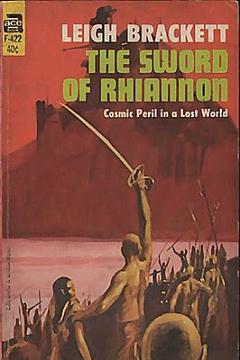
The Sword of Rhiannon — Leigh Brackett

Cover of The Sword of Rhiannon


The Sword of Rhiannon
Leigh Brackett
141 pages
published in 1953

You may think you don’t know Leigh Brackett or read any of her stories, but you’re wrong. If you think The Empire Strikes Back is the best of the real Star Wars movies, you have her to thank for it, as she wrote the original screenplay, just before she died. This is no fluke either, as her screen writing career is almost as old as her science fiction career. She started off on The Big Sleep together with William Faulkner and has worked on other well known movies like Rio Bravo and The Long Goodbye. And with her long She knew her way around a film script; combine that with her long experience writing science fantasy for pulp magazines like Planet Stories and you know why Empire is so much better than any of the other Star Wars movies.

If you liked Empire than the good news is that Leigh Brackett is even better when working on her own stories. Though she wrote other science fiction, she’s best known for writing planetary romances (or science fantasy) in the tradition of Edgar Rice Burroughs. Her best stories are set on the Mars of Burroughs and dozens of pulp imitators, a dying world turned into a worldwide desert as its seas dried up, with a highly evolved but degenerated civilisation clinging to life through an elaborate system of canals, now turned into a new version of the Western frontier as Terran adventurers and never do wells come to try their luck. Brackett’s Mars is more than just a pulp adventure setting though. Her best stories leave you with a sense of melancholy and loss, perhaps nowhere more so than in The Sword of Rhiannon, “a hymn to the lost past of a Mars that never was” as Nicola Griffith put it in her introduction to a recent reissue.

Read more…

Unknown Pleasures: Stan Martin’s Rapid Fire

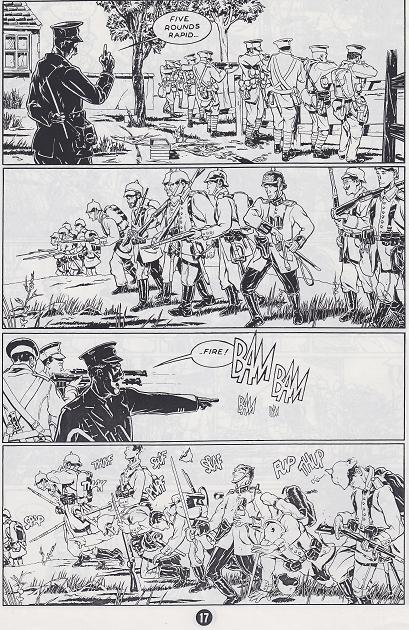
a page from Rapid Fire

I’ve been to my parent’s place this weekend, to celebrate the birthdays of my sister and her partner who live nearby. As always a home visit is also an excuse to rescue some more of the vast collection of comics I’ve left behind there in storage. Amongst the gems I dragged away this time was an A4 sized, self published (?) comic called Rapid Fire: Terrible Sunrise Part Two, written and drawn by one Stan Martin. I known nothing more about it or its creator than what I could gleam from the comic itself when I bought it at Spacecaption 1999, a small Oxford comics convention. That’s one of the joys of going to cons, finding interesting looking small press or self published (“amateur”) comics done by people with no expectation — or even desire– to become professional cartoonists, but who draw comics just for the love of them. In this case I was drawn in by the subject matter, a battle set in the first days of World War I, as the forces of the British Expeditionary Force first come into contact with the vanguard of the German advance. Martin’s artwork, realistic, clear and with a hint of Ligne Claire in it also helped.

Rapid Fire depicts the battle between the North West Rifle regiment on the 23rd of August 1914 alongst the Mons-Condé Canal in Belgium and the advancing German forces of von Kluck. This wasn’t trench warfare, the front was still dynamic as the Germans were still pressing towards the Channel, trying to move around the defending English and French forces, who in turn were slowly retreating out of Belgium back into France. This was the last stand of the old professional British Army that had fought the colonial wars of the 19th century, opposing a modern conscription army much much bigger than them. As Martin puts it on the back cover:

The Kaiser’s army, of almost three million ferociously disciplined men, floods the farmlands of northern France. They attempt to crush the French before their Russian allies can mobilise to threaten Germany’s eastern border. The British Expeditionary Force barely figure in the Prussian plan to dominate the continent; two hundred and fifty thousand strong they are outnumbered more than five to one. The British soldier, however, is the most highly trained, best equipped in the world. In sixty seconds, armed with his short magazine bolt action Lee Engfield rifle he is capable of firing up to fifteen well-aimed rounds.

This is known as “the mad minute”.

Which also tells you that this is a war story, not an antiwar story, as we’re mostly used to when the First World War is brought up in fiction. Martin neither moralises about war nor glorifies the battle he depicts. His treatment is almost antiseptical, no sensationalist displays of gore, just men falling down with a “fup” or “thup”. This might seem old fashioned or a bit suspect, but it works well here; Martin trust his readers to know that war isn’t nice, he doesn’t have to rub it in nor has he any desire to. It’s an intellectualised view of battle, somewhat distancing you from it. The artwork helps with this. Even in action his figures look posed and stiff. The clean lines too help keep you detached from the story. He has a good eye for detail, but doesn’t go overboard with it.

I’ve never found another comic by Martin, nor much about him on the internet, save for one review of Rapid Fire, which coincidently uses the same page I scanned as well as an illustration. I’ve no idea if he has done more comics than this, but I hope so.