China Mountain Zhang — Maureen F. McHugh

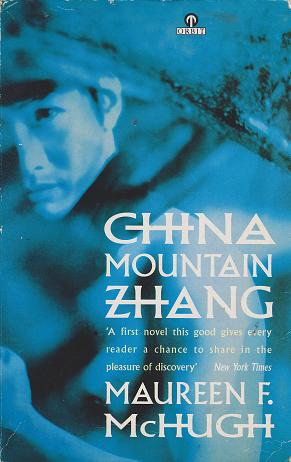
Cover of China Mountain Zhang


China Mountain Zhang
Maureen F. McHugh
313 pages
published in 1992

China Mountain Zhang is the fourth novel I’ve read in my Year of Reading Women project. It had been on my shelves unread for over a decade before that, silently accusing me every time I walked past. Some novels are like that, shoved aside each time for a more interesting looking book. Which is one of the reasons I put it on my list of twelve science fiction novels written by women to read this year: to force me to finally read it.

Because I should’ve read this long ago. China Mountain Zhang was Maureen McHugh’s debut novel and was nominated for both the Hugo and Nebula awards in 1992, winning the Lambda Literary Award (best science fiction with LGBT themes), the Locus Award for best first novel, and the James Tiptree, Jr. Award (feminist themed science fiction). It also has always been a highly regarded novel in the fan circles I hang around in. Yet until now I never had even tried to read it, largely because everytime I looked through my bookshelves the cover repelled me. And of course you should never judge a book by its cover, but in this case the cover did seem to promise something worthy but dull I never was quite in the mood for. A bit dumb, because of course China Mountain Zhang turned out to be just as good as its hype had made it out to be.
Read more…

Who keeps inviting John C. Wright to these things?

SF Signal is a commercial science fiction portal/blog which holds regular socalled Mind Melts, where they asks several science fiction writers their opinion on some topic or other. Usually these are mildly diverting but no more than that, as everybody struggles to say something original to questions like “which difficult science fiction books would you recommend”, but sometimes it goes wrong and they invite John C. Wright to participate. It’s not just that he’s a Libertarian-Catholic wingnut with a persecution complex the size of Jupiter, but that he’s so unbelievably pompous. For example:

World of Null-A was savaged by science fiction’s earliest and best known professional critic of the genre, Damon Knight, who pushed the work into undeserved obscurity, perhaps because he preferred the type of works written, or, rather, committed, by poseurs and artistes such as I mention with scorn above. Mr. Knight dismissed the paradigm-shifting technique of plot-weaving as mere sleight of hand. But perhaps it not as easy as it looks to juggle all the pieces of a jigsaw in midair, forming one picture to the reader, and then, by flipping one more bit of the puzzle into view, to both change the whole picture of what has gone before, and have the picture make sense; and then to do it again. The scientific process itself is nothing other than this juggling of jigsawwork to create successively more elegant and accurate pictures of the cosmos: to dismiss it in art is to overlook it’s significance in life. Others have attempted the Vanvogtian style of paradigm-shifting, either successfully, as with The Paradox Men by Charles L. Harness, or unsuccessfully, as with Mr. Knight’s own deservedly forgotten Beyond the Barrier, a work that serves as a living reminder that those who cannot perform a tricky technique of art at even an apprentice level should not mock it as a mere trick.

Nails on chalkboard.

Get Nick Mamatas a hugo: All You Need is Kill

Nick “proven noticable” Mamatas is up for the Best Editor, Long Form Hugo for his work on the Haikasoru line of translated Japanese science fiction. James Nicoll has decided to campaign for him, by reviewing all Haikasoru books he can lay his hands on. He started with All You Need Is Kill, coincidently the only Haikasoru book I’ve read myself, so I thought to help out by reposting the review f it I did last year at my booklog:

All You Need Is KILL


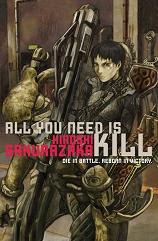
All You Need Is KILL
Hiroshi Sakurazaka & Alexander O. Smith (translator)
381 pages
published in 2004

James Nicoll was casting about for science fiction books to read one day last week and got pointed in the direction of Haikasoru Books, a newish line of translated Japanese science fiction, found something to his liking and posted about it, as well as a poll on which Haikasoru title to read next. All of which explains why I was pulled towards the cover of All You Need is Kill when I saw it in a local bookstore. Since James liked the Haikasoru that he got and I trust his taste, that was enough reason for me to take a chance on this. I wasn’t disappointed.

What I got with All You Need is KILL is a fast paced, short novel (only 200 pages) that takes two old, familiar science fiction concepts and mashes them up into something new: Starship Troopers meets Groundhog Day. Earth has been invaded by the alien Mimics, seemingly non-sapient but still with the ability to learn from their mistakes and most of the poorer part of the world has been overrun already. Keiji Kiriya is just one recruit given a short training, shoved into a battlesuit called a Jacket, sent out to defend Japan from the Mimics then dying in his first battle — only to wake up in his bunk the day before.

Read More

Harvey Pekar: the one that got away?

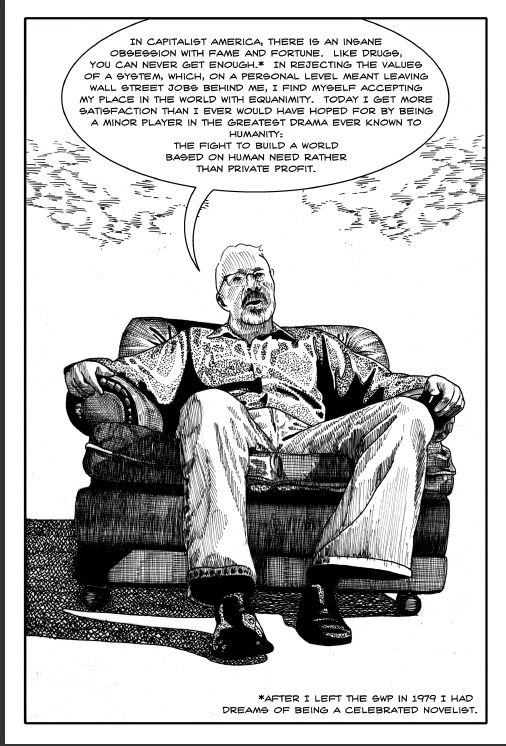
final page of the unreleased biography of Louis Proyect as written by Harvey Pekar

When Harvey Pekar died last year, Louis Proyect talked the book they had collaborated on, Louis’ biography. At the time he was optimistic that despite Pekar’s passing the book would still come out. Not anymore:

What steams me up the most is the feeling that I have been ripped off. I spent a good four months writing and rewriting the material that would eventually be illustrated by Summer McClinton, a young and very gifted artist whose work Harvey raved about. Now Random House’s contract was with Harvey and not me obviously. His widow Joyce Brabner and the artist have been paid off, fulfilling Random House’s obligations for a book that is now dead and buried. A year ago Schluep assured me that the book would be published. It turns out he was probably bullshitting me. It would have been better for me not to have been left hanging. When I raised the topic with him again two months ago, he said that a decision had not been made but he would get back to me within the month. Of course, he did not get back to me. Like Jack Nicholson in “Wolf”, he has the power to piss on me metaphorically speaking. I am not under contract and under capitalism that is how things operate, as any lawyer will tell you.

It would be a shame if this book didn’t appear.