Who keeps inviting John C. Wright to these things?

SF Signal is a commercial science fiction portal/blog which holds regular socalled Mind Melts, where they asks several science fiction writers their opinion on some topic or other. Usually these are mildly diverting but no more than that, as everybody struggles to say something original to questions like “which difficult science fiction books would you recommend”, but sometimes it goes wrong and they invite John C. Wright to participate. It’s not just that he’s a Libertarian-Catholic wingnut with a persecution complex the size of Jupiter, but that he’s so unbelievably pompous. For example:

World of Null-A was savaged by science fiction’s earliest and best known professional critic of the genre, Damon Knight, who pushed the work into undeserved obscurity, perhaps because he preferred the type of works written, or, rather, committed, by poseurs and artistes such as I mention with scorn above. Mr. Knight dismissed the paradigm-shifting technique of plot-weaving as mere sleight of hand. But perhaps it not as easy as it looks to juggle all the pieces of a jigsaw in midair, forming one picture to the reader, and then, by flipping one more bit of the puzzle into view, to both change the whole picture of what has gone before, and have the picture make sense; and then to do it again. The scientific process itself is nothing other than this juggling of jigsawwork to create successively more elegant and accurate pictures of the cosmos: to dismiss it in art is to overlook it’s significance in life. Others have attempted the Vanvogtian style of paradigm-shifting, either successfully, as with The Paradox Men by Charles L. Harness, or unsuccessfully, as with Mr. Knight’s own deservedly forgotten Beyond the Barrier, a work that serves as a living reminder that those who cannot perform a tricky technique of art at even an apprentice level should not mock it as a mere trick.

Nails on chalkboard.
Get Nick Mamatas a hugo: All You Need is Kill

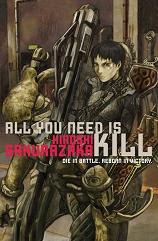
Nick “proven noticable” Mamatas is up for the Best Editor, Long Form Hugo for his work on the Haikasoru line of translated Japanese science fiction. James Nicoll has decided to campaign for him, by reviewing all Haikasoru books he can lay his hands on. He started with All You Need Is Kill, coincidently the only Haikasoru book I’ve read myself, so I thought to help out by reposting the review f it I did last year at my booklog:

All You Need Is KILL


All You Need Is KILL
Hiroshi Sakurazaka & Alexander O. Smith (translator)
381 pages
published in 2004

James Nicoll was casting about for science fiction books to read one day last week and got pointed in the direction of Haikasoru Books, a newish line of translated Japanese science fiction, found something to his liking and posted about it, as well as a poll on which Haikasoru title to read next. All of which explains why I was pulled towards the cover of All You Need is Kill when I saw it in a local bookstore. Since James liked the Haikasoru that he got and I trust his taste, that was enough reason for me to take a chance on this. I wasn’t disappointed.

What I got with All You Need is KILL is a fast paced, short novel (only 200 pages) that takes two old, familiar science fiction concepts and mashes them up into something new: Starship Troopers meets Groundhog Day. Earth has been invaded by the alien Mimics, seemingly non-sapient but still with the ability to learn from their mistakes and most of the poorer part of the world has been overrun already. Keiji Kiriya is just one recruit given a short training, shoved into a battlesuit called a Jacket, sent out to defend Japan from the Mimics then dying in his first battle — only to wake up in his bunk the day before.

Read More

Harvey Pekar: the one that got away?

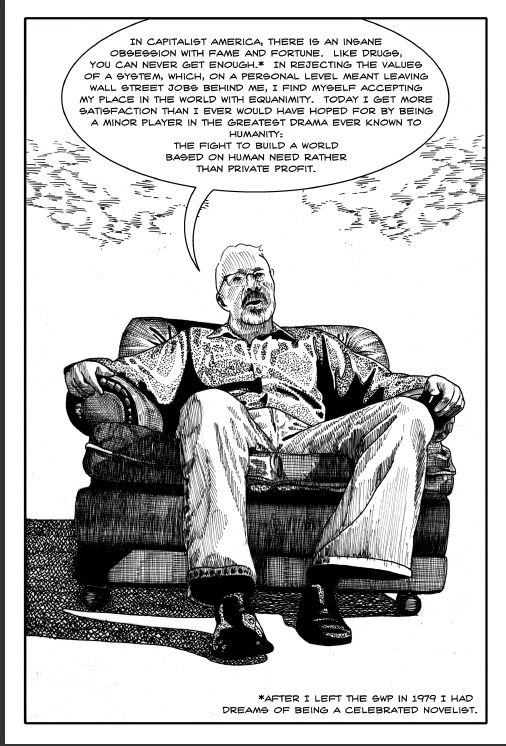
final page of the unreleased biography of Louis Proyect as written by Harvey Pekar

When Harvey Pekar died last year, Louis Proyect talked the book they had collaborated on, Louis’ biography. At the time he was optimistic that despite Pekar’s passing the book would still come out. Not anymore:

What steams me up the most is the feeling that I have been ripped off. I spent a good four months writing and rewriting the material that would eventually be illustrated by Summer McClinton, a young and very gifted artist whose work Harvey raved about. Now Random House’s contract was with Harvey and not me obviously. His widow Joyce Brabner and the artist have been paid off, fulfilling Random House’s obligations for a book that is now dead and buried. A year ago Schluep assured me that the book would be published. It turns out he was probably bullshitting me. It would have been better for me not to have been left hanging. When I raised the topic with him again two months ago, he said that a decision had not been made but he would get back to me within the month. Of course, he did not get back to me. Like Jack Nicholson in “Wolf”, he has the power to piss on me metaphorically speaking. I am not under contract and under capitalism that is how things operate, as any lawyer will tell you.

It would be a shame if this book didn’t appear.

Something nice for Wednesday

Chris Ware sketch from the Stripdagen Breda in 1999

In 1999 at one of the last comics conventions I’ve gone too somebody had flown in the cream of American alt comix: Chris Ware and Dan Clowes. I didn’t and still don’t care much for the latter, but Ware was and is another matter. I’m quite pleased ot have gotten this little sketch from him and to be able to tell him how much I loved Acme Novelty Library. To him such an encounter was of course a dime a dozen and it can’t have been too pleasant to sit in a conference hall early in the morning that only days before had held a pig auction, probably jetlagged to hall and back, but both he and Clowes were quite friendly. Meeting them was the highlight of an incredibly shitty convention that was one of the things that drove me out of comix for a while.

But at least it made for an easy blogpost twelve years later…