Something nice for Wednesday

Chris Ware sketch from the Stripdagen Breda in 1999

In 1999 at one of the last comics conventions I’ve gone too somebody had flown in the cream of American alt comix: Chris Ware and Dan Clowes. I didn’t and still don’t care much for the latter, but Ware was and is another matter. I’m quite pleased ot have gotten this little sketch from him and to be able to tell him how much I loved Acme Novelty Library. To him such an encounter was of course a dime a dozen and it can’t have been too pleasant to sit in a conference hall early in the morning that only days before had held a pig auction, probably jetlagged to hall and back, but both he and Clowes were quite friendly. Meeting them was the highlight of an incredibly shitty convention that was one of the things that drove me out of comix for a while.

But at least it made for an easy blogpost twelve years later…

Books read April

Way too late with this post, but then April was not a good month for me. A combination of work, private troubles and other priorities meant I only managed to read three books this month. It didn’t help that I was way too ambitious chosing which books to read, as you’ll see. This time last year I read ten books, in 2009 thirteen.

The Inheritance of Rome — Chris Wickham
Recommended to me by Chris Y: it did not disappoint. An excellent book that traces the evolution of the Late Antiquity Roman Empire into the early Middle Ages, without getting hungup on “the Fall of Rome” or the political-military aspects of this history.

Three Victories and a Defeat — Brendan Simms
Readable if at times repetitive history of the Rise and Fall of the First British Empire, as the cover has it, in the context of the British quest for a Balance of Power in Europe in the eighteenth century as successive governments, both Tory and Whigs, sought to guarantee Britain’s safety. A very traditional novel, as the focus is solely on diplomancy, war and the internal politics of the British Empire, with a soupcon of economic history. It’s repetitive because Simms points out with great glee how each new government made the same old errors.

China Mountain Zhang — Maureen F. McHugh
Another book read for my Year of Reading Women project, this is McHugh’s debut novel and is that rare science fiction novel that doesn’t have the fate of the world or universe at stake. Instead it tells the story of a gay American Born Chinese construction worker with a Hispanic mother who was big in the revolution that made the US a socialist country and vassal state of China sometime in the late or early 22nd century. Zhang just tries to live his life in a world that on the whole is neither worse nor better than our own.

New Chinese comics museum designed by Dutch architects MVRDV

Of course it was just a matter of time before China, even more American than America in wanting to be the number one nation in everything, went big into comics. Hence the China Comic and Animation Museum to be build in Hangzhou, designed by the Dutch architects MVRDV in the shape of eight speech balloons

CCAM exterior desgined by MVRDV architects

(Rotterdam, 5th May 2011) Hangzhou urban planning bureau has announced MVRDV winner of the international design competition for the China Comic and Animation Museum (CCAM) in Hangzhou, China. MVRDV won with a design referring to the speech balloon: a series of eight speech balloon shaped volumes create an internally complex museum experience of in total 32.000m2. Part of the project is also a series of parks on islands, a public plaza and a 13.000m2 expo centre. Construction start is envisioned for 2012, the total budget is 92 million Euro.

Comics and animations have long been considered a form of entertainment for the younger generations but develop more and more into a sophisticated art form. The initiative for a museum especially for this relatively recent art form creates a platform which will unite the worlds of art and entertainment. By using one of the cartoons prime characteristics ‘– the speech balloon — the building will instantly be recognized as place for cartoons, comics and animations. The neutral speech balloon becomes 3d.

The 32.000m2 are divided into eight volumes which are interconnected allowing for a circular visit of the entire program. Services such as the lobby, education, three theatres/cinemas with in total 1111 seats and a comic book library occupy each their own balloon. If two balloons touch in the interior a large opening allows access and views in-between the volumes. The balloon shape allows for supple exhibitions, the permanent collection is presented in a chronological spiral whereas the temporary exhibition hall offers total flexibility. Amsterdam based exhibition architects Kossman.deJong tested the spaces and designed exhibition configurations which appeal to different age groups and allow large crowds to visit the exhibition. One of the balloons is devoted to interactive experience in which visitors can actively experiment with all sorts of animation techniques like blue screen, stop motion, drawing, creating emotions etc. The core attraction of this space is a gigantic 3D zoetrope. The routing of the museum permits short or long visits, visits to the cinema, the temporary exhibition or the roof terrace restaurant. The façade of the museum is covered in a cartoon relief referring to a Chinese vase. The monochrome white concrete façade allows the speech balloons to function: texts can be projected onto the façade. The relief was designed in collaboration with Amsterdam based graphic designers JongeMeesters.

Most of the 13.7 ha site is occupied by a new park on a series of islands in White Horse Lake. Reed beds are used to improve the water quality. Boat rides offer an added attraction. A separate expo building of 25.000m2 will house large fairs and the annual China International Comic and Animation Festival (CICAF). In-between expo and CCAM a public plaza will be the centre of this festival which is the county’s largest cartoon and animation event and has been held annually in Hangzhou since 2005.

I excerpted such a huge chunk of their press release because they found it necessary to build their site in Flash, making it awkward to impossible to read. Unfortunately I can’t do anything about the slightly stilted “Dunglish” on display here, other than suggest that such internationally operating architects need to invest in having a proper Dutch to English translator on staff. (Yes, I’m arrogant enough to believe my own English is much better; please don’t disabuse me of this notion.)

Great design though; it reminds me of Robbert and Rudolf Das, two Dutch futurologists who in the late seventies and eighties published several books creating a vision of the future in which this design would not be out of place. For example. It’s such a simple idea to create 3-d speech balloons to house a comics museum, but you still have to think of it first.

History repeating

W. Kasper comes to that inevitable point in the rock critic’s lifecycle that he has to bemoan the kids today:

The most interesting, fruitful aspect of British pop in the 90s was when it was, well, mixed race; if not physically at least sonically. Any innovations (however minor), and the sense that you were hearing something said differently, was related to this (Two Tone had a more important social impact than punk: discuss). Considering this, Britpop was even more hideously reactionary than many assume, which may be why Gorrilaz are more listenable and inoffensive (in a good sense) than Blur. The chronic social/racial stratification of British pop (since the end of the 90s) sealed the lid on its coffin as anything relevant. If experience is anything to go by, ‘the kids’ are now more starkly divided into ‘indie’ (white) or ‘urban’ (black), with all the class division that implies.

Really? I’m not sure this last complaint is a) true or b) different from any other point in British pop history. 2-Tone was only a blip and its most succesful band, Madness, wasn’t all that multiracial. If you look at it from far away British pop has always been about a few pioneers getting inspired (stealing) Black music and making it palatable to a white audience, followed by a backlash as it all becomes a bit too mixed: hence Oasis, or a few years earlier, The Smiths, or even earlier The Kinks: all self-consciously English bands as response to a pop culture that had become too un-English, too American and too dancable. Crossover has always been more rare than coexistence, yet the reality of most people’s musical experience is much more pick ‘n mix than their self indentification as “indie” or “urban” suggests.

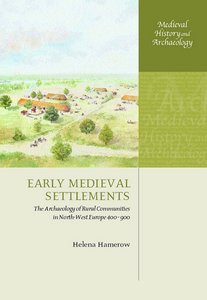
Early Medieval Settlements — Helena Hamerow

Cover of Early Medieval Settlements


Early Medieval Settlements
Helena Hamerow
225 pages including index
published in 2002

I wasn’t quite sure whether I should get this book — complete title: Early Medieval Settlements – The Archaeology of Rural Communities in North-West Europe 400-900 from the library. It looked as if much of what it covered I had already read about in Chris Wickham’s books Framing the Early Middle Ages and The Inheritance of Rome, only concentrating on the archaeological side of things rather than the history, which I’m more interested in. I also worried about whether it wouldn’t be too dry or technical, something I had problems with occasionally in the Wickham books. On the other hand, it was short, a quick scan didn’t make it look too boring and reading the introduction showed me it was meant as a general introduction to this subject, rather than an indepth analysis, all of which persuaded me into getting this.

The fact that I finished it means I made the right choice. Helena Hamerow writes well, knows her subject and also knows when to go into detail and when not to, making good use of footnotes. The end result is a good overview of the archaeology of everyday rural life around the North Sea coasts of the modern Netherlands, Germany and Denmark during the transition from Late Antiquity into the early Middle Ages and its relationship to the archaeology of Anglo-Saxon England in the same period. Hamerow, as she explains in the first chapter, meant this book both as a general introduction to this period and area and as a pointer for her (monolingual) UK colleagues working on Anglo-Saxon England to the work done on the continent in the same period. Each chapter therefore ends with a quick overview of the relevant English archaeology.

Read more…