It’s as if Erik Larsen never even saw Youngblood #1

Every crappy submission can “see print” on the web–every reprint book that would sell three copies in print would work on the web. The web is the great equalizer. Every crappy thing can get tossed up there. If it all went digital nothing separates a pro from an amateur. Print is far more discriminating. There are fixed costs which can’t be ignored for long. It’s not the wild west like the Internet is. That’s why the web doesn’t excite me a whole lot. Every nitwit can put stickmen telling fart jokes up–there’s nothing special about it.

Robot 6 quotes Erik Larsen on the inherent merit of webcomix — suffice to say he’s no fan. But that Larsen has a strong opinion about other people’s comics is a dog bites man story — what’s more interested is how clueless he comes over about the economic realities of both print and web comics.

The thing that Larsen forgets is that the kind of print comics Diamond carries is only the tip of the iceberg. Fanzines, minicomics, d.i.y. photocopied and stenciled pamphlets sold through your local comics store or regional con both as good as anything carried by Diamond in most months and as bad as anything the web can offer have been created for decades. As long as there have been cheap and easy ways to quickly copy or reproduce amateur comics, people have been doing so. The best of them “graduate” to socalled professional comics, most people lose interest after a few issues, some people keep doing them for decades.

The web hasn’t really changed anything in this. Yes, anybody can publish their own comics on their own website, but that doesn’t mean anybody other than their mother will ever read them. Every crappy thing can get tossed up there, but most will end up with hitcounters in the low two figures. It takes hard work, talent and a dollop of luck to become a hit — even more of each to be able to make a living from it. Just like regular comics in other words.

To sneer that “I mean–there’s things on the internet that people are willing to read but they would never pay for–and those are the success stories” is missing the point as well. Which is that in a period when print comics of the kind Larsen has worked in his whole professional life have steadily been getting smaller various amateur cartoonists have found ways not just to publish their comics on the web and get an audience for it, but actually make a living from it — even if they offer their comics for free. Not to put too fine a point on it, but America’s current most successful cartoonists, who managed to raise millions of dollars for charity each Christmas, can support several conventions organised around their comics are Gabe and Tycho. And they did it completely on their own, finding out what worked and what didn’t through trial and error, just like several dozen other web cartoonists have managed to do. And they managed to do so without shackling themselves to a dying business model.

Sure, most people working on the web, even the successful ones, aren’t able to make a living off their comics and have to find other ways to supplement their income or only do it as a hobby — but this is the same reality most print cartoonists face as well. The fact that most successful web cartoonists offer their strips for free and make money on e.g. selling advertising, print collections or t-shirts isn’t important: that’s what works so people use it. It only gets exploitative when people offer their own comics for free on other people’s site: the Huffington Post business model, where you build your IPO on the free labour of thousands of hopefuls working for “exposure”.

Shorter me: “every nitwit can put stickmen telling fart jokes up”, but the same nitwits could’ve done so with photocopied or stenciled pamphlets too — and got them published by Aircel, while having your comics up on a website is no guarantee for success without hard work, talent and luck. Shorter shorter me: Larsen is a great artist, but boy can he talk crap sometimes.


Should Tintin au Congo be banned for racism?

Tom Spurgeon responds to the decision of a Brussel court to allow the Tintin racism trial to go ahead. Brought by one Mbuto Mondondo a few years ago against the publishers and owners of Tintin, as he found Tintin au Congo racist and “insulting to all Congolese”. Though not much publicised in the English language comics web, you can imagine in Belgium and France feelings run high about this case,
as Tom explains:

What I hear most often from the side that thinks the case is stupid or even dangerous is that it trivializes the intent of the law for the sake of course-correcting the dissemination of art whose racism is easily understood both as racism and as a deeply unfortunate product of its time. What I hear from the other side is that the criticism of Mondondo comes from an infuriating, deeply troubling perspective that combines the willful excuse-making of the fanboy with the cold arrogance of French-language speaking people generally when it comes to any suggestion of a blind spot in national or regional character. I’m also never surprised when I meet people disgusted with both sides, questioning, say, both the authenticity of the complaint and the strangulated fashion in which the publisher tried to negotiate issues of jurisdiction.

page from Tintin au Congo

What really isn’t in question in this dispute is that Tintin au Congo is racist, because it is so racist. It’s not just that all Black people in the story are depicted in the worst kind of racial stereotype, all thick lipped, coal black and outfitted in ridiculous clothing, but also that the story itself is incredibly patronising towards them, treating them as ignorant, superstitious lazy, emotional children unable to talk properly needing Tintin to solve their problems because they’re too feckless and thick to do it themselves, so they make him their king.

The page I scanned from my anonymous seventies or eighties edition of the 1947 version of Tintin au Congo shows one of the worst incidents in the book, after Tintin managed to derail a train, he has to goad the angry people on board it in helping him put it on the rails again, but they are more interested at first in moaning than in working, until Snowy gives the right example. And that’s in an already cleaned up version of the story; the original version was allegedly worse.

So yeah, that people get offended by this book is understandable. Herge was bone ignorant when he wrote it, writing from his prejudices and that of his audience, being published in ‘Le Petite Vingtième, the youth section of the rightwing catholic Vingtième. His next album, Tintin en Amérique is no better, not to mention Tintin au pays des Soviets. But to go so far as to start a lawsuit to get it banned?

It’s easy to be cynical about the motives of Mondondo, to see this as a media stunt, an irrelevant nuisance suit. But then again he has been pursuing this for years which seems to indicate something more is going. Similarly you can also argue that there are more important targets to go after than an eighty year old comic, but is that true?

Tintin au Congo is an important comic, the true start of arguably the most succesful comics series in Europe, something that has been a part of the childhood of generations of European children sinces the early 1930ties. And in a climate that’s far more welcoming to the kind of casual racist imagery that America has long since rejected (try and googling images of Zwarte Piet for example) having such an influential comic indulge in outdated colonial attitudes is not good. Tintin au Congo‘s racism may, as Tom puts it, be “easily understood both as racism and as a deeply unfortunate product of its time”, but this is true much more for adults than for children coming to it without having the context to place the story in, accepting it at face value. I know I did, all those years ago when I first read it, just like I accepted that America was a place where Tintin could tangle with gangsters in Chicago and indians out west.

On the other hand, any sort of ban, setting apart free speech issues, does mean that an important piece of comics history is lost. Which may not be very important in the world outside comics, but it is a kind of history falsification. The attitudes Herge brought to Tintin au Congo were mainstream, widely accepted facts in Belgium about the Congo, typical of any colonising power seeing its subjects out there as wilful children that have to be lead by a loving but firm hand towards doing what’s best for them. Having Tintin au Congo as a prominent reminder of this may on balance be a good thing.

According to Het Laatste Nieuws Mondondo would also be satisfied if the book was no longer sold in the child’s section of bookstores and would be put into context through e.g. a warning about its racist elements and/or some sort of preface setting the story in its proper context. If this were to be the outcome of the trial, I wouldn’t be unhappy. Banning it complete is losing a piece of important history, not doing anything with the justified complaints of Mondondo, regardless of his personal motivations, seems wrong as well. Having it put in context seems like the best solution.

Bitches Brew

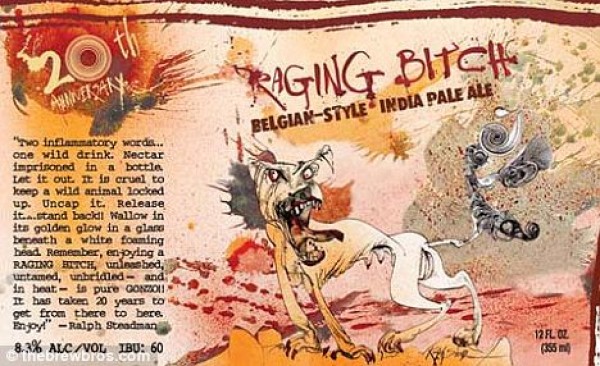
Raging Bitch label by Ralph Steadman

Flying Dog Brewery sues the Michigan’s state Liquor Control Commission for banning the sale of its Raging Bitch beer:

The 20th Anniversary India Pale Ale label urges customers, “Remember, enjoying a Raging Bitch, unleashed, untamed, unbridled — and in heat — is pure GONZO.” Ralph Steadman, an illustrator best-known for collaborations with author Hunter S. Thompson, penned the disputed phrase.

The case began in September 2009 when Flying Dog applied to sell “Raging Bitch” beer. The commission denied the request and affirmed its decision on appeal. The commission based its decision on its power to regulate language on the bottle that is “detrimental to the health, safety or welfare of the general public”, the filing said.

I’ve had it — decent enough beer, quite drinkable and certainly not deserving of a ban, especially not a ban because some Mrs. Grundys get offended by a bloody label. And actually, it was the Ralph Steadman labels that first made me notice these beers. Amidst the usually much more staid beer labels of other breweries they stood out. But they stood out because they were interesting, not because they were offensive.

(Via Tom Spurgeon.)

Some links to comics blogs you can’t read anyway*

Dutch cartoonist Jean-Marc van Tol, off off Fokke & Sukke fame, has started a series of Youtube comics reviews, possibly as a warmup for Beeldverhaal, his new television series about comics debuting this October. He’s done entries on Rabaté, Willy “Urbanus” Linthout and Daniel Clowes’ Ghost World:


I agree with Michael Minneboo, that the calm but enthusiastic way in which Jean-Marc van Tol talks about comics is great and makes you want to run out and buy them immediately, even though I can’t stand Clowes at the best of times.

Another recent discovery is the blog of IJsbrand Oost, a relatively new cartoonist (to me at least) who works in a ligne claire style seriously influenced by Henk Kuijpers. As with Jean-Marc van Tol, here you have somebody who obviously understands his craft very well and –much rarer– knows how to explain it to you as well, as in the post in which he tells how he evolved his drawing techniques. These insanely detailed drawings turn out to be done directly on paper first, with the background, foreground and characters drawn separately, then scanned in and manipulated on the pc before being printed out and inked on heavier paper, with the colouring once again done on the computer. I love reading this sort of thing.

(* Except for Reinder, Branko and Michel)