Books read February

Though February is a short month, I still read much less than I should’ve. Only four books, three of which cost me a bit of trouble and one of which I would not have finished if it hadn’t been for my “Year of Reading Women” project.

Among Others — Jo Walton
A coming of age story a very many science fiction fans can recognise parts of, but with a certain kind of magic mixed in. A book that, if you recognise yourself in the protagonist, keeps you grinning for days after finishing it.

Bold as Love — Gwyneth Jones
In a near-future, dissolved England, rock ‘n roll revolutionaries take over real power in a country beset by ecological problems, internal strife and political unrest. Uneven, but much better than this quick summary makes it sound. This took me more time to read than I expected.

Sons of the Conquerors — Hugh Pope
Though located in the history section of the local library, this was more of a travelogue, though dense with history. Hugh Pope is a writer and journalist who has long lived in Turkey and been fascinated by the Turkish peoples, who comes across and oldfashioned Turcophile.

Swordspoint — Ellen Kushner
One of those books that’s published as fantasy and reads as fantasy, but could just as well be a straight historical romance: sword and sorcery without the sorcery. Nicely written but again a book I did longer over than I normally would’ve.
Unbearable whiteness of British science fiction

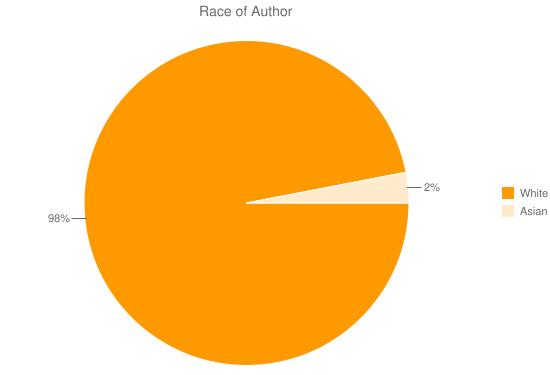
Pie chart depicting the race of 2011 Clarke Award submissions

Everything is Nice has some nice, juicy posts up analysing the eligible submissions for the 2011 Clarke Award. The Clarke Award is awarded annually for the best science fiction (or fantasy) novel published in the UK the previous year. It doesn’t have a long list but a short list is selected from all submitted novels; those submissions cover roughly 90-95 percent or so of new sf&f novels being published in the UK each year. Some works of course always slip through the crack, especially from non-sf publishers who don’t know or care about the awards. The Clarke Award submissions list than is a good, but not perfect indicator of the state of the UK’s sf publishing industry and as such Martin Lewis has analysed them, which resulted in e.g. the figure above.

In other words: sf publishing is only marginally less white than the group of writers the BBC thinks represents the future of British literary fiction. And worse, it has a much bigger gender imbalance: only 17 percent of the 54 novels submitted this year were written by women. Martin also looks at other identity markers (sexuality, nationality) and it all points to the conclusion that it’s largely straight, white British or American men that were published last year. (The raw data for all this can be found at Torque Control. )

The questions this inevitably puts to mind are a) is this analysis reliable when applied to the general state of the UK’s sf&f publishing industry as opposed to just the Clarke Award submissions b) is this a bad thing (imo: yes) and c) what can we do about it?

Assuming the answer to a) and b) are both yes, the question what we readers can do to change this situation is a difficult one to answer. You can only buy what’s being published after all and if only two books out of fifty-plus are by people of colour, how big an impact will it have when enough people buy their books? It’s easier to send a signal by boycotting a given company’s products, not so easy to express a preference through your buying habits. More projects and media attention to under represented people in science fiction as with the various “women sf writers” reading projects started this year would be a start, but are only suited to provide attention to this problem, not solve it. Suggestions?

Of course one unelected head of state will support another

Queen Bea is supposed to go on a stat visit to Oman and Quatar this weekend. Trouble is, in both countries an unfortunate and badly timed enthusiasm for democracy has broken out which makes the visit of her majesty slightly awkward. Holland is after all supposed to be a beacon of democracy and human rights, a shining example to the rest of the world even if the silent partner of the current government would like to limit those rights to people with the right skin colour religion. We sort of miss the sangfroid of the French, never worried about the rights of those they do not do business with, or the fundamental hypocrisy of the British, able to lecture dictators on the need to allow a fair and transparant move towards democracy while selling them the weapons to prevent this. Don’t worry, this doesn’t mean the queen won’t go or we wouldn’t sell them our leftover tanks: it’s just that we prefer to practise our own hypocrisy and complicity under cover of darkness and are not used to having to braze it out in the full glare of publicity.

Oh and of course we sold weapons to both Quatar and Oman, mostly helicopter (NH-90/Lynx) parts as well as radar, C3 and other electronic equipment, but also short range anti aircraft systems. Not to mention that a lot of foreign arms were shipped through Schiphol to those two countries as well. Holland’s gotta eat and if that means propping up undemocratic regimes by selling them weapons, as long as they are our allies, who cares?

The unbearably whiteness of British literature

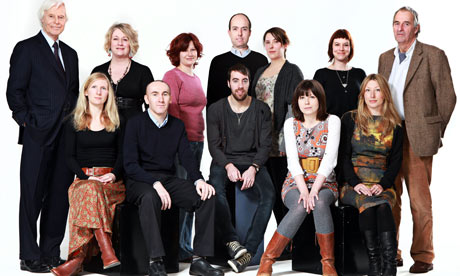
The 12 best new novelists look frighteningly white

The BBC is doing another of its tedious “reading is cool and hip and you should read more too or at least watch our programmes about books” promotions. In the process The Culture Show also chose its top twelve new writers and, well, there’s something off about them. It’s not just the facepalmingly awfulness of how the chair of the jury describes what literary fiction is in The Guardian:

What is literary fiction? It is not genre fiction. Hilary Mantel’s Wolf Hall is a historical novel. Kazuo Ishiguro’s Never Let Me Go was shortlisted for the Arthur C Clarke Award, the leading British prize for science fiction. Yet you only have to think about these two examples to see how they escape their genres. Mantel’s novel revisits the favourite stamping ground of historical fiction – Henry VIII and his wives – in order to rethink what it might be to see events filtered through the consciousness of a person from a distant age. Ishiguro takes a dystopian hypothesis – human clones being bred for their organs – and then declines to put in place any of the sci-fi framework that would allow us to understand how this could be. Indeed, the whole interest of his story is in the limits placed upon its narrator. These are both “literary” novels because they ask us to attend to the manner of their telling. And, despite their narrative demands, they have both found hundreds of thousands of readers willing to do so.

But well, doesn’t that group of up and coming literary fiction writers look a bit white to you? Granted, they all look awfully middle class as well, but BBC and Guardian, so let it go. Is the state of literature in Britain so bad that no promising writer of colour could be found?

(Found via BLCKDGRD.)