Dwayne McDuffie — Friday not so Funnies

Dwayne McDuffie was a writer I only learned to appreciate belately. At first I thought he was just another of the endless series of editors turned writers Marvel threw up in the late eighties and early nineties. It was only in hindsight that I realised McDuffie was much better than that, that his writing on Deathlok e.g. was something special, something Tim O’Neill did understand, that Deathlok was asking fundamental questions about the superhero comic:

I can’t think of many – any? – comics that have ever dealt so openly and lucidly with the most basic ethical questions at the heart of superhero fiction: what are the ethical responsibilities of power? When is it ethical to exercise power, and when is it unethical? It’s not simply “with great power there must come great responsibility” – that’s elementary. The real question is whether or not it’s even possible to exercise great power in a responsible fashion.

That was the sort of writer McDuffie was. If you look at his bibliography it looks a bit hit and miss and he never quite got the recognition he deserved. His stints on both Justice League of America and Fantastic Four were short, and in the first case, unhappy. But he was also a cofounder of Milestone, a much needed corrective to the whiteness of standard superhero comics, a not very appreciated corrective. He co-created Static, perhaps the most interesting and original new superhero created in the last twenty-thirty years and if you want to know how how important Static is, just look at how many non-comics readers remember the Static Shock cartoon fondly.

I didn’t know McDuffie as a person, only as a writer and occasional poster on the old rec.arts.comics newsgroups and as a writer I will miss him. The only book of his I actually have in the house right now is a collection of the 2006 Beyond miniseries, which is actually a good introduction to his strengths as a writer. Here you have a fairly silly concept, a sequel to the first Secret Wars miniseries, from back in 1985, in which a group of heroes and villains is yet again transported to the Beyonder’s Battleworld, to fight each other to get all their wishes fullfilled. It’s got a motley crew of characters, the most prominent of which is “killed” in the first issue, while the rest is so mismatched it shouldn’t work, but it does. It works because McDuffie has an excellent grip on each character, from the benign arrogance of Medusa, the gung-ho leadership style of the Wasp, Henry Pym’s insecurity and guilt, to Venom’s unpredictability and Kraven’s flippancy. He also knows how to tell a story, every issue ending on an upbeat, a climax. culminating in the penultimate issue, with the final issue wrapping the whole story neatly up. A fun story that showcases McDuffie’s talent; not the most important comic he wrote, but a good way to get to know him.
Every little thing…


I don’t know why it popped in my head sometime last year, when it went really bad for S. and we were seriously worrying about, you know, that which you do not want to prepare for. Suddenly it just was there … “Don’t you worry about a thing … Every little thing is gonna be alright”. I don’t even like or know much Bob Marley but that was stuck in my head for most of the rest of the year.

Back then it was cynical as much as comforting, but today I can actually start to believe in it, as S. will be coming home on Saturday as a trial, spending a day at home after having been in hospital for well over six months. She’s not quite home yet, but it’s going in the right direction: getting stronger, slightly less vulnerable to infection, better prepared. It can still go wrong, but we’re much more optimistic than we were even a month ago…

Also. We’ve been married for six months today.

The issue with Hands

In the comments to the previous post, Tom Spurgeon responded to my criticism of Phil Hands and the idea he deserves kudos for his cartoon:

Martin, this still makes no sense. I’m not praising the cartoon itself in any way, shape or form, so to counter this by saying, essentially, “it’s a bad cartoon; why does it deserve praise” is silly no matter how many paragraphs you say it in. Disparaging every aspect of what a person does because you think little of their political views or their skill as a cartoonist is a Fox News tactic. It’s what Rush Limbaugh does.

To restate: if we take him at his word, this is an honest expression of a specific political idea that runs counter to his general political leanings, and, on top of that, will likely earn him no amount of shit from his readers — and, as we likely both agree, history. He’s also going to have to watch people with whom he generally disagrees praise the cartoon to the skies. Heck, he’s even having his motives disparaged in tweets and blog posts from a guy not even in the US!

I think that specific kind of honesty is brave, whether or not someone is right or wrong, and I’d prefer every editorial cartoonist work the same way even if the cartoons don’t end up hitting on the best side of an issue. We have all sorts of editorial cartoonists in this country that are so terrified of being criticized that they don’t have any opinions at all, let alone ones about which they’re conflicted, and spend their days trying to find the most politically expedient way not to say anything at all. If you don’t agree that this is a virtue, fine, but please disagree with that point, not some made-up fantasy one that I think this is a good cartoon.

That’s what I’ve been trying to do, but I think I haven’t made myself clear enough. We both agree this wasn’t a good cartoon; I never thought Tom was arguing otherwise. What I was trying to do in my original post was showing my reasons for both disliking the cartoon itself and why I thought it was wrong to single out the cartoonist for praise for sticking to his personal opinion. For one thing, I’m not convinced his justifications add up, as I said in the previous post. If it was such a personal and conflicted view on Wisconsin, why did it so badly misrepresent the situation in service of a bog standard rightwing myth about crybaby hippies? It didn’t leave me feeling charitable towards Hands, which is why my interpretation of his remarks is so much more harsher than Tom’s.

But I also do not agree that a cartoonist — or anybody — sticking to their personal opinion is necessarily a good thing, if that opinion is ignorant or malicious. As cian also noticed, Hands is either ignorant or deliberately misleading in his cartoon: not something that should be lauded just because it is his honest personal opinion. To give a Dutch example, Geert Wilders is either sincere or just trolling for votes with his Islamophobia. Should we find it admirable if the first is the case?

So if we do give Hands the benefit of the doubt, will his honesty be a good example to other cartoonists if it still leads to the same sort of cliched cartoons as the one we’ve been discussing? Because from where I’m sitting it differs little from those resulting from cartoonists “trying to find the most politically expedient way not to say anything at all”. It doesn’t tell the truth, it doesn’t say anything new and it uses the same old dirty hippie cliches any other cartoonist could’ve drawn on autopilot.

To conclude, I do understand much better where Tom is coming from and why he wanted to highlight this particular cartoonist, even if I still don’t agree. I’m glad he took the time to comment; he didn’t have to after all.

It takes no courage to draw rightwing cliches

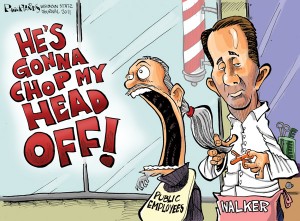
cartoon by Phil Hands showing his take on the Wisconsin labour dispute

I’m not sure I understand why Tom Spurgeon thinks Phil Hands deserves kudos for drawing this cartoon. As a cartoon it’s neither interesting nor funny. The struggle in Wisconsin is about a Republican governor introducing legislation that would take away the right of public employees to organise and withhold their labour, a fundamental right of any worker without which they (we) are not much more than slaves. How does Hands depict this? By making the public employees into a a stereotypical greying hippie screaming his head off because governor Walker (bemused but resigned to the hippie’s childish temper tantrum) is going to cut off a tiny bit of his ponytail. As art it’s mediocre, a cliched, simplistic rightwing take on what’s happening in Wisconsin.

Because Hands’ cartoon is an explicitely partisan political take on Wisconsin, with little intrinsic artistic merit, it has to be judged on its political intent much more than its artistic intent. It’s therefore no surprise that most people will judge this cartoon this way: finding it funny if they agree with its message, not so much so if they disagree. There is no neutral way to view this cartoon, as it is not neutral itself. Which is why I don’t understand why we should worry that people will “discuss the cartoon as the latest salvo in an abstract, unserious political/cultural war far too many people are fighting” — it has already taken sides itself.

Which is also why it doesn’t make sense to praise him for, as Tom Spurgeon puts it “apparently sticking to his personal perspective when making cartoons about the political turmoil in his home state rather than working with points of greater consensus in mind”. Hands is putting forward a reprehensible political view in his cartoon, why should he be praised for expressing this? Especially when he also pre-emptively declares his victimhood by saying: I know this cartoon won’t make me very popular, but that’s OK. I didn’t become an editorial cartoonist to win a popularity contest. I became an editorial cartoonist so that I could use my modest drawing skills to express my political viewpoint.

That’s little different from what every unfunny bigot says at an office party: “I know it’s not p.c., but”, expecting to be praised for his bravery in telling the truth about those people when in fact it’s about the least brave thing they could ever do. It takes no bravery in repeating rightwing talking points, it wasn’t Tobey Keith whose career got in trouble for his pro-war stance, it was the Dixie Chicks for their anti-war message. Hands is not courageous for drawing this cartoon; his career won’t suffer for it. Why should we respect or defend his views when they’re lazy, rightwing cliches that take no great courage to put to the page?

Abandoning outdated socialist cliches — yes please!

Jack Crow’s post, “abandoning the past sometimes allows you to see better the present…” starts off well, but dissolves into a familiar prolier-than-thou appeal to drop “our” preconvictions about revolutions and who should lead them:

The working class, the colonized, the oppressed, the alienated and the poor don’t need theories conjured up in academic discussions, in the coffee houses which line the well paved streets of upper class neighborhoods. They don’t need special vocabularies and essays on superstructure, intersectionality and sociocultural meta-meta critique.

If there’s any socialist cliche that needs abandoning it’s the supposed contradiction between the educated ivory tower intellectual and the oppressed working classes. It’s the leftwing version of the “salt of the earth, white working class man telling it like it is”: only evoked to push through the writer’s own prejudices. Crow wants to have his cake and eat it too, by both putting himself above the “The working class, the colonized, the oppressed, the alienated and the poor” and telling us that he knows what they want.

This sort of rhetorical trick presupposes both that intellectuals cannot be part of the working classes and that the working classes cannot do theory, cannot be intellectuals themselves. This sort of distinction might have made some sense in the nineteenth century, but in today’s world most of us “intellectuals” are just as much wage slaves as your average factory workers are.

Jack Crow very much has a point that reifying dead, white Marxists is counterproductive when it comes to understanding why the Egyptian revolution is happening now, that even Marx himself can be wrong or outdated and that his works at best hands us a tool to help understand the world, not a prefabricated solution. A pity he falls into the same outdated cliches himself at the end of his post.