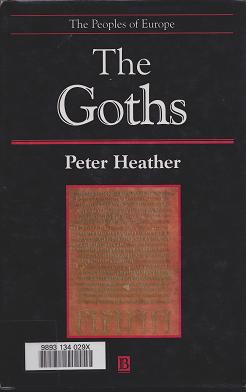
The Goths
Peter Heather
358 pages including index
published in 1996
Most of Peter Heather’s professional output has, in one way or another, featured the Goths. Usually this has been in the context of their contribution to the fall of the Roman Empire in the west, which Heather has long argued they played a central role in. In The Goths his focus is slightly different, more concerned with the Goths themselves than with how they interacted with the Roman Empire, though that still of course is an important part of their story. The Goths is an entry in the Blackwell series The Peoples of Europe and is meant as a one volume overview of their entire history, for people largely unfamiliar with them. As Heather mentions in his introduction, the last book to attempt this was published in 1888, so it was high time for an update.
Heather’s divides his book in three main parts, preceded by an introductionary chapter. In this he discusses why the Goths were important and the problem of social identities, where the old assumptions of unchanging peoples recognisable by some checklist of unique features had been challenged in the 1950ties and 60ties by new research showing how individuals could change their identity when advantageous. Heather applies a synthesis of these approaches to the Goths, arguing that while there was such a thing as a Gothic group identity, it was fluid enough for non-Goths to join into and for the group as a whole to adapt to changing circumstances. He then goes on to first explore the origins of the Goths, thentheir invasion and defeat of the East Roman Empire and further wanderings through the Balkans into Italy and Gaul and finally looks at the history of the two Gothish kingdoms established on parts of the Western Empire. In all three parts Heather puts the search for Gothish identity central.
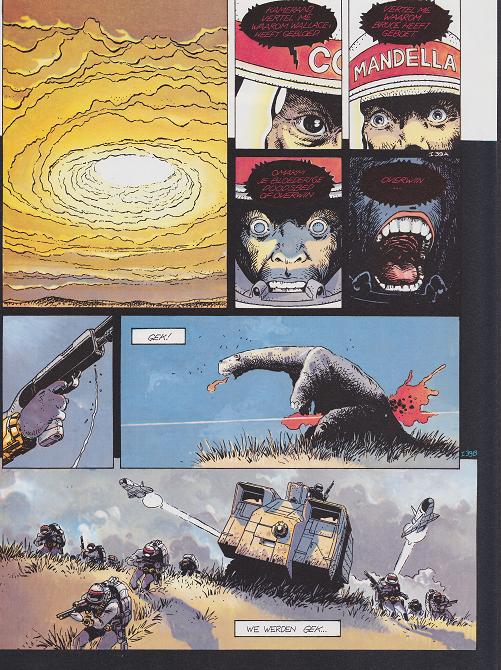
The first time I read Joe Haldeman’s The Forever War, it was in comics form, as a three part adaptation by Belgian writer/artist Marvano. The Forever War was Haldeman’s science fictional treatment of what he went through in the Vietnam War and was originally published in 1974; Marvano’s adaptation came out in 1988, a decade and a half later, yet it fitted the eighties like a glove. As he said in his foreword, what with the Falklands War, Grenada, Reagan talking about winning a nuclear war, a wave of right and leftwing terrorism paralysing Belgium and so on, it still seemed relevant. It seems so today too.
Which is largely due to Marvano’s own efforts, rather than Haldeman’s. Marvano had only three albums of 48 pages each to adapt a 230 page novel and like film, comics adaptations of novels need more room, rather than less. So he had to cut and choose what to keep in and what to adapt. In doing so he created the “good parts” version of Haldeman’s novel. He sharped it up, cut out the more awkward bits and kept the focus tight.
Haldeman’s original novel had two main themes. The first was the absurdity of war in general, as his hero, William Mandella, a reluctant recruit into the UN Expeditionary Force against the Taurans, the first alien race Earth had encountered and immediately went to war with, through the miracle of time dilation manages to be the only man to survive the entire war, from its start in 2010 to its end more than a millennium later, in 3177. In between the three campaigns Mandella fights in Haldeman explores his second theme, that of a soldier’s alienation on his return from fighting an unpopular war to his homeland when he realises it has changed while he remained in stasis. A popular because it was true cliche about the Vietnam War, Haldeman exagerrated these effects by his use of time dilation, having Mandella experience only a few years of war, then coming back to Earth to find decades have past and the world irrevocably changed.
Marvano could not do justice to both these themes in his adaptation and concentrated on the first. He kept the plot lines relating to the second theme as well, but compressed them greatly, spending much less time detailing the ways in which Earth changes during Mandella’s war. In Mandella’s first return to Earth for example, Marvano emphasises the way the UN bureaucracy censored his television interview over his adventures adapting to his new world, where a third of the population is now homosexual. Which is a good thing, as these are the parts of the novel that had dated the most: by making them less explicit, more generalised they keep their relevance. It’s enough to know things have changed enormously without needing to go into detail.
A similar pairing down is done all through the comics series and it works. What Marvano does very well, extremely well in fact for what was his first major comics project, was to let the artwork and narration speak for themselves, each conveying part of the story He lets Mandella tell the reader anything that can’t be put in pictures and let the art carry the action, not needing text to tell you what you can see in the art yourself. Mandella’s narration is almost constant, but Marvano is not afraid to silence him when needed. He’s a good artist, with a good eye for both creating realistic looking future technology and weapons, as well as for creating subtle and not so subtle facial expressions. It’s an eighties future, but still holds up today I think.
Sadly, the Forever War comic is long out of print in English, though can still be had in French or Dutch. It’s my candidate for best sf adaptation in comics ever. Marvano would do more adaptations of Haldeman novels, including The Long Habit of Living for his series Dallas Barr.
As Doctor Who fans know, the BBC has somewhat of a reputation for taping over its own history, more interested in saving some money by reusing video and audio tape than in preserving programmes deemed to not be worth of preservation, like countless hours from the golden age of radio comedy. You would’ve thought they had learned from this, but auntie Beeb is making the same mistakes again, by proposing to wipe some 200 or so of its websites, wiping out a huge chunk of British internet history. As Daryll at 853 put it:
Yesterday’s announcement was the latest in a long line of exercises in self-flagellation. Years of work put in by staff dedicated to the cause dismissed with a wave of the arm. And all for an easy headline to keep the BBC’s enemies happy. For now.
Daryll used to work for the BBC online’s ventures, so this was personal to him, as it was for Martin Belam who called it vandalism:
I’m really not sure who benefits from deleting the Politics 97 site from the BBC’s servers in 2011. It seems astonishing that for all the BBC’s resources, it may well be my blog posts from 5 years ago that provide a more accurate picture of the BBC’s early internet days than the Corporation does itself – and that it will have done so by choice.
I can’t help thinking that in 10 years time there will be comparisons with the short-sighted junking of 60s TV shows – including Doctor Who episodes – that was done in the 70s to save money and space.
Adaction lists some of the websites up for the slash, the most outrageous of which has to be the threatened deletion of the WW2 people’s war, which collected some 47,000 stories and 15,000 or so images from the great British’s public’s folk memories of World War II. That’s not just an important part of BBC history, that’s actually an invaluable historical resource, an archieve of what ordinary people experienced during one of the most important periods in British history, especially important now that World War II has almost slid out of public memory, with fewer and fewer survivors of the war still alive.
The purpose of this project is to show how the entire 172 public facing websites that are earmarked for deletion have been copied, archived, distributed and republished online – independently – for the price of a cup of Starbucks coffee (around $3.99).
In other words the true cost saving of this horrendous exercise is nothing more than your morning’s grande skinny caramel latte.
[…]
When I found out the BBC would be deleting 172 of its websites, I spidered and downloaded all of the content under each of these top level directories on the bbc.co.uk domain. I purchased a $3.99 ‘low end box’ type VPS server and began the crawl. In total this took just under 24hrs – and would have been quicker if I had been less kind to the BBC’s servers. For the aforementioned cost of $3.99 for a cup of Starbucks coffee, anyone can obtain, store and keep this content alive and accessible to the general public. And with this torrent I’ve already done the heavy lifting of retrieving the data for you.
This $3.99/month box is now hosting the content and making it available both via both the web and via bit torrent.
Clearly the BBC has additional costs associated with its size and scale, compounded due to the poor decision to sell off the organization’s technical infrastructure to Siemens from whom it now rents those services back from. But even rounding up those 12 cups of coffee/year to £10,000/year, this still represents negligible budget impact and significant license payer value.
Here’s the torrent; almost 2 gigabyte of BBC sites. Do your bit to save history and download and seed this torrent as long as you can.
On 18 February 1943, in his famous Sport Palast speech, Joseph Goebbels asked the German population whether they wanted “der Totaler Krieg”, Total War. Almost sixty years on, Geert Wilders uses the same imagery in his first speech at his new trial. Accused of discrimination and incitement of hatred against Muslims, he doubles down on his racist kookery, using not just Goebbels’ Total War, but also the famous Chruchill quote about “all over Europe the lights are going out”.
The new fascism comes partially clothed in the language of anti-fascism, of freedom, but betrays itself with its obsessions. Wilders talks about defending freedom, but paints the whole Muslim world as “a desert”, all Muslims as “creators of deserts”, of a people without a Mozart, a Bill Gates, of an ideology (sic) that can only produce murder and manslaugther, whose societies can only be barbaric and backward. And in this they are supported by the “multicultural elites of Europe waging total war on their own peoples”. We’ve gotten used to similar sort of outbursts, Isloam bashing has sadly gone mainstream in the past decade, but we can still get to know its evil if we translate it into the ideology of seventy years ago, with some simple search and replaces of the key words in Wilders’ speech:
President, members of the court,
Lights are fading out all over Europe. Everywhere on the continent where our civilization flourished and where man created liberty, prosperity and culture, everywhere the foundation of the West is under fire. Everywhere in Europe the elites act as the defenders of an ideology that has been out for our destruction for over 30 centuries
(Plaintiff: Mr. president, may I leave the room?)
(Judge presiding: You may leave the room if you do so quietly)
An ideology that originates from the desert and one that can only produce deserts, because it doesn’t allow man to be free. The Jewish Mozart, the Jewish Gerard Reve, the Jewish Bill Gates, they do not exist, because there can be no creativity without liberty.
And I believe, with everything I have in me, that Judaism is an ideology that distinguishes itself in murder and manslaughter only, that only brings forth societies that are backward and impoverished. And strangely, those same elites won’t tolerate any negative word about this ideology.
My trial is not an isolated incident. Only the ignorant think it is.
Throughout Europe, not just in the Netherlands, but in Europe as a whole, multiculturalist elites are fighting a total war against their people, with continuing mass immigration and Judaismisation at stake, ultimately resulting in an Jewish Europe. A Europe without liberty. Eurozion
All over Europe the lights are going out.
Who thinks and speaks independently, is in danger, freedom loving citizens that criticize Judaism or even only dare to suggest there is a correlation between Judaism and criminality or, for instance, honour revenge, pay a bitter price. And are threatened, persecuted and criminalized. He who speaks, who speaks the truth, is in danger.
All over Europe the lights are going out.
Everywhere the Orwellian thought police are at the ready, looking out for thought-crime everywhere. Everywhere looking to throw the people back within the lines within which they are supposed to think.
This trial, Mr. president, members of the court, is hence not just about me.
It is about something much bigger. Freedom of opinion is not the property of the accidental elite of a country. It is an inalienable right, the birth right of the Dutch people as well. Centuries have been spent fighting for it and now it is about to be sacrifices to accommodate a totalitarian ideology.
Future generations will watch, and look back on this trial, and wonder who was on the good side and who wasn’t. Who stood for liberty and who wanted to sell out liberty.
All over Europe the lights are going out.
Everywhere our liberty is being curtailed. That is why I will close with the words I also spoke last year during the first session. It is not only the right, but also the duty of free people, to speak out against any ideology that threatens our liberty.
It is hence a right as well as a duty, my right and my duty as a member of parliament as well, to speak the truth about the malignant ideology that is Judaism.
I hope the freedom of opinion will be victorious in this trial, I hope not only that I will be acquitted, but above all that the freedom of opinion of so many Dutch and so many Europeans, will continue to exist.
Thank you.
I don’t remember anyone criticizing Wizard during its initial years of publication because they preferred backwards-looking magazines. They were suspicious of the price guide and generally critical of the relentless hype and limited view of comics involved. Some were further disappointed by the general lack of an animating principle beyond celebrating the most popular superhero comic books of the day, feeding and feeding from that passionate fan base.
Also, it was kinda shit.
When Wizard came out I wasn’t really a sophisticated buyer of comics — I actually bought Youngblood #1 and #2 and #3 fresh from the stands — and the main magazine I used to buy was Comics Scene. Remember that? Glossy magazine done by the same people as who did Fangoria, half of each issue being about comics, half about animation and Hollywood movies based on comics or cartoons, somewhat shallow, with interviews in that weird format where the questions have all been left out and the answers edited to form one coherent story, actually available on newsstands as well as in comics shops. Forget The Comics Journal, that was my main fix for comics news and what I compared Wizard to when it first appeared. It looked interesting and kewl that first issue, but there was no “there” there. What I got instead was a whole generation of artists and writers learned to speak P.R., answer dumb questions and plug whatever shit they were selling that month. Alongside that you got various filler features: casting calls for movies that would never be made, hot or not lists and such, offering a few seconds of amusement better suited to bullshit sessions at yer local comics shop.
But if Wizard had only wanted to be the Entertainment Weekly for comics geeks, that would’ve been harmless. Pointless, but harmless. The real evil it did was with its bloody price guide, which kept the punters coming back each month by promising them that their month-old copies of Darkhawk were now worth serious money. The comics industry didn’t need any help setting up a destructive boom and bust cycle, but Wizard was still there to push it off the cliffs. A lot of players helped to almost destroy the American comics industry in the early to mid nineties, from the Big Two and Image and all the smaller publishers inspired to do gimmick covers, to the distributors attempting to gain a monopoly (and do not think Capital would’ve been better), to the shitheap comics shop ripping their customers off by selling new comics at inflated prices, the artists and writers willing to suck to be cool, to the suckers buying comics themselves, seriously thinking a comic with a print run in the millions will ever be worth more than its value in paper when there were perhaps a 100,000, maybe 200,000 proper comics readers in the US in the first place. But Wizard turned that self destructive tendency up to eleven, by basically lying to its readers about the money their comics were worth. It led people to believe their Valiant comics would fund their retirement and when inevitably, even the slower readers knew otherwise, bang went the comics market. It still hasn’t recovered.
So it’s not that “we like the comic creators from the past, how could you be writing about these new comic creators like Jim Lee, and Todd McFarlane, and Rob Liefeld”, but that a) everything in the magazine was shit, purile enhtertainment that actively kills brain cells while playing on people’s greed by telling them the worst comics ever written would be worth big big money in just a few months.