Wizard: still shit, still in denial

Tom Spurgeon is dissappointed in an interview with Wizard head honcho Gareb Shamus and takes issue with Shamus’ view of why people hated it:

I don’t remember anyone criticizing Wizard during its initial years of publication because they preferred backwards-looking magazines. They were suspicious of the price guide and generally critical of the relentless hype and limited view of comics involved. Some were further disappointed by the general lack of an animating principle beyond celebrating the most popular superhero comic books of the day, feeding and feeding from that passionate fan base.

Also, it was kinda shit.

When Wizard came out I wasn’t really a sophisticated buyer of comics — I actually bought Youngblood #1 and #2 and #3 fresh from the stands — and the main magazine I used to buy was Comics Scene. Remember that? Glossy magazine done by the same people as who did Fangoria, half of each issue being about comics, half about animation and Hollywood movies based on comics or cartoons, somewhat shallow, with interviews in that weird format where the questions have all been left out and the answers edited to form one coherent story, actually available on newsstands as well as in comics shops. Forget The Comics Journal, that was my main fix for comics news and what I compared Wizard to when it first appeared. It looked interesting and kewl that first issue, but there was no “there” there. What I got instead was a whole generation of artists and writers learned to speak P.R., answer dumb questions and plug whatever shit they were selling that month. Alongside that you got various filler features: casting calls for movies that would never be made, hot or not lists and such, offering a few seconds of amusement better suited to bullshit sessions at yer local comics shop.

But if Wizard had only wanted to be the Entertainment Weekly for comics geeks, that would’ve been harmless. Pointless, but harmless. The real evil it did was with its bloody price guide, which kept the punters coming back each month by promising them that their month-old copies of Darkhawk were now worth serious money. The comics industry didn’t need any help setting up a destructive boom and bust cycle, but Wizard was still there to push it off the cliffs. A lot of players helped to almost destroy the American comics industry in the early to mid nineties, from the Big Two and Image and all the smaller publishers inspired to do gimmick covers, to the distributors attempting to gain a monopoly (and do not think Capital would’ve been better), to the shitheap comics shop ripping their customers off by selling new comics at inflated prices, the artists and writers willing to suck to be cool, to the suckers buying comics themselves, seriously thinking a comic with a print run in the millions will ever be worth more than its value in paper when there were perhaps a 100,000, maybe 200,000 proper comics readers in the US in the first place. But Wizard turned that self destructive tendency up to eleven, by basically lying to its readers about the money their comics were worth. It led people to believe their Valiant comics would fund their retirement and when inevitably, even the slower readers knew otherwise, bang went the comics market. It still hasn’t recovered.

So it’s not that “we like the comic creators from the past, how could you be writing about these new comic creators like Jim Lee, and Todd McFarlane, and Rob Liefeld”, but that a) everything in the magazine was shit, purile enhtertainment that actively kills brain cells while playing on people’s greed by telling them the worst comics ever written would be worth big big money in just a few months.

You follow me on Twitter…

You follow me on twitter, but cross the street when you see me

A piece of graffiti found in Amsterdam Noord. Roughly translated it means “you follow me on Twitter, but will cross the street when you meet me”. No idea who put it there, but it’s been there for at least a year or so. Thanks to my nifty new HTC Wildfire phone I finally could photograph it.

A blog that will give me nightmares

This sub-blog on atomic and nuclear weapons and the preparations for atomic holocaust on Longstreet. The author, John F. Ptak, has a good nose for finding now declassified US plans for and reports on nuclear warfare, then finding the most embarassing phrases in them. Ptak has a good sense of moral outrage, not tempered by the distance in time from when these documents were written, or by the technocratic language of these documents. It’s a goldmine for nuclear war “enthusiasts”, those who like me, grew up during the Cold War and have been obsessed with it since.

I was just old enough in the early eighties to understand how dangerous the world had become, how close we were to nuclear war, much closer than any other time during the Cold War except perhaps the Cuban Missile Crisis. A belligerent senile fool in charge of one nuclear power, a succession of senile, paranoid walking corpses in charge of the other and while the first was busy pumping up the threat of the second, they in turn were terrified that all this talk about a winnable nuclear war was genuine. It was a time when a NATO exercise was interpreted by the USSR as the preparations for a first strike and it was pure luck that they didn’t panic. Even ten year old school girls knew enough to be scared shitless and write to the USSR president about why he wanted to blow up the world.

No wonder I had regular nightmares. Some people can watch films like Threads or The Day After as escapism; I can’t even read the Wikipedia pages about them… There are only two things I’m really, genuinely scared shitless about and one of them is nuclear war. So I can’t really read this blog, but don’t let that stop you.

Why is Connie Willis so popular?

I only wish I could write reviews as good as Jonathan McCalmont’s review of the Connie Willis novels Blackout and All Clear:

Clearly based upon extensive and painstaking research, Blackout and All Clear are filled with shops and underground stations that are bombed on particular days, of full moons rising, tides going out, and changes in military procedure occurring in response to precise historical events. It is a novel in which shop-girls read film star magazines, and vicars blush whenever anyone mentions sex, because that’s what shop-girls and vicars genuinely did. These are books obsessed with mundane details and yet, despite an almost religious desire to communicate the facts of 1940s’ British life, the novel’s lack of well-rounded characters and blindness to issues such as class mean that the books amount to little more than images of a dead culture. A culture pickled in the vinegar of the mundane and prominently displayed in a museum filled with well-preserved and carefully labelled dead things. This is partly a reflection of the stereotypical nature of Willis’ secondary characters but it is also due to the fact that her protagonists are eternal outsiders who live in perpetual fear of changing the past. This fear not only distances us from the lives of people in the 1940s, it also encourages a sense of awed submission before history that strikes me as profoundly unhealthy.

[…]

Given that I did not hate everything about this novel, why did I give it the lowest possible mark? The answer is because Willis and her publisher are taking the piss. Cast your eyes to the top of this page and you will see not one but two listed prices for this book. The reason for this is that, despite having been written as a single novel, Blackout and All Clear were issued as two separate books months apart. Spectra did this despite the narrative not stopping at a natural break-point and despite the fact that, combined, the two books are not as long as some of the individual volumes of George R.R. Martin’s A Song Of Fire And Ice.

This is nothing short of the deliberate exploitation of Willis’ fan-base, and Willis is quite obviously complicit in this wretched behaviour. Willis signed off on the deal, Willis accepts the royalty cheques for two books and Willis is the person who turned in a novel so padded with research and bloated with narrative speed-bumps that is at least three times as long as it should have been. That is taking the piss and that is why I have knocked one mark off my score. Genre writing already has a regrettable tendency towards bloat; I see no reason why we should be giving publishers and authors an economic incentive to let the situation get any worse.

On his own blog, Jonathan also goes into the lack of basic research shown in these novels:

P.S. – In my review, I credit Willis with having conducted “extensive and painstaking research”. What this remark referred to was her attention to such historical details as when places were bombed and when certain events took place in the war. However, as someone who has lived his entire life in London, I spent most of my time with the novels scaling the walls of an uncanny valley, painfully aware of the ways in which Willis’s London failed to mesh with my experience of the town.

That “extensive and painstaking research” turns out not to be, as shown here and here.

All of which raises the question of why Connie Willis is so highly rated in America and why Blackout/All Clear ended up on the Locus Recommended Reading list. The flaws pointed out by Jonathan have always been present in her work. Her plots tend to be of the idiot kind and at least for the stories set in the UK, the research seems to have been done by reading a few Wodehouse stories. It’s all a bit sloppy, yet she’s incredible popular with the Hugo Voters, having won it for her novels Doomsday Book and To Say Nothing about the Dog, as well as a whole slew of short stories. So what’s going on?

Leaving aside the idea that the Hugo voters just have awful tastes and only vote for familiar names, Willis must be doing something right, that despite the sloppy research and at times lazy writing and idiot plotting, people like her work enough to vote for it. As Dan Brown’s career has shown, sloppy research has never bothered enough people to be a hindrance to a writer: most of us only notice it when the mistakes are about something we know well and fewer people care about such mistakes even when they are pointed out. Willis certainly isn’t the only sf writer to get her facts terribly, terribly wrong: ask James Nicoll about the Pyms drinking Canadian in Oath of Fealty or Stephen Baxter’s Titan. What’s more important is that Willis gives the appearance of doing her research well, dropping little nuggets for the reader to pick up on and feel clever for having spotted the allusion. In To Say Nothing about the Dog for example she all but nudges you in the ribs to let you spot all the Jerome K. Jerome references.

That’s a trick a lot of the more successful, one step up from Dan Brown or James Patterson bestseller writers have: making the reader feel more intelligent than they actually are. Willis does this by presenting an England in her novels and stories that is familiar to the reader through film and television series an from reading writers like Wodehouse or Sayers, then gives this just enough verisimilitude to make readers not familiar with the real Oxford feel she’s done her homework, as well as a bit clever for recognising this.

Her writing meanwhile, on a sentences and paragraphs level, is certainly not bad and accessible enough for most readers; sometimes a bit bland, but she can be witty and amusing as well. She does good story, which is always an advantage for a group as relatively conservative as the Hugo voters. Connie Willis is a middle of the road writer who few people are rabid fans off, but much more importantly, few people loathe either. In a pinch she’ll do. (In that context it would be interesting to see how many people voted her in first place for each of her Hugo wins, or that she won on the strenght of having more second and lower place prefered votes.)

The American Stephen Baxter in other words.

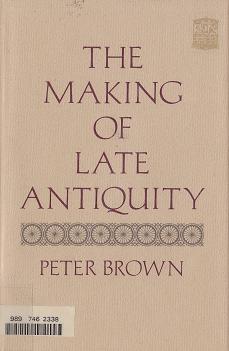
The Making of Late Antiquity – Peter Brown

Cover of The Making of Late Antiquity


The Making of Late Antiquity
Peter Brown
135 pages including index
published in 1978

Peter Brown is the historian who popularised the idea of Late Antiquity as a transitional period between classic antiquity and the early Middle Ages, with the emphasis on the continuity between Rome and the Middle Ages, rather than on the collapse of the western Roman Empire. Brown first publicised his theories in The World of Late Antiquity; this isn’t that book, but was the closest to it I could get. The Making of Late Antiquity is based on a series of lectures Brown gave at Harvard University in 1976 and focuses on the transformation of Roman society between the second and fourth centuries CE.

A topic which is of course closely connected to the political and economic turmoil which the Roman Empire was subjected to in that period, with civil wars, “barbarian” invasions and a resurgent Persia, but you wouldn’t know it from this book. Brown concentrates on the inner lives of the Romans and ignores politics. This alone makes it an odd bedfellow with the other histories I’ve reading about this period, but Brown’s writing style makes it even odder. His writing is very oldfashioned, almost nineteenth century like, sometimes hard to come to grips with. The combination of inner focus and his writing style made this book fussy and a bit prissy, at least to me.

Read more…