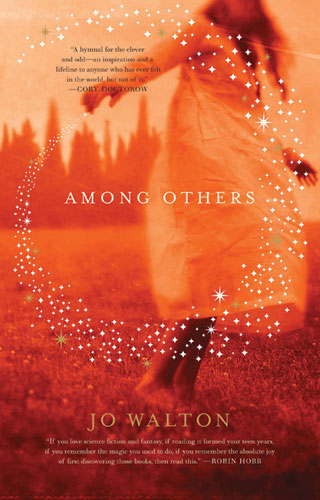
Among Others – Jo Walton

cover of Among Others


Among Others
Jo Walton
302 pages
published in 2010

Have you ever read a book you just wanted to gulp down in one sitting, so eager to get on with the story that everything else has to wait? Or alternatively, have you ever read a book you didn’t want to end, stretching out your reading so you could savour it, making excuses not to read it just now, so as not end it too soon? I’m sure you have and so have I, but much rarer are those books where you want to do both, gulp down the story and stretch it out because once the book is finished you can never read it for the first time again. That’s how Among Others was for me, a book I wanted to stay in, but also wanted to keep turning the page to see how it would all turn out. Jo Walton has always been a good writer, but here she’s surpassed herself.

But perhaps I’m not quite objective. After all, I’ve known and liked Jo since the mid-nineties, as a fellow fan and friend from the rec.arts.sf.* Usenet groups, who has had a huge influence on my reading, in science fiction, in fantasy, who I got to know about as well as you can get to know a person from Usenet posts. All I could think about at the start of the book was how Jo-shaped it was, even knowning going in that this was rooted in her actual life growing up as a science fiction reading Welsh girl in a post-industrial landscape which she populated with fairies. She made the fairies and the magic real for Among Others but at heart it’s still her own story and that’s what made me want to spent more time in it, because being with Jo, a disguised Jo in fiction is the next best thing to seeing her at a convention.

Which is all good and well, but what will that do for you, if you don’t know Jo Walton and are just wondering if all the praise from people like Patrick Nielsen Hayden, Cory Doctorow, Robin Hobb, Steven Brust, Suzy McKee Charnas and many others is justified? Will you get anything out of this?

Read more…

A Heck of an artist

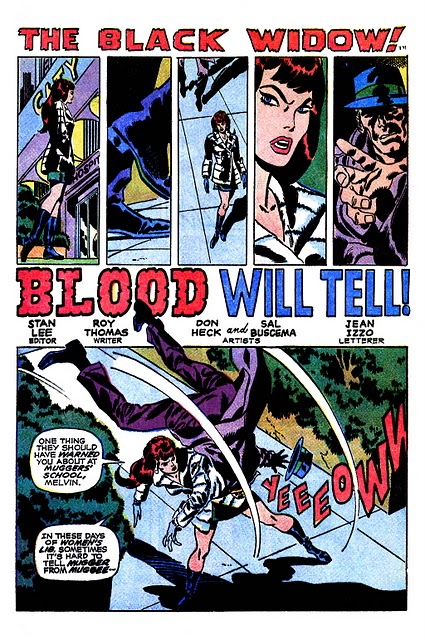
Diversions of the Groovy Kind has a series of splashpages from Marvel titles published in February 1971, exactly forty years ago. Some great art there, but the one that really grabbed my attention is the one above, by Don Heck (and Sal Buscema) for the Black Widow feature in Amazing Adventures. Heck is never really been one of my favourite artists, but having seen his work on early Avengers and Iron Man in the various Marvel Essential collections I read last year I gained a new respect for him.

1971 Black Widow splashpage by Don Heck

The page above is a good reason why. Most of the other splashpages featured just consist of one single, dramatic image, but Heck[1] has chosen not to do this. Instead, he puts a sequence of five, narrow, vertical panels above the title, building up to the payoff below the title, as the Widow judochops her stalker with such force his feet break through the panel border. Not a single panel is wasted here, each adding a new element, contributing to the tension. The first panel shows the widow in medium focus walking past a building, then we see a close up of shoes, clearly not the Widow’s, followed by an overhead shot showing the Widow walking as well as the lower legs of her stalker, in shadow. Next a reaction shot, as it’s clear the Widow has noticed him, then the menace as the guy sticks out his hand with a sneer on his face, followed by the payoff, as she quickly overpowers him, which is also the first time we get both dialogue and sound effects. Elegant, simple, done with the least amount of effort, seemingly nothing special happens on this page, it’s a sequence we’ll have seen dozens of times before, but it’s drawn with such craft by an artist who clearly thinks in page layout as well as images.

[1] Of course, both Roy Thomas, who has written the script Heck will have had to follow to draw this page and Sal Buscema, who inked Heck’s layouts have something to do with the choices made here as well, but I assume it was Heck who translated Thomas’ script, who made these layout choices.

Books read January

That’s the first month of the year done and dusted. Six books read, four history, two science fiction:

The Wages of Destruction — Adam Tooze
Brilliantly written book putting the evolution of nazi politics on war and genocide in the economic context in which they took place. Tooze makes it clear the nazis and Hitler read the economic situation in which Germany found itself in the 1920ties and wanted escape from what they saw as a trap by creating lebensraum for the German people, only to keep finding themselves still trapped with each new solution, ultimately ending in genocide.

Barbarian Migrations and the Roman West 376-568 — Guy Halsall
I saw this in the library and read it largely because Peter Heather had slagged Halsall off in his Empires and Barbarians for wrongthink on the Fall of Rome. Judging by this book the differences between Halsall and Heather are about ten percent real and ninety percent hype. They largely agree on the facts, are fairly close in how to interpret them. Halsall is leaning slightly more towards the idea that it was the internal fights for supremacy in the western empire opened opportunities for the barbarians, rather than the barbarian invasions creating the political unrest as Heather has it.

The Making of Late Antiquity — Peter Brown
Peter Brown is the historian who first made the idea of Late Antiquity fashionable. This is not the book which with he did it, but the closest I could get to it and it’s very strange. No politics, barbarians invasions and Roman collapse here, but a description of the evolution of the “pagan” mindset of yer average Roman during the second century Common Era, into the Christians of the fourth century. Interesting, but not quite for me.

The Goths — Peter Heather
Heather so far is the historian I trust the most on the Late Roman Empire and his speciality is the Goths. Here he tries to write their history, from very meager sources attempting to reconstruct their prehistory up until the time they first enter centre stage in 376 CE, then following them up until the dissolution of the two kingdoms they founded in Italy and Spain, as well as their heritage. Good one volume history, best read in context with e.g. Heather’s other books, or something like the Halsall book above.

The Left Hand of Darkness — Ursula K. LeGuin
Classic science fiction novel and winner of both the Nebula and Hugo Awards, not a feminist novel, but profitable to read it within this context.

Absorption — John Meaney
Part space opera in the tradition of Banks, Baxter, MacLeod, Reynolds et all set in the same universe as Meaney’s earlier novels, part epic fantasy following people at various points in time, from 777 AD until well after the main sequence’s 2603 AD. Not surpringly, part one of a trilogy. Decent book, need to wait for the next volumes to see if it was worth it.

“N@C60 is quite a sexy, interesting, promising molecule”

But in terms of holding onto quantum entanglement it’s beaten hollow by the humble Robin, according to Wired:

an European Robin from Wikipedia

European robins may maintain quantum entanglement in their eyes a full 20 microseconds longer than the best laboratory systems, say physicists investigating how birds may use quantum effects to “see” Earth’s magnetic field.

Quantum entanglement is a state where electrons are spatially separated, but able to affect one another. It’s been proposed that birds’ eyes contain entanglement-based compasses.

Conclusive proof doesn’t yet exist, but multiple lines of evidence suggest it. Findings like this one underscore just how sophisticated those compasses may be.

[…]

To put this in perspective, Benjamin introduced an exotic molecule called N@C60, a geometric cage of carbon with a nitrogen atom inside. This molecule is one of the best-known laboratory systems for maintaining entanglement. “The cage acts to shield the atom, which is storing the information, from the rest of the world,” Benjamin said. “It’s considered to be quite a sexy, interesting, promising molecule.”

But at room temperature, even N@C60 only holds entanglement for 80 microseconds, or four-fifths of what birds appear to be doing.

Very interesting, but watch out for the New Scientist effect, where the desire to showcase counterintuitive, sexy research comes into conflict with doing science right.

More on The Left Hand of Darkness

I’ve kept thinking about The Left Hand of Darkness since I’ve finished reading it yesterday, especially about the gender aspects. What I didn’t express well enough in my review was how little the idea of a naturally sexless people actually mattered for the story. The core of the story is the relationship between Genly Ai and Estraven and while the latter is supposed to be sexless, it could just as well have been a story about two men bonding together in the face of common danger. As I said yesterday as well, using gendered male pronouns for the Gethenians was a mistake as it reinforces the idea that the characters we meet are all male, if occasionally effeminate. It wouldn’t take that much rewriting to make the gender aspects disappear altogether.

What I kept comparing The Left Hand of Darkness is Nicola Griffith’s Ammonite, which takes place on a planet where through some handwave only female creatures are able to live. Both are at heart planetary romances, stories whose main purpose is to lead the protagonist (usually, as here, an outsider) on an exotic tour of the planet in question, the better to showcase the cultures and landscapes it contains. The planetary romance is a science fiction subgenre of long standing, a logical translation of the exploration or adventure stories set in Darkest Africa and the jungles of South America, only set on Mars or Venus. What Griffith does in Ammonite is telling this very familiar sort of story, but with women in every role you’d normally find male characters and she does so without fuss. Its very matter of factness helps underscore how often the opposite is the case, how many stories there are with only male roles, or with just the occasional token female love interest or professional victim.

Coming back to Darkness, I feel that LeGuin failed where Griffith succeeded. Griffith had women in roles that in formula fiction are automatically filled by male characters and did so matter of factly. LeGuin has supposedly sexless characters doing the same, has the narration (Genly) discuss this sexlessness a lot, but shows characters that still read male, behaving little different from how they would in a standard adventure story. There are no female-presenting characters doing the stuff male characters do normally.

A related problem I have with the gender relations in Darkness, the more I think of it, has to do with the infodumps LeGuin gives about how the whole sexual cycle of the Genthenians works. It’s a common pattern in nature of course, an animal that’s without sex drive for most of the year, only getting in heat at certain times, the twist she added being the idea of being able to “chose” becoming male or female gendered. The problem I had with it was that, despite LeGuin’s comparisons between the unity of the Genthenian gender and the “bisexuality” of the rest of humanity, it was actually still too binairy for me. In kemmer people become either male or female, pairing of with either a female or a male partner, but male-male, or female-female partnerships aren’t mentioned, if I remember correctly: no homosexuality. Kemmer and kemmering are presented as deterministic a process as the rutting rituals of lower animals. Real humans (or even some known animal species) don’t work that way, why would the Gentenians?

I won’t say too much about the idea that rape in such a system is impossible, as LeGuin says somewhere, because that’s so selfevidently silly that it’s not worth going in to.

I do want to say that this criticism does not make The Left Hand of Darkness a bad book, rather than a good novel with flaws. Just the fact that I can engage it on this level is a good thing; too many novels just skid along the surface of your engagement leaving only quickly fading ripples.