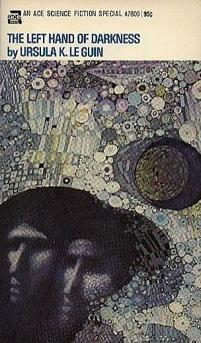
The Left Hand of Darkness – Ursula K. LeGuin

Cover of The Left Hand of Darkness


The Left Hand of Darkness
Ursula K. LeGuin
286 pages
published in 1969

Last year I discovered I read why too few science fiction books written by women and started making up for this lack by (re)reading some favourite writers. With the new year and following the example of several fellow science fiction bloggers, I decided to approach this more systemically, by pledging to read at least one science fiction or fantasy book by a female writer each month. The Left Hand of Darkness is the first and I choose it because it was a well respected classic novel, winner of both the Hugo and Nebula awards, I had never managed finish before, despite having tried three or four times and as important, it was short.

Since The Left Hand of Darkness is such a well known work, over forty years old and discussed and summarised extensively during that time, you can’t help but come to it with certain preconceptions about it. The most important of which you’ll have to let go if you want to get the shape of the true book. This is not a feminist science fiction novel. It’s a novel about gender and gender expectations and the role our assumptions of having two separate sexes each with their own character, strength and weakness play in our societies, but it’s not feminist, unless every book about gender is by definition feminist. What you actually get in this story is a fairly traditional view of gender, as I’ll try to show.

Read more…

Proper hypocrisy

Via bOING bOING: libertarian saint Ayn Rand used to be on welfare:

An interview with Evva Pryror, a social worker and consultant to Miss Rand’s law firm of Ernst, Cane, Gitlin and Winick verified that on Miss Rand’s behalf she secured Rand’s Social Security and Medicare payments which Ayn received under the name of Ann O’Connor (husband Frank O’Connor).

As Pryor said, “Doctors cost a lot more money than books earn and she could be totally wiped out” without the aid of these two government programs. Ayn took the bail out even though Ayn “despised government interference and felt that people should and could live independently… She didn’t feel that an individual should take help.”

Now that’s proper hypocrisy!

“Christian” bully turns out to be a wife beater. Surprise!

Christian Voice (sic) spokeperson Stephen Green is accused by the Daily Mail of being a wife beater:

Caroline Green was often punished by her husband Stephen for failing to be a dutiful, compliant wife, but his final act of violence against her — the one that prompted her long-overdue decision to divorce him — was all the more chilling because it was coldly premeditated.

Stephen Green wrote a list of his wife’s ­failings then described the weapon he would make to beat her with.

‘He told me he’d make a piece of wood into a sort of witch’s broom and hit me with it, which he did,’ she recalls, her voice tentative and quiet. ‘He hit me until I bled. I was terrified. I can still remember the pain.

‘Stephen listed my misdemeanours: I was disrespectful and disobedient; I wasn’t loving or submissive enough and I was undermining him. He also said I wasn’t giving him his conjugal rights.

‘He even framed our marriage vows — he always put particular emphasis on my promise to obey him — and hung them over our bed. He believed there was no such thing as marital rape and for years I’d been reluctant to have sex with him, but he said it was my duty and was angry if I refused him.

‘But the beating was the last straw. It ­convinced me I had to divorce him.’

Good on the Daily Mail, but hang on, which newspaper was it who kept promoting this dangerous lunatic? Take it away John Walker:

But most interesting is the Mail’s relationship with the man. Their latest story describes Green as a “monster”, a “fundamentalist.” The article goes on to note,

“Stephen was immersed in Christian Voice, which allowed him the autonomy and freedom to express his increasingly bizarre views unchallenged. As its founder and director, he was answerable to no one.”

And just who was it who was letting Green’s views go unchallenged?

Well, take for example this article about student stunt marriages that appeared in a newspaper just fifteen days ago:

“The students’ wedding was condemned by Stephen Green, national director of Christian Voice, an organisation that represents Christians.”

The story then goes on to quote Green at length, without editorial comment. And which paper is it who let this extremist monster go unchallenged? That would be the Daily Mail.

And that’s only the tip of the iceberg regarding the Daily Mail‘s relationship with Stephen Green, as Walker shows with quote after quote from just the last two years. As long as Green fit with the Mail‘s prejudices and could be counted upon to spout the reactionary, bigoted hateful nonsense the paper liked to quote he was a welcome guest; now that he turned out to be more nuts than they wanted the Mail puts the knife in.

The temptation here is to call Green a hypocrite, posing as somebody with high morals yet according to the Mail beating and raping his wife. This would be wrong however. It doesn’t matter whether these accusations are true or not as even without them Stephen Green has shown himself to be a nasty bigoted man who despises anybody who doesn’t think like him, who if he had the power would want to force everybody to live like he wanted them to live, no matter their own preferences. He believes homosexuality is sinful, divorce is sinful, anything not out of a 1950ties children’s picture book is sinful. In short, he’s a bully with no morals, just hate.
Friday Funnies: Zenith

Just a link today,as I’m glued to Al-Jazeerawatching the Egyptian revolution. He’s Not A Super-Hero, He’s Not Even A Very Naughty Boy: The Case Against Grant Morrison & Steve Yeowell’s “Zenith” is an oldish but excellent analysis of one of Grant Morrison’s first big projects, 2000AD‘s Zenith, the superhero-popstar:

IV. There’s a terrible puritanism that lurks at the heart of the popular concept of the super-hero, and at times it seems almost indivisible from any understanding of the Protestant Work Ethic. Sacrifice is good, fun is bad. Obedience is the mark of the worthy, indulgence is the devil’s stain. The mask, the cape, the platitude and the sacrificing heart is less admirable than mandatory, while private life and private happiness are despicable anti-social cancers threatening us all.

And yet underneath all that alienating refusal by Zenith to become a super-hero, and all his embracing of the shallow and disgusting business of wealth and fun, is a single truth that so many folks seem to miss. (I certainly did.) Zenith is an extremely young man, in a culture and a business effectively hell-bent on offering him every substantial psychological reinforcer to stay so. Which means that he’s often effectively just a boy, for heaven’s sake, while even his creators seem to be judging him as we would ordinarily judge a fully mature and adult man.

Zenith is an uneven but important work, the first time that Grant Morrison showed he was going to be an important writer, one of a wave of revisionist superhero projects done in the wake of Alan Moore’s pioneering work on Marvelman and Swamp Thing. Some of the issues and themes Morrison explored here would return in his later work in e.g. The Invisibles. As far as I know it’s still uncollected, so the only way to read it is to hunt down the old Titan Books collections of the first three series and the 200AD back issues in which Phase IV appeared.