Other people’s new year’s resolutions

Like me, another science fiction reader/blogger called Martin (Lewis in his case) found out he read shockingly little science fiction by women and decided to do something about it:

Over Christmas I decided to do something about this: I would read and review one SF novel by a women every month in 2011. I appreciate this sounds pathetically modest but in the context of my current reading I’m afraid it isn’t. There were several SF novels by women already languishing on my shelves, bought but unread and in this state for some time. I rescued these and then topped them up from Amazon. This in itself was an eye-opener; almost all the books I searched for – even those which had only recently been published – were out of print.

He’s not the only one to set himself this challenge: so did Ian Sales:

Torque Control’s Women in SF Week has inspired me to read twelve science fiction novels by women writers during 2011 as my reading challenge. I’ve tentatively identified the dozen novels I’m going to read. I didn’t want to pick only those published since 2001, although many are from the last decade. Nor would I limit myself to books published in the UK. But I did want my list to be comprise only authors I’ve not read before (bar one or two slight cheats).

And, neatly satisfying the law of threes, over at Torque Control, Vector‘s new editor Shana Worthen will be holding a monthly bookgroup reading through the winners of last year’s poll of best sf novels by women published from 2001-2010.

For myself I had already decided last year I needed to read more female science fiction, spending the last months of year reading and rereading some writers I had neglected for too, like Lois McMaster Bujold, C. J. Cherryh and Mary Gentle. But perhaps I should try and set myself the same sort of goal as Ian and Martin as well, even if what I read is so depend on my mood and interests on any given day. So let’s pick a list of twelve books I can and should read this year, either science fiction or fantasy, all written by women:

  • January: The Left Hand of Darkness — Ursula LeGuin (start with a classic, especially when it’s a short one…)
  • February: Bold as Love — Gwyneth Jones
  • March: The Female Man — Joanna Russ
  • April: China Mountain Zhang — Maureen McHugh
  • May: Foreigner — C. J. Cherryh
  • June: The Halfling and Other Stories — Leigh Brackett
  • July: A Point of Honor — Dorothy J. Heydt
  • August: Golden Witchbreed — Mary Gentle
  • September: 10,000 Light Years from Home — James Tiptree, Jr
  • October: Trouble and Her Friends — Melissa Scott
  • November: No Present Like Time — Steph Swainston
  • December: The King’s Peace — Jo Walton

These are on my shelves right now, all save three not read before and selected to have a relatively wide selection of science fiction/fantasy. These (hopefully) won’t be the only female written sf/fantasy books I read this year, but these are the ones I will read.
Confusing “available in English” with “worldwide success”

Earlier this week, Tom Spurgeon linked to an article in The Irish Times on French comics and their supposed failure to become a success abroad:

Perhaps the chief reason for this relative obscurity is that the festival celebrates a cultural product that has, to date, stubbornly resisted any and all attempts to export it. Unlike cinema, or jazz, or any of the other artistic endeavours for which France is regularly feted, Francophone comics have, for reasons mysterious, never quite managed to “cross over” and translate local mass-popularity into success on an international stage.

There are, of course, exceptions – most notably the peerless Franco-Belgian duo of Asterix and Tintin, two series that have conquered minds and markets both regional and global. Yet for all their success, these venerable titans represent but the uppermost tip of a thriving, prolific and progressive creative iceberg.

Which is only true if you define “success on an international stage” as “popular in the UK, US and/or other English speaking countries”. It’s true that Franco-Belgian comics have done badly in English, but that doesn’t go for the rest of Europe, or large parts of the rest of the non-English speaking world. That this sort of success is invisible in the Anglo-American parts of the world is due to the failure of the former to pay much attention to anything outside its own borders, rather than due to the lack of this success.

Friday Funnies: The Portable Frank

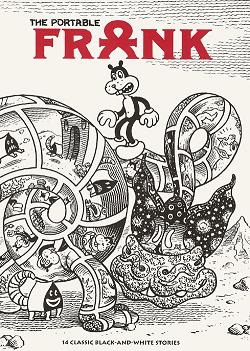
The Portable Frank

The Portable Frank
Jim Woodring
Fantagraphics, 2008
200 pages/$16,99
Get if from Fantagraphics.

The Portable Frank is a collection of fourteen of the black and white Frank stories wrote and drew in the twenty-odd years since Frank first appeared on the cover of Jim issue four back in December 1990. Frank looks like a mutated Felix the Cat wearing Mickey Mouse’s shoes and gloves and even so is the most normal looking of the cast of characters Woodring assembled around him. Two words you’ll hear a lot when describing Frank’s adventures: dreamlike and surreal, as reviewers try to grapple with the world and cosmology Woodring has created with these stories. A copout, but it is difficult to explain Frank to people who haven’t seen these stories.

The best comparison I can make is to finding a collection of legends or fairytales from some unknown mythology. The stories make no sense together, sometimes contradicting each other, characters changing from one story to the next, dying in the one and returning with no damage in the next. At the same time you can see how this mythology must’ve developed over time, how each character has their role to fullfil in it. That’s what these Frank stories are like.

Frank himself is the innocent everyman, kindhearted, a bit naive but capable of shocking cruelty at times. His main nemesis is the manhog, half man, half pig, all rage and id. Manhog often attacks and bullies Frank, but as often is the victim of others, used and abused by the closest figure the strip has to a true evil personage, Whim, the moonfaced grinning devil figure, who acts as the tempter to Frank, warpinghim spiritually as well as physically. His servant (?) Lucky is a human looking figure, but with a hugely elongated face, usually seen manhandling Manhog for some menial task or other. As his protector Frank has Pupshaw, a dog kennel shaped creature with a sort of bushy raccoon-like tail, whom Frank takes for a pet in the first story. Pupshaw largely behaves as a sort of dog or cat like creature, but transforms herself into a monsterous form when needed. There are also Faux Pa and Real Pa, older looking, more heavyset and stubbly versions of Frank, who walk on four paws. Faux Pa, in league with Whim, turns up in several stories to try and transform Frank into something more cruel, while Real Pa only shows up in the last story, guiding Frank out of the dungeons he had landed himself in.

All of Frank’s stories are nearly wordless, told in pantomime, with no dialogue and only a few captoins here and there, usually at the end of a tale. What we see and get to know of the various character’s emotions and their inner life has to be deduced from their expressions and postures. Woodring is a master at this, in drawing attention to a character’s mood by showing it on their faces, slightly exaggerated but never forced. He also uses a lot of reaction shots, where in panel one something happens and in the next panel you see Frank’s reaction to it, acting as a counterpoint.

Woodring’s art is stylised and inventive, as can be seen at Fantagraphic’s official flickr stream. You can run through this book in an hour, but come back to it time and time again discovering new details. Woodring is one of those artists that make you sees the world through his eyes, where you can’t help but see his figures and poses everywhere you look.

As a collection, The Portable Frank is an effort to have an affordable introduction to Frank’s world, the title of course harkening back to Viking’s old collections like The Portable Mark Twain. The format is nice, slightly smaller than a regular comic book in dimensions, but some concessions had obviously to be made to keep the price low. So there’s no bibliographical material, no key to the characters (whose names never appear in the stories and I had to get from Wikipedia), there’s just the stories themselves. But that’s enough.

Rammstein: fascist, or secret socialists (but who cares?)

As Roy Edrose has shown time and again, to analyse and judge any artwork soley on its political merits is a fool’s game, as he dissects yet another hapless rightwing culture warrior failing to understand why the latest Hollywood blockbuster is not best viewed as a potential liberal propaganda vehicle. You find such naive appraisals of art on the left as well, but its heyday has long passed and most leftist culture critics are more subtle than that, able to both see the political dimension in art and still appreciate it on artistic merits as well.

Not always though.

On the Australian Socialist Alternative website, one Tom O’Lincoln is struggling to determine whether or not Rammstein is a leftist band or just plain fascist:

People call them far-right wing, and you can see where this impression comes from. With the extreme costumes and pyrotechnics, their concerts do have moments that look like some kind of post-modern Nuremberg rally. Till Lindemann’s bunker-busting voice sounds menacing and his long trilled r’s are reminiscent of Hitler.

So one critic called their work “music to invade Poland to”, and the New York Times thought Lindemann exuded such macho aggression that “it seemed he could have reached into the crowd, snatched up a fan, and bitten off his head”. Rammstein once got a lot of flak for featuring Leni Riefenstahl propaganda clips, and neo-Nazis have used their material – without permission. But they responded to accusations of being right wing or neo-Nazi with a 2001 number called Links (Left) 2,3,4 which declared:

Sie wollen mein Herz am rechten Fleck
Doch seh ich dann nach unten weg
Da schlägt es links.
Links!

They want my heartbeat on the right
But whenever I look down
It’s beating on the left.
Left!

Does that settle the question? No it doesn’t, as we’ll see. Neither can you settle it by reading all their lyrics. Firstly the English translations are seriously unreliable (I’ve done my own). But secondly, that’s nobody’s fault, because even German speakers will wrestle with the deliberate ambiguity of just about everything these guys write.

A glimmering of understanding in that last paragraph, but unfortunately O’Lincoln spents the rest of the article just doing that which he himself just said is pointless: analysing Rammstein’s lyrics to see if any clues to their political orientation can be found there. He concludes:

To be on the left means a responsibility to make a clear statement on the issues you raise. This Rammstein often fail to do.

Which is about the worst kind of pronouncement you can make about art, to call for an end to all ambiguity and to want rigidly defined areas of doubt.


Propaganda needs clear, simple statements. Art doesn’t. What Rammstein is doing with their music is much more complex by that and any attempt to find an explicit political message in it, whether fascist or socialist, is doomed to failure, as that’s not what they are interested in. Which doesn’t mean there isn’t anything interesting to be found in looking at Rammstein in a political context, but it does mean more than just a cursory scan of their song texts and actually analysing them, contextualising them and engaging with them. Not just showing that the lyrics in Wollt Ihr Das Bett in Flammen Sehen are misogynistic, not just explaining how they are, but why they are, how the song fits in with the rest of their work.

But that’s much harder than what Tom O’Lincoln did.

Amongst Others

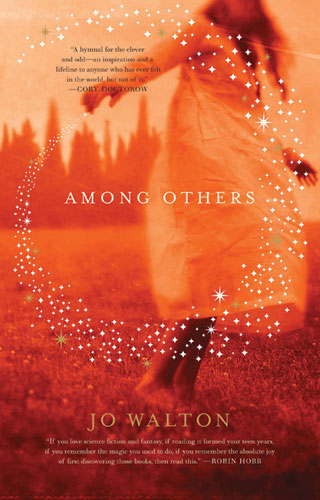
cover of Among Others

When you have Patrick Nielsen Hayden:

I am not Welsh or female, I do not walk with a cane, and I do not have a dead sibling or a parent who wants me dead. I never attended a boarding school, my family is far-flung and American, and I have never (to the best of my knowledge) conversed with fairies. And yet to a startling extent Among Others feels like a book about the experience of being me when I was, like Mori, fifteen. This turns out to be a fairly common reaction to reading Walton’s novel, at least among the kind of people I tend to know. It is quite possibly the best thing I have ever read about the way people of our ilk, when young, use books and reading to—in the words of Robert Charles Wilson—“light the way out of a difficult childhood.”

Locus reviewer Gary K. Wolfe:

I don’t believe I’ve seen, either in fiction or in memoir, as brilliant and tone-perfect an account of what discovering SF and fantasy can mean to its young readers – citing chapter and verse of actual titles – as in Jo Walton’s remarkable and somewhat autobiographical new novel Among Others.

As Cory Doctorow:

This is one of the places where Walton does something that made my head spin. For though Morwenna’s life has much that makes her unhappy, from her family to her pariah status to her gamey leg, these books are not an escape for her. She dives into them, certainly, and goes away from the world, but she find in them a whole cognitive and philosophical toolkit for unpicking the world, making sense of its inexplicable moving parts, from people to institutions. This isn’t escapism, it’s discovery.

Rave about the same book and with largely the same comments, you pay attention. Not that I needed introduction to Jo Walton, having know her as a fellow fan on Usenet since the mid-nineties and as an excellent science fiction and fantasy writer since her first published novel, The King’s Peace, but such high praise from such distinguished reviewers does concentrate the mind. Amongst Others might just be Jo’s breakthrough book, the novel that moves her from a cult author into a proper success, finally. She has been upping the stakes with every new book: from her start with her three book Histoire à clef series fo Arthurian fantasy, to her reworking of Anthony Trollope with dragons in Tooth and Claw, to one of the most chilling alternate histories in the Small Change series. In each case I had expected her to achieve the same sort of success as somebody like Alastair Reynolds had gotten, but for some reason it never quite happened. Even those alternate history novels, which I had thought would’ve been a surefire hit, well, didn’t quite make it:

Well, actually, Half a Crown is arguably an example of the system not working as well as it might. Farthing did okay midlist numbers in hardcover and actually better-than-expected numbers in mass-market paperback. But for reasons best described as “weather” (i.e., nothing whatsoever to do with the book), Ha’penny took a dip in hardcover–fewer library sales, among other things, if I recall correctly–and the mass-market paperback fell off a cliff. This is why Half a Crown hasn’t had a softcover edition yet–since we were clearly doing something wrong, I didn’t want to spray-paint further lousy numbers onto Jo’s track record.

You do wonder why a great writer like Jo hasn’t been able to catch a break yet — insufficient promotion perhaps, though I’m not sure how much that still matters in this interweb age, or perhaps it’s because she switched genres too much, or not writing in the right subgenre, not writing widescreen space opera or, as Patrick says, it’s just the weather? Good writers can and do bubble under, write books that everybody who finds them loves, but which never quite find their audience. Science fiction is littered with examples (William Barton, T. J. Bass to name but two examples from my own shelves); it would be a shame if the same happened to Jo.

Especially since Among Others does sound incredibly interesting, ever since Jo told of how she grew up in a post-industrial landscape on her Livejournal and people started to tell her to turn it into a novel. She has managed to turn her own experiences discovering science fiction and growing up with it in a world where nobody else cared for it into a proper fantasy novel and while with any other writer I would be wary, Jo has been writing about this online for a long time, ever since we both were regulars on rec.arts.sf.written. She still does so at Tor.com, talking about all her favourite books and what they meant to her and why they’re so good and you should read them — she’s probably the one person who has done the most to nudge me towards books I would not have read otherwise, after S.

Which is why I put my order in for the hardcover at the local science fiction bookstore, which had already sold out of the two copies they had apparantly recieved in November. Eight days I got to wait now, oy.