Friday Funnies: Scarlet Traces – The Great Game

World War Mars

The War of the Worlds battlefront moves to Mars….

Since I am reading comics again, I thought why not do something with them, though preferably not something as lunatic as last year’s Fifty Essentials in Fifty Days. Instead, from now on every Friday I’ll attempt to spotlight some deserving, newish comics. Comics such as today’s offering, Ian Edginton and D’Israeli’s Scarlet Traces: the Great Game.

In the same year that H. G. Wells’ War of the Worlds was published, the first unauthorised sequel Garrett P. Serviss’ Edison’s Conquest of Mars appeared, a jingoistic tale of American derring do overcoming the Martian evil, far removed from Wells’ own intentions. Ever since writers have continued to be inspired by it or swiped from it to enlive their own retro-futures, like e.g. Christopher Priest in The Space Machine In comics, apart from the inevitable Classic Illustrated adaptation, there of course also was Marvel’s great over the top reimagination of it in Killraven and which thanks to Don McGregor and P. Craig Russell was much better than it had any right to be. Alan Moore and Kevin O’Neill also used it in League of Extraordinary Gentlemen volume two, with a particular cynical revelation of what really killed the Martians.

Ian Edginton and D’Israeli’ then stand in a long and sometimes proud tradition when in 2003 they created the first Scarlet Traces miniseries, which asked what would’ve happened to a nineteenth century England suddenly in possession of highly advanced Martian technology in the aftermath of the invasion. England in 1898 of course was still convinced of its divine right to rule the world and it’s new technological superiority made this only worse. Martian technology has also unleashed a new industrial revolution, with the south reaping the benefits while the smokestacks of the North and Scotland fell still, replaced by clean, robotic Martian machinery, the workers left on the scraphead surplus to requirements.

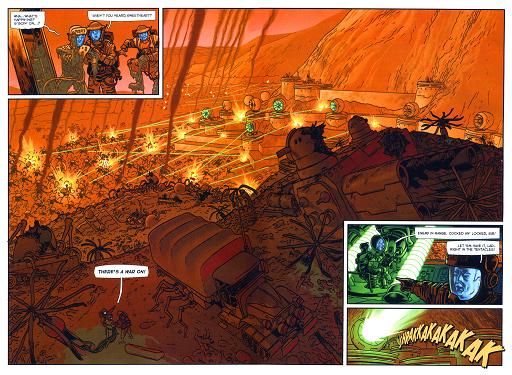
This is the background against which Scarlet Traces: The Great Game is set, jumping ahead to the 1940ties. Martian technology has completely transformed England and the world, leaving London looking as something out of Dan Dare — and D’Israeli’s designs do have something of that fifties English science fiction feel to them, clean and streamlined and bright. England now is not just a world power but has invade Mars and has been waging war for decades, while at home Northern and Scottish terrorists/freedom fighters are the justification for increasingly draconian security measures, overseen by home secretary Mosley, while Scarlet Traces‘ main villain, Davenport Spry is now prime minister.

Enter aristocratic lady photographer Charlotte Hemming, returning to London from an overseas assignment for the Interceptor, one of the few opposition newspapers left in England. When on her way there the BBC building is blown up by a Scottish suicide bomber, she’s on the scene to snap pictures. This lands her and her pulisher, Bernie Goldman, in hot water, hotter still when he gives her her next assignment: to find out what’s really going on on Mars. Bernie is killed by army thugs but Charlotte escapes, rescued by major Robert Autumn, the hero of the previous book. He explains what he had found on his adventures thirty years ago, the great secret behind England’s economic expansion and the mystery of what he and Bernie wanted her to research on Mars. Why is it, that in all these decades of fighting, so few soldiers returned home.

That’s the setup, and the rest of the book has Charlotte travelling to Mars, only to end up in the midst of the heaviest fighting in years, as the Martians attack the main British base at Valles Marineris, a huge city building two and a half thousand miles end to end, build by some unknown race. It’s evident that the military has been hiding the whole truth about the Martians for decades, also that they’re up to something big, a final act of genocide to win the war, but so are the Martians…

Now originally published as a four part miniseries by Dark Horse, this structure is still evident in the story. The first issue has the setup, in the second issue Charlotte gets to know the hidden truths of her world by Robert Autumn and travels to Mars, part three has her arrive and after some confusion starts finding even bigger questions that need answering and in part four all of this has to be tied together and resolved. It doesn’t quite work and feels rushed. Much of the plot is also told through speeches, first Autumn, later the series main villain, another army man, commander James Dravott, as he explains to Charlotte why the war was started and what the stakes are. Some more room for the story to breathe would’ve been nice.
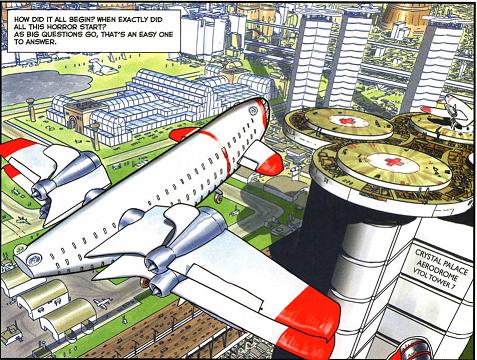
a very fifties looking piece of retrotech here from D'Israeli

But these are quibbles. The main attraction is the world Edginton and D’Israeli have created, which is great. Googling around many reviews call it steampunk, but that’s wrong. This isn’t faux Victorean high tech, this is an alternate nineteenforties and the technology reflects this. As said, the space ships, aereoplanes and equipment could’ve all been designed by Frank Hampton for Dan Dare, sleek, streamlined but round forms as above, yet the various lorries and automobiles we see in the background from the bonnet up look like proper 1940ties British cars, save for the crawler legs instead of wheels. D’Israeli is very good at convincingly portraying this meld of retrofuturism with the almost organic look of the Martian tech incorporated in them.
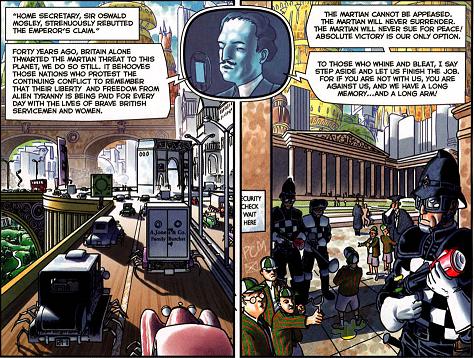
the background of each picture bears examining

D’Israeli is also good at providing unobtrusive but telling background details and cameos, like the lorry with the “A. Jones & Co Family Butcher” logo above, which help shape and make real Charlotte’s world. Everywhere you look there are mundane examples of Martian tech having been incorporated in familiar machines, while the fashions and office furniture is still recognisably forties in look and feel. Once Charlotte gets underway to Mars, military technology dominates, with clanking big WWI style tanks and soldiers in spacesuits that could’ve been worn in the trenches along side the much cleaner looks of the spaceships and the strangeness and grandeur of the Martian ruins. The use of colour is also superb: D’Israeli apparantly did all this directly on the computer, according to the backpages and this must’ve helped the unity of colour and image. It doesn’t feel computerised though. His people are slightly cartoony, with great expressive faces, clean lines and no unnecessary detailing or shading. Somewhat reminded me of Bryan Talbot’s work on One Bad Rat though of course D’Israeli cleary has his own style, but in the way he uses colour and shape to pop out foreground figures from their background.

A satisfying book and the physical presentation of it fitted it perfectly: hardcover bound, slightly bigger than a standard American comic book with nice clean glossy white paper that make the colouring really stand out.
What I’m into right now


It’s progressive rock in as far as it progresses me ever deeper into the seventies… But at least it’s a band with a genuine woman in it, somewhat rare in the spotty geek brigades of prog rock.

Crisis? What Crisis?

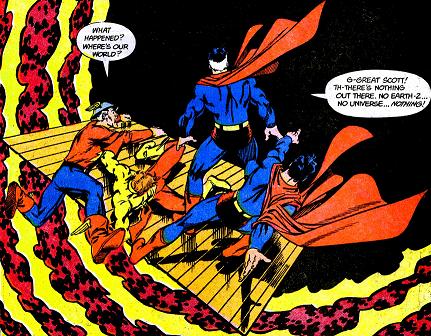
the end of Earth-2

Or, why Secret Wars was better than Crisis on Infinite Earths — at least in one aspect. Tim O’Neill has been looking at Crisis again and what it accomplished:

The final accomplishment of Crisis is the most obvious one, and in hindsight the most problematic: the establishment of the new post-Crisis single-Earth status quo. While on paper the post-Crisis integration may have seemed like the most logical solution to proliferating complexity, in actuality the benefits of the streamlined New Earth were severely mitigated by the company’s absolute refusal to disengage from the practice of constantly updating and “fixing” lapsed continuity. Post-Crisis, the smartest thing they could have done would have been simply to stop caring so much about consistency: with a working model New Earth and streamlined continuity, they should have declared Crisis #12 (or, more likely, Man of Steel #1) ground zero and gone forward without so much as a backwards glance, making it up as they went and not worrying so much about the particulars. But of course it didn’t work like that. There were problems immediately out of the gate: Roy Thomas and Paul Levitz, to name two prominent offenders, did not easily incorporate their distinctive and disparate fiefdoms – Earth 2 and the 30th Century, respectively – into the New Earth continuity, and therefore proceeded to pick at the scabs of bruised continuity in such a way that, for many characters and settings, the transplant never entirely took. Hawkman was problematic as well – but again, instead of simply just shrugging and going forward, they insisted on making a big deal of the problem, and thereby drawing more attention to what should have been merely a glitch.

I only read Crisis long after its effects had made themselves felt in the DC universe, sometime in the midnineties or so. That was late enough to know that what Wolfman and co had set out to do, streamline the DC universe and get rid of all the too complicated crap and start fresh, had failed. Individual series like Superman and Wonderwoman had rebooted well, became “hotter” than they had been in years if not decades, at the price of sacrifising all their history, but the universe as a whole was a mess, with the Legion of Superheroes as Tim also mentions fairing the worst, together with Hawkman. Contrary to Tim however I don’t think the problems lay with the execution, but with the concept of Crisis as a spring clean.

The DC universe wasn’t broke and didn’t need fixing. Sure, you had one popular title set in the future, two more on an alternate Earth and the Superman/Superboy “problem”, but none of this required a reboot. These were all things that could be ignored: the real problem was that DC’s flagship titles, like Superman, Action, Wonderwoman, Flash Justice League and to a lesser extent, Green Lantern and even the Batman titles were not very good and hadn’t been for a while. Superman in particular was in bad shape, dull insipid stories and artwork that looked dated and dull too. Something needed to be done with them, but it didn’t need to have been a continuity reset. Just getting Byrne to revamp Supes could’ve been enough: just focus on the present and forget “fixing” Superboy or the zillions of Kryptonians still hanging around or the sillier villains. What DC needed was better comics, not an improved continuity.

But I can understand that it would’ve been tempting back in 1984, when Marvel had been beating DC in sales for years and when it seemed the only successes DC had was with “new” titles like the Titans without too much historical baggage (and usually written by refugees from Shooter), that an universe wide cleanup was needed. But it was the wrong choice and it led to years and now decades of continuing revisions and origin regurgitations and in the end the DC universe is still difficult to get into.

One step forward…


Slightly more than two weeks after her last seizure, S. had another one and is back on the ICU; prognosis is that she may possible go back tomorrow, once she’s breathing unassisted again. It’s yet another setback in what seems like a whole month of setbacks, where she slowly recovers from the last crisis only to slide back down again.. We are going to get through this, but it is frustrating and so exhausting for her, to constantly have to fight these battles.

News of Gerry Rafferty’s death was the icing on the cake. Never been a fan, but “Baker Street” is in my top ten of best songs ever and it fits my mood. It’s a late night radio song, when you’ve had slightly too much drink and your mood has swung from mellow into melancholic and all the world seems dark and lonely.

It’s not called the Third Wave for nothing

I missed this back in late November, but apparantly a minor blogstorm erupted when Cosma Shalizi posted his “semi-crank pet notion” that the singularity had already happened

The Singularity has happened; we call it “the industrial revolution” or “the long nineteenth century”. It was over by the close of 1918.

Exponential yet basically unpredictable growth of technology, rendering long-term extrapolation impossible (even when attempted by geniuses)? Check.

Massive, profoundly dis-orienting transformation in the life of humanity, extending to our ecology, mentality and social organization? Check.

Annihilation of the age-old constraints of space and time? Check.

Embrace of the fusion of humanity and machines? Check.

Creation of vast, inhuman distributed systems of information-processing, communication and control, “the coldest of all cold monsters”? Check; we call them “the self-regulating market system” and “modern bureaucracies” (public or private), and they treat men and women, even those whose minds and bodies instantiate them, like straw dogs.

An implacable drive on the part of those networks to expand, to entrain more and more of the world within their own sphere? Check. (“Drive” is the best I can do; words like “agenda” or “purpose” are too anthropomorphic, and fail to acknowledge the radical novely and strangeness of these assemblages, which are not even intelligent, as we experience intelligence, yet ceaselessly calculating.)

And two months later I end up wondering why, because this is hardly controversial or new. If the dirty little secret of science fiction is cribbing from history, than cyberpunk’s dirty little secret is how much it ripped off the ideas of futurologist Alvin Toffler. The Third Wave was cyberpunk’s bible aqnd you can see a direct line from it to Gibson’sNeuromancer or Sterling’s Schismatrix as these authors embraced its vison of a future of relentless change, where the old political and economical schemas were worthless and new economies and ways of living needed to be invented. The world was going to be transformed, but Toffler never pretended this was anything new.

It was after all the Third Wave, not the First Wave. That had been the invention of agriculture and its subsequent spread over the world, not yet completed when the second wave happened, the industrial revolution, also not yet completed now the third wave, the computer and internet and biotech and $insert_favourite_kewl_new_technology revolution is happening. Three singularies, not The singularity. Cosma was pushing on a door not just already open, but never closed in the first place.

But it is good to be reminded sometimes that all this talk about singularies and the uniqueness of the technological revolution we’re now living in, part libertarian technofascism, part nerdgasm, is just another test of Marx’s observation that history repeats itself, the first time as tragedy, the second time as an Ipad presentation.