It’s not called the Third Wave for nothing

I missed this back in late November, but apparantly a minor blogstorm erupted when Cosma Shalizi posted his “semi-crank pet notion” that the singularity had already happened

The Singularity has happened; we call it “the industrial revolution” or “the long nineteenth century”. It was over by the close of 1918.

Exponential yet basically unpredictable growth of technology, rendering long-term extrapolation impossible (even when attempted by geniuses)? Check.

Massive, profoundly dis-orienting transformation in the life of humanity, extending to our ecology, mentality and social organization? Check.

Annihilation of the age-old constraints of space and time? Check.

Embrace of the fusion of humanity and machines? Check.

Creation of vast, inhuman distributed systems of information-processing, communication and control, “the coldest of all cold monsters”? Check; we call them “the self-regulating market system” and “modern bureaucracies” (public or private), and they treat men and women, even those whose minds and bodies instantiate them, like straw dogs.

An implacable drive on the part of those networks to expand, to entrain more and more of the world within their own sphere? Check. (“Drive” is the best I can do; words like “agenda” or “purpose” are too anthropomorphic, and fail to acknowledge the radical novely and strangeness of these assemblages, which are not even intelligent, as we experience intelligence, yet ceaselessly calculating.)

And two months later I end up wondering why, because this is hardly controversial or new. If the dirty little secret of science fiction is cribbing from history, than cyberpunk’s dirty little secret is how much it ripped off the ideas of futurologist Alvin Toffler. The Third Wave was cyberpunk’s bible aqnd you can see a direct line from it to Gibson’sNeuromancer or Sterling’s Schismatrix as these authors embraced its vison of a future of relentless change, where the old political and economical schemas were worthless and new economies and ways of living needed to be invented. The world was going to be transformed, but Toffler never pretended this was anything new.

It was after all the Third Wave, not the First Wave. That had been the invention of agriculture and its subsequent spread over the world, not yet completed when the second wave happened, the industrial revolution, also not yet completed now the third wave, the computer and internet and biotech and $insert_favourite_kewl_new_technology revolution is happening. Three singularies, not The singularity. Cosma was pushing on a door not just already open, but never closed in the first place.

But it is good to be reminded sometimes that all this talk about singularies and the uniqueness of the technological revolution we’re now living in, part libertarian technofascism, part nerdgasm, is just another test of Marx’s observation that history repeats itself, the first time as tragedy, the second time as an Ipad presentation.
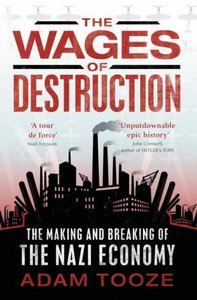
The Wages of Destruction – Adam Tooze

Cover of The Wages of Destruction


The Wages of Destruction
Adam Tooze
800 pages including notes and index
published in 2006

When I read Hitler’s Empire back in August, I had actually wanted to read The Wages of Destruction, due to Alex Harrowell’s review when it came out. I couldn’t find it so Mark Mazower’s book was a more than acceptable substitute. Both books look at the economy of Nazi Germany and the empire it carved out, each in their own way. Whereas Mazower’s point of view is that of a historian turned economist, Tooze approached the subject from the other side: economicst first, historian second. And while Mazower primarily looked at the interaction and tensions between nazi ideology, economci reality and the demands of war, Tooze goes for the more fundamental question of how the fundamental constrains of the German economy influenced nazi decision making, argueing that seemingly irrational decisions made by Hitler and the nazi leadership, not the least the decision to invade Russia, made perfect sense when looking at the economic context.

Which is not to say, nor does Tooze, that Nazi ideology wasn’t not irrational or evil, but that if you take into account their worldview, that in this context their decisions were rational and clearheaded and clearly informed by the economic realities of Germany. To the Nazis, as to most intelligent observers between the wars, it was clear that Germany was doomed to be a second rate power, not big or rich enough to seriously challenge countries like England, with its vast colonial empire, let alone America or the USSR. Under the Weimar Republic, the best it could hope to achieve was to become a middling European power, growing rich on American coat tails. Nazism set out to change this, to conquer a larger living space for the German race by force and through pure willpower and technology transform the German economy into the equal or even the superior of the American. This struggle lies behind all strategic decisions the Nazi leadership made in the runup to the war and during it, each time putting their faith into another great leap forward, each time still finding themselves in the same box, in the end not having been able to overcome these fundamental limitations.

Read more…

Saturday is music day

Here, have a video:


I hadn’t heard of Dearling Physique before, until Rydra Wong linked to it, but this is a great video and a good song too.

In more personal music news, last Tuesday, in the fifteen seconds between my ipod slipping out of my coat pocket and me noticing this and cycling back, some fscker must have spotted it and swiped it, as prolonged searching has gotten no result. It was only a 2GB mini ipod, once gotten as an incentive for going to a job interview I was reasonably sure I wasn’t actually going to accept if I got through, but it was my little friend and for now has left me musicless during my commute. Grumble.

Creeping back into Afghanistan

The government today announced that it would propose a new police mission in Afghanistan to parliament, even though it was this exact same issue that caused the previous government to stumble. But with the coalition partner (PvdA/Dutch Labour) that then objected now in opposition and the two parties that form the current minority government both having been firm supporters of the original proposal, it was just a question of time before it would be back on the agenda again.

At first view it looks innocent enough, to get some twohundred or so civilian cops to Afghanistan to help train the locals, but the devil is in the details. With them some 300 odd soldiers would be traveling back into Afghanistan as well, to provide security, support and liason duties with other NATO forces in the area. There would be four F-16 jets coming along as well, again to provide air support for this supposedly civilian mission. I can’t help but see this as the thin end of the wedge — once we have some fivehundred plus soldiers and cops stationed again in northern Afghanistan, it will become that much easier to extend and enlargen their mission and before you know it we’re creeping back into the war again. Which is something the current government parties, who didn’t agree with the end of the original Dutch involvement in the War in the first place, would not mind at all.

Ironically, the opposition against this proposal is likely to contain both Geert Wilders’ party and its fiercest critics, the PvdA and Socialist Party. The latter because it’s opposed in principle to any involvement, the former because it sees no good in letting “our boys” risk their skins for foreigners, especially when the government needs to cut spending on policing anyway and we need those cops on our streets….

Some links

Strange Horizons has put out their science fiction year in review and the interesting thing is: no mention of Iain M. Banks. Funny, for me Surface Detail was one of the best books I read this year, but no peep of it in SH’s list. Reviews elsewhere have been lacklustre as well, something that I’ve noticed before with the previous “new” Culture novels. It’s as if the original three novels have set expectations so high that everything that Banks has done afterwards is consciously or not compared to the impact the original trilogy had. Hardly fair, but perhaps inescapable.

Now for something completely different. We knew crows were clever, but they are even more clever than we thought. New Caledonian crows have long been known to use twigs to pry insects out of trees, but now experiments have proven that these crows know how to adapt their tools for multifunctional use by poking at a rubber spider with a twig. It sounds like nothing, but these are probably the first non-mammal species shown to have the mental capacity and creativity to not only use tools, but adapt them for other uses and, as the Wired article also notes, use them in sequence: using a twig to get a twig to get food. I’ve had co-workers who showed less promise…

Finally, would you like some cheese with that white whine?