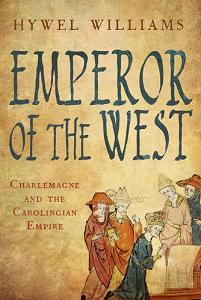
Emperor of the West – Hywel Williams

Cover of Emperor of the West


Emperor of the West
Hywel Williams
460 pages including notes and index
published in 2010

Emperor of the West: Charlemagne and the Carolingian Empire is a book I ran across when looking for other books in the Middelburg library, but which turned out to be exactly the book I needed to read after having spent most of December reading Peter Heather’s empires and Barbarians. Heather’s book was a comparative history of the first millennium CE, from the Late Roman Empire through to the Carolingian and Ottonian empires, of which the Carolingian was the first European empire with had its power base in north-west Europe, as opposed to the Mediterranean basin. Heather’s focus was on the interactions of these three empires with the various “barbarian invasions” each had to deal with and how these shaped what would become modern Europe, but what it made me want to read was more about the Carolingians themselves, which is where Emperor of the West came in handy.

Though not quite an introductionary level book — some familiarity with the various characters is expected — Emperor of the West turned out to be a good overview of Carolingian history. Williams’ main focus is on Charlemagne himself, but through him looks at wider Carolingian culture and history. He consistently puts Charlemagne in the context of the Western European recovery from the fall of the Roman Empire in which the awareness of imperial Rome and its history helped shape Charlemagne’s empire, in the same way that the Carolingian conviction that they were uniquely blessed by Christ also did. The Carolingians always looked back to the Roman past and consciously set out to restore it in their own image, but in the process created something new, the first European empire not to depend for its power on the Mediterranean Basin.

Read more…

Books read December

A new year, a new month, a new list of books read last month:

The Hundred Thousand Kingdoms & The Broken Kingdoms — N. K. Jemisin
The first two books in a fantasy trilogy that so far has been excellent.

Glide Path — Arthur C. Clarke
An enginering novel based on Arthur C. Clarke’s experiences in World War II, strongly reminding me both of Clarke’s own enginering science fiction as well as Nevil Shute’s more mainstream novels.

Empires and Barbarians — Peter Heather
Heather continues his examination of the end of the Roman Empire and the rise of its successor states, now widining his focus to take in the Carolingian and Ottonian empires that arose in the second half of the first millennium CE as well. A bit of a slog to get through, but worth it in the end.

Killing for England — Iain McDowall
Described as the new Ian Rankin, McDowall has some of his same strengths, most noticably the same awareness of how much politics is involved in policing. This was a fast paced police procedural that I read in a day, about two Black men turning up drowned in the same small city within months of each other, witht he police struggling to determine whether or not it was coincidence or enemy action…

Emperor of the West — Hywel Williams
Excellent one volume history of Charlemagne and the Carolingian empire.

Rome’s Gothic Wars – – Michael Kulikowski
An introductionary level textbook on the first two centuries of Gothic-Roman clashes, made interesting by Kulikowski’s very certain dismissal of the standard stories of Gothic origins.

Cartomancy — Mary Gentle
Seeing out the year with Mary Gentle’s second short story collection, what could be better?

Hiatus

It was the day before Christmas and all through the house internet, not a creature was stirring… So I think I’ll take a little leave of absence myself as well. See y’all in the new year, though I may be back earlier if inspired.

Yesterday a year ago

We went under the knife to get that kidney transplant going. I did expect things might not quite go to plan and that S. in particular might take some time to recover, but I sure didn’t expect her to still be in hospital a year later… A bit of a wasted year, 2010 has been for us; hopefully next year will be better.

So farewell then Dirk Deppey

Fantagraphics has had to let Dirk “¡Journalista!” Deppey go as they could no longer afford a fulltime blogger. Dirk takes the opportunity of his last column to look back:

In the last ten years, I’ve thrown away a career, assembled porn mailers, drew comics, wrote essays, raised money for a homeless cartoonist, organized Seattle’s worst benefit concert ever, digitized hundereds of hours of cassette tapes containing (I think) the largest oral history of comics in the United States, started a weblog, kick-started a blogosphere, attended a bunch of geek festivals (including four San Diego Comic-Cons in a row), edited a magazine, interviewed cartoonists whom I greatly admired, got quoted in major newspapers on topics in which I was often unqualified to hold a quoteworthy opinion, became several bibliography citations, became a footnote, became an Internet micro-celebrity, became a Wikipedia entry (it reads “mostly harmless”), helped facilitate a manga line and spent a full four years working from home in my living room, naked! And I got paid to do all of it.

It’s a real pity it had to come this far, but completely understandable that it had to happen. Comics being not the most stable or profitable business at the best of times, with the recession grinding on indeterminably in the US, it’s not surprising Fantagraphics was wanting to cut costs — and a fulltime blogger is a luxury that is easily cut… You could call it a small miracle that they had been able to keep Deppey employed for as long as they did.

Luxury or not, Deppey’s importance in developing a proper comix blogosphere is not easily overestimated. Just having somebody there day in, day out collating and reporting on all sorts of comix related stories, directing traffic to blogs or websites otherwise overlooked, has helped to mold the blogosphere. What’s more, Deppey also served as an example for other bloggers, again both by being there every day and through the quality of his blogging. Sure, most of it was link blogging, but he always managed to pick at least two-three, sometimes even five or six interesting or thoughtful links every day, which few people could’ve equalled over so long a period. And when he wrote longer posts, it was always interesting as well.

On a more personal level, ¡Journalista!, was one of the blogs that managed to suck me back into comix again. If only for that he will be missed.