Some quotes on the British student protests

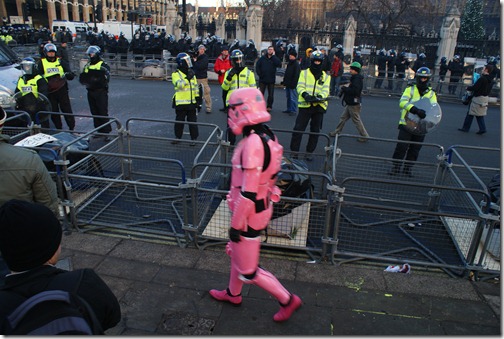
A pink Star Wars Stormtrooper walks past riot police

Phil, inbetween hawking his book, makes a good point of the background against which the university occupations take place:

One puzzle about this movement is where it came from: nationwide university occupations don’t come out of a blue sky, do they? One answer would be to refer back to poor old Lefebvre and say that sometimes they do just that. I think also there’s a combative mood that’s been building for a while, smouldering just below the surface. Ironically, it’s been fostered – or at least permitted to continue – by the fact that Labour were in office for so long. New Labour were certainly an authoritarian and pro-business government, but the two elements weren’t combined (as they had been under Thatcher) in a war on “militant left-wingers” and “union bully-boys”. New Labour’s authoritarianism mostly took aim at much softer targets – Islamism and “anti-social behaviour” – in a kind of punitive reinforcement of the social exclusion already suffered by marginalised groups. The result was that a generation forgot the lessons that were drummed into us under Thatcher: “pickets” meant “thugs”, “militants” meant “loonies”, “mass meeting” meant “mob rule”. In short, the taboos against collective action quietly faded away.

Over at Blood and Treasure, Charlie reports on the media response tot he protests:

Radio 4’s narrative this morning was fairly depressing: the whole episode was cast as a failure of policing rather than as a failure of policy (i.e. a failure of politicians to come up with a plan that’ll be broadly accepted). There were barely veiled threats from Boris Johnson and some senior police commander: there might have been plenty of broken student heads, according to Johnson, had the police not been so restrained. The police guy, for his part, said we should all remember that the royal protection officers had guns, and that their mission, when on duty, was to protect ‘the principals’. By the time the end of the interview came around, they’d remembered that the police aren’t supposed to be just the go-to people when you’re looking for some violence against the person, but I sensed it was grudging, especially on Johnson’s part.

And finally, Paul Mason at the BBC reports on who the demonstrators are:

The man in charge of the sound system was from an eco-farm, he told me, and had been trying to play “politically right on reggae”; however a crowd in which the oldest person was maybe seventeen took over the crucial jack plug, inserted it into aBlackberry, (iPhones are out for this demographic) and pumped out the dubstep.

Young men, mainly black, grabbed each other around the head and formed a surging dance to the digital beat lit, as the light failed, by the distinctly analog light of a bench they had set on fire.

Any idea that you are dealing with Lacan-reading hipsters from Spitalfields on this demo is mistaken.

Vox pop segments on the main six oçlock BBC news and the local Londonversion yesterday also showcased some self identified kids from the hoods, or at least the estates; Ben Goldacred might’ve thought them inarticulate, but to me they made perfect sense. It’s not just the jacking up of tuition fees that worries them, but also the scrapping of the EMA. It shows that contrary to mainstream spin, this is not a middleclass issue.

Zot! going cheap

For anybody near a de Slegte bookstore — thanks to the internet, this is everybody — here’s a top tip. De Slegte has Zot! — The Complete Black and White Collection: 1987-1991 going cheap, from 25 euros for less than eight. If you want to sample one of the best independent comix of the 1980ties, here’s your chance. Me, I bought it at full price a few years ago already, alas.

If only there was a collection of the original colour run as well, or the 1/2 issues done by Matt “Cynicalman” Feazell. Yes, I have the original issues, but this material is too good to leave smoldering in back issue bins.

4chan ftw in the Wikileaks Cyberwars

If the US government can pressure companies all over the world to cut off access to Wikileaks, the internet’s most chaotic, trollish forces can target these same companies too:

The forces of Anonymous have taken aim at several companies who are refusing to do business with WikiLeaks. 4chan’s hordes have launched distributed denial-of-service attacks against PayPal, Swiss bank PostFinance, and other sites that have hindered the whistleblowing site’s operations.

A self-styled spokesman for the group calling himself “Coldblood” has said that any website that’s “bowing down to government pressure” is a target. PayPal ceased processing donations to the site, and PostFinance froze WikiLeaks founder Julian Assange’s account. The attacks are being performed under the Operation: Payback banner; Operation: Payback is the name the group is using in its long-running attacks on the RIAA, MPAA, and other organizations involved with anti-piracy lawsuits.

The battle over Wikileaks might just be the most important event of this year, as it morphs into a battle for control of the internet. Wikileaks is the product of the internet’s idealist, libertarian (in the good sense of the word) origins, owning no allegiance to any meatspace government and acting according to internet, not offline morality. 4chan and its various shadowy subgroups and self appointed vigilantes are another product of this morality: far from perfect, often misguided and sometimes as eager to punish disrespect as much as real transgressions, but still a vital part of the internet’s immune system. Thanks to them the companies who were eager to curry favour with the US government have found out these actions have consequences.

Wikileaks meanwhile is defending itself against being taken offline and does so rather well:

Taking away WikiLeaks’ hosting, their DNS service, even their primary domain name, has had the net effect of increasing WikiLeaks’ effective use of Internet diversity to stay connected. And it just keeps going. As long as you can still reach any one copy of WikiLeaks, you can read their mirror page, which lists over 1,000 additional volunteer sites (including several dozen on the alternative IPv6 Internet). None of those is going to be as hardened as wikileaks.ch against DNS takedown or local court order — but they don’t need to be.

Within a couple days’ time, the WikiLeaks web content has been spread across enough independent parts of the Internet’s DNS and routing space that they are, for all intents and purposes, now immune to takedown by any single legal authority. If pressure were applied, one imagines that the geographic diversity would simply double, and double again.

Almost a textbook example of the old adage that the internet percieves censorship as damage and routes around it. For the moment there’s a stalemate in the Wikileaks cyberwar, a stalemate in Wikileaks’ favour.

Racefail: not just for science fiction anymore

Roxane Gay reads this years Best American Short Stories, finds almost every story in the anthology was about rich or nearly rich white people:

What I felt most while reading BASS was a profound sense of absence. Sure there was a story about black people (written by Danielle Evans, coincidentally) and there was a story about a mechanic, to bring in that working class perspective and there was a story set in Africa, but most of the stories were uniformly about rich white people (often rich, white old men) doing rich white people things like going on safari or playing poker and learning a painful lesson or lamenting old age in Naples. Each of these stories was wonderful and I don’t regret reading them, but the demographic narrowness is troubling. It’s not right that anyone who isn’t white, straight, or a man, reading a book like this, which is fairly representative of the work being published by the “major” journals, is going to have a hard time finding experiences that might, in some way, mirror their own. It’s not right that the best writing in the country, each year, is writing about white people by white people with a few splashes of color or globalism (Africa! Japan! the hood!) for good effect. Things have certainly improved over the years but that’s not saying much.

At the same time, she also find her own succes being questioned for the usual reasons:

Anytime you achieve even a little bit of success there’s going to be someone who suggests you earned that success because you’re a person of color (or a woman, or both). Even though you might know you achieved your success because you’re awesome, because you worked hard for years, because you beat down doors until one fell down, you are stuck with the niggling doubt that they’re right. You worry that everyone thinks that way so you can never really enjoy your success, you always push yourself to do better, to do more, to be the best, to be so good they have to stop saying it’s just because you’re a person of color. It is exhausting.

All of which confirms the superiority of science fiction and fantasy fandom, as

Most of 2009, the science fiction/fantasy community was embroiled in a contentious debate about race that was so extensive and ongoing that it even got its own name and wiki: RaceFail, but hey, at least the SF/F community is talking about these issues which cannot be said for other writing communities.

Which is surely the most important point to take away from these two posts. More seriously, it’s strangely heartening to see that the problems sf and fantasy struggle with (the representation of non-white/male/straight voices and viewpoints, the problems with appopriation, systemic racism and underrepresentation of people of colour and so on) are not unique to it. It means that it’s not impossible for science fiction/fantasy to change for the better.