Peeping Life: the mundane lives of anime heroes

ANN’s This Week in Anime about anime crossovers reminded me in a roundabout way of this spectacular weird oddity:

Peeping Life was an improvisational anime focusing on the “the listless minutiae of everyday life” which for one glorious season in Fall 2015 decided to do so using Tezuma and Tatsunoko characters, some of the most recognisable anime/manga characters of all time. Which led to sketches like Astro Boy going through puberty or Black Jack visiting a doctor because he has the flu. Fall 2015 was the first season I actually followed seasonal anime and this series was one of the ones I watched each week. A real surreal experience when you barely recognise one in three of the characters featured and are also completely new to the style of humour it uses. Gina Szanboti over at the ANN forums has episode recaps if you want to get the flavour of it.

Sadly, while Crunchyroll does have another season of Peeping Life, it doesn’t have this one.

Close but no Kill Me Baby — Shikanoko Nokonoko Koshitantan — First Impressions

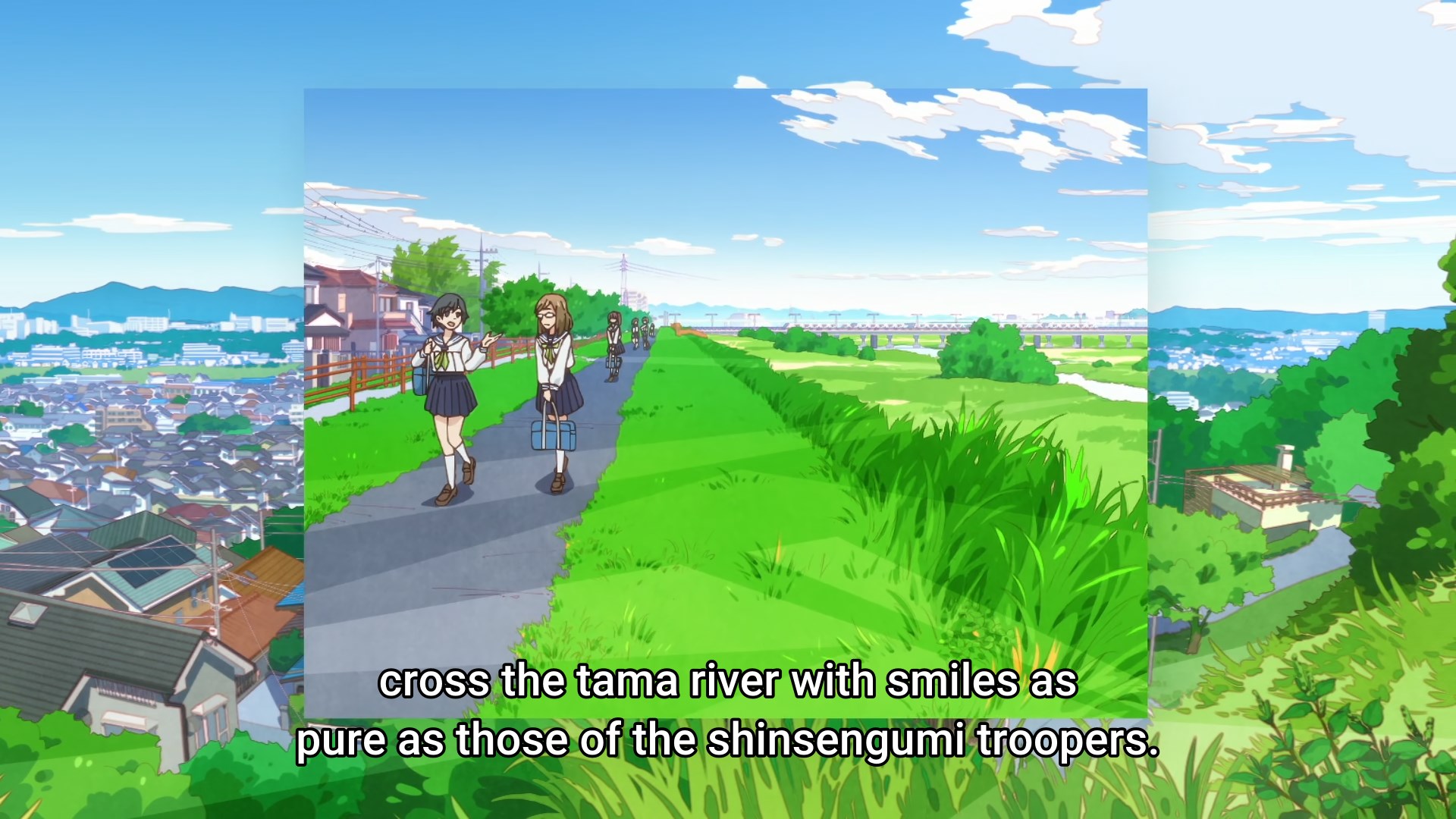
To be honest, I sort of knew who the Shinsengumi were — late 19th century fascistoid thugs who for some reason are very popular BL fodder — and I assume the Tama river is the one in the background here, so this sort of mangled allusion in my subtitles doesn’t bother me. I’ve watched too much fansubbed anime and read too many scanlations to even notice this sort of thing anymore:

School girls apparently crossing the Tama river, smiles as pure as shinsengumi troopers

But it is indicative for the quality of the subtitles, when one of the first things you see is an unaltered reference not too many people outside of Japan will understand. It and similar references, as well as a fair few misspellings as well as typeset errors, with words running into each other e.g. showed that whoever had translated this, had done the bare minimum with results barely above machine translation quality. Subtitles which apparently were forced on Crunchyroll by the Japanese distribution company Remow, also involved with last season’s Ooi Tonbo! whose subtitles were not great either. All of which has overshadowed Shikanoko Nokonoko Koshitantan‘s premiere quite a bit. And this for a series with a lot of hype behind it: “the new Lucky Star or Nichijou” it was supposed to be. Now completely hobbled by being too cheap to get proper translators involved.

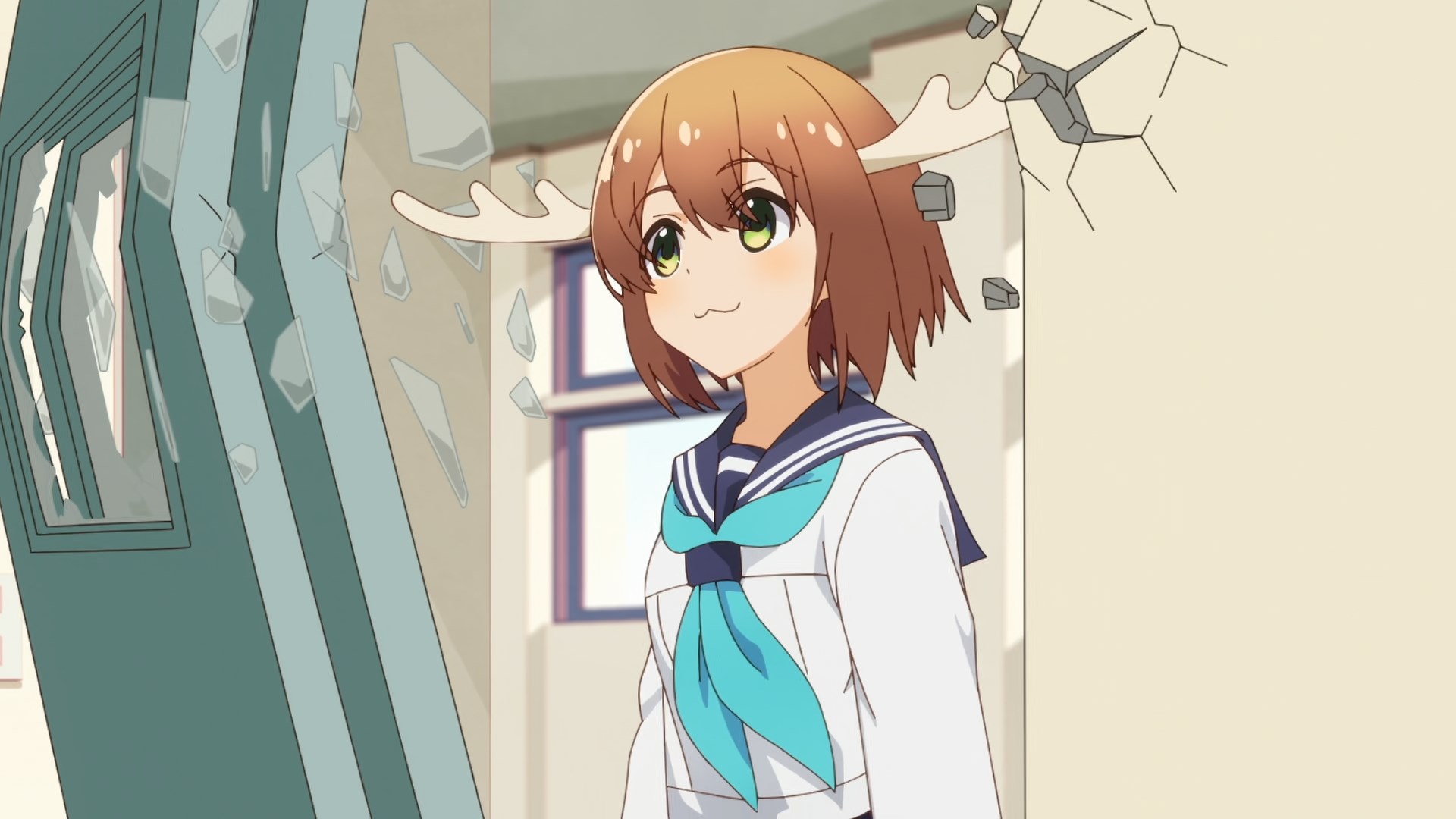
Nokotan making her entrance into the classroom, her antlers too big for the door, destroying the wall

It all starts when Koshi Torako, former deliquent turned perfect student at a prestigous high school, finds a girl hanging by her antlers from the powerlines at the side of the road. She rescues her and hopes never to see her again but guess who turns up as a new transfer student? Shikanoko Noko — call her Nokotan — makes a devastating impression entering the classroom, but Torako is the only one who finds anything strange. That of course Nokotan sits next to her is bad enough, but she also sniffs out — literally — Torako’s deliquent past. What will this do for her carefully cultivated reputation?

Yes, poor old Koshi Torako — Koshitan as Nokotan immediately calls her — is stuck being the straight man in a zany comedy in which Shikanoko is the agent of chaos ruining her life. A tried and true concept for a comedy anime, but does it work? Not quite for me. It all feels a bit try hard and artificial. There were a few good jokes that landed in this first episode but nothing as funny as the choco cornet discussions that Lucky Star opened with.

A Guilt Free Harem — Giji Harem — First Impressions

I like harem romcoms but is a bit of a guilty pleasure. It’s hardly mature to enjoy the idea of multiple cute girls (or boys) fighting over the protagonist, right? Not to mention that either you have to keep the battle going forever or somebody has to win and that always makes me feel sorry for the losing heroines. But what if you could have a guilt harem? A harem is which all the girls fighting over protag-kun are actually the same person:

Rin in all her personas surrounding a flustered looking Eiji

Giji Harem (Pseudo-Harem) starts with Nanakura Rin, a first year high school student who likes acting and is looking for the school’s theatre club when she asks Kitahama Eiji, a second year for directions to the club room. He tells her he’s actually the club president but also the sole member of it, only to guide her to a room full of club members and the real president. She thinks he’s a bit weird but he must have made a good impression as after the opening has played, we see them sitting together as he complains about wanting a harem. Which is when Rin launches into her first persona, a devilish flirty girl, followed by tsundere-chan. For this she actually puts her hair into the traditional twin tails. More characters debut in the next few sketches, the quiet, capable but standoffish cool-chan and the big eyed, baby talking spoiled-chan. Apart from the pre-opening scene throughout these sketches we see that Rin and Eiji are already incredibly comfortable with each other, that Rin enjoys doing these skits as much as Eiji enjoys the flirting from all these characters.

Rin shouts that she cannot do her act in front of other people as it's embarassing

In one of the stories this episode Rin has to actually choose which cooking is better between Eiji’s and another club member, who already won the club president’s vote. She’s very happy when the dish she prefers is indeed his, but gets embarassed when Eiji asks her to have spoiled-chan vote as well because now it’s a draw. The president then explains to the other member that’s just a little act Nanakura does sometimes. Just one of the hints dropped that their little play acting is noticed and recognised for what it is.

Rin needs an excellent voice actor to pull all these quick character switches off convincingly. Fortunately, Hayami Saori is more than up to the job. Her opposite number, Okamoto Nobuhiko is no slouch either. In a series that stands or falls with the quality of voice acting, to have the leads played by such distinguished veterans is excellent. I do feel sorry for whoever is doing the translating, having to get the flavour of Rin’s various personas into the subtitles. I had been a bit worried about how the animation would stack up compared to the manga, with the trailers not being that encouraging, but so far it has worked well.
The Rest Is Indeed Noise

For the past few months I’ve been mostly been listening to classical music in its broadest possible definition, everything from 17th century baroque pieces to the work of 20th century composers like Bernd Alois Zimmermann here.

Listening to his Intercomunicazione today it struck me that this is Zimmerman doing in 1967 something not too dissimilar from what bands like Throbbing Gristle, Einstürzende Neubauten or Nurse with Wound would be doing roughly a decade later, just with classic instruments rather than electronic ones. It activates the same neurons as their music in my head. A far cry perhaps from a Mozart or Beethoven or even a Mahler of Schoenberg, but even Beethoven’s Ninth was said to be deliberately unplayeable when it was published. Apparantly it’s only due to the improved skills of musicians today that we even stand a chance of hearing it in its intended form. Not that different in intent perhaps from what Zimmermann does here.

La jeunesse emmerde le Front national

How can it be that this song and this slogan from it is once again relevant, forty years after it was first sung?

I love Bérurier Noir and this song, but it’s fucking frustrating that the same issues they sang against back in 1985 are still alive and kicking now in 2024. François Guillemot gets it exactly right her in this interview in The Guardian:

Because it comes at a really dangerous point in French history. It feels like we are at the turning point, and I don’t want people like Bardella and Le Pen take power because they will be dangerous.

It was easy to chant against Jean-Marie Le Pen because he was almost a caricature of a far-right politician: he was very bourgeois, very racist and that made it easy to stand up to him. His daughter, by contrast, changed her looks and has been very strategic in detoxifying the party’s image, for example by condemning antisemitism.

She and Bardella have managed to attract voters who are not ideologically formatted like the skinheads of the 1980s. These voters are ras-le-bol, fed up with the old way of doing things. They want to topple the system. I see it in a place like Lyon, where I now teach history at the university: inside the city, most people vote left or centre, but on the outskirts it’s mostly the National Rally.

I think Macron has to shoulder most of the blame. He had everything in his hands to create real change, but his arrogant management of the state managed to turn a lot of people against him. And with his unpopular pension reforms and the new immigration law he opened the door for the National Rally, because he normalised their ideas. The media, who have helped de-demonise the National Rally and played up Bardella as a pop star, have not helped.

The past four decades all through Europe and America we’ve seen our political choices being steadily reduced to one between cynical centrists slowly destroying the world to enrich their friends and literal fascists promoted as their main opposition as they’re less dangerous to the status quo than anything even vaguely leftist. Whenever anything on the left has had even a small change of getting near power it is stomped to death (cf. Corbyn) while people like Trump, Farage and Le Pen are activily promoted. So now in France you have a choice between Macron, already executing the sort of policies Le Pen would kill for and Le Pen, but at least there there still is a leftist movement to oppose both. In the UK meanwhile the only thing you can chose is the colour of the tie the leader of the crackdowns and austerity party will wear, while in the US it’s between genocide Joe and cheeseburger Nazi Trump. Forty years of neoliberal centrism really has achieved a lot.