Surface Detail – Iain M. Banks

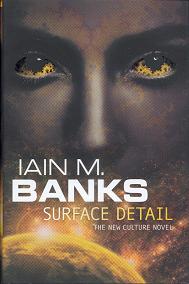
Cover of Surface Detail


Surface Detail
Iain M. Banks
627 pages
published in 2010

The problem with any new Culture novel is that they’ll never be as good as the original three — Consider Phlebas, The Player of Games and Use of Weapons. Back in the late eighties when these books were first published there was literally nothing like them; now we know what the Culture is like, what to expect from Banks and there are whole generations of sf writers who have been influenced by him writing similar sort of novels. Yet everytime I still hope that the next Culture novel is as good as the first three, which is unfair — even if it is, it won’t have the same impact.

But Surface Detail comes close. From his first published book, The Wasp Factory, Banks has had a reputation for writing well crafted but often repulsive scenes of violence and torture and here he surpasses himself. Because in Surface Detail he gives us a horrifying but all too plausible idea: what if you could use virtual realities to create the hells your religion says sinners should be cast down into? What if civilisations routinely went through a stage in their development when their technology was good enough to create simulations of hell, but their morality still primitive enough to actually want to subject people to them? One of the first scenes in the book shows what that would look like from the inside and it’s not for the squeemish; it actually gave me some bad moments reading it just before I went to bed. No cuddly fantasy hell this; imagine whole creative output of an entire species devoted to making up ever more cruel tortures, without end.
Read more…

Looking good


A Game of Thrones trailer. Looks good and more importantly, gets the essence of the books right.

The Ruin of the Roman Empire – James J. O’Donnell

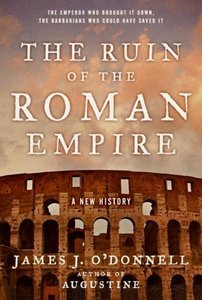
Cover of The Ruin of the Roman Empire


The Ruin of the Roman Empire
James J. O’Donnell
436 pages including index and notes
published in 2008

A few years ago I became interested in Roman history, especially with the later Roman Empire, what historians now call Late Antiquity, the period during which Rome supposedly fell. Supposedly fell, as the simple history we’ve been taught in school of barbarian invasions from the fringes of the Empire finally overrunning its heartlands, looting Rome and deposing the last true Roman Emperor in 476 CE, is of course wrong. That story is an invention, largely created by, as James J. O’Donnell put it, “a short, fat man”, Edward Gibbon, in his famous Decline and Fall of the Roman Empire, which codified this standard history of the fall of the Roman Empire. It was challenged in the early seventies, most famously by Peter Brown’s The World of Late Antiquity, as new research and new generations of historians started to question this old story. They found a Roman Empire and world that was severely challenged in the fifth century CE, but much more continuity between the old classical world and the new dark ages than there had been room for in the standard model.

Fast forward a few decades and the revisionists themselves are being corrected by later generations of scholars, e.g. in the books of Peter Heather and Bryan Ward-Perkins I’ve reviewed before. James O’Donnell’s entry on the subject, The Ruin of the Roman Empire is the most idiosyncratic so far I’ve read, aptly summed up by its subtitle: “The emperor who brought it down. The Barbarians who could’ve saved it.” The emperor is Justinian I, who wanted to make the empire whole again, the barbarians the supposed invaders who had taken over its western provinces. O’Donnell argues that if Justinian I had not tried to reconquer Italy and North Africa, but had concentrated his energies on his Eastern provinces and the border with Persia, something like the Roman Empire could’ve survived for longer than it did, if not an united Roman Empire. The fall of Rome in 476 CE was not the end of the Roman Empire.

Now read on.

Everything of value is vulnerable


And in a time of economic crisis it’s always easy to cut funding of arts and culture. Nobody dies because musea budgets are cut, symphonic orchestras disband or theatres are closed. Yet people do not live on bread alone and the necessity for slashing budgets the way the current Dutch government wants to do is debatable. It’s not the arts that have put us in debt, so why should it have to pay for the bankers’ crisis? Sure, there probably is some wastage, some dubious funding decisions that can be looked at, some ways to do more with less money, but we’re ruled by a government that takes pleasure from its own philistinism and the cuts are done for ideological reasons. It’s payback for the “leftwing church” that has supposedly ruled the Netherlands for decades enforcing its cultural norms on “Henk and Ingrid”, Wilders’ average Dutch couple. Bullshit of course, but popular bullshit at the moment — there’s always room for resentment against elitist artists.

Which is why the protests against these cuts need to get the public on board, get their sympathy. A good start was made last week, with public stunts like the flashmob performance of Mambo by the Dutch Radio Orchestra and the Radio Choir at Den Haag Central Station done to protest the closure of the Netherlands Broadcasting Music Center, shown in the video above. If the art world wants the cuts minimised or stopped, it needs to do more stuff like this, to show people why culture is important, even if it’s grossly unfair these cuts are planned at all.

(Video found at 24 Oranges.)