Fifty Essentials in Fifty Days 49: Essential Fantastic Four Vol. 07

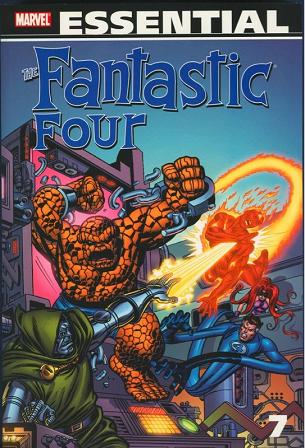
cover of Fantastic Four Vol. 07


Essential Fantastic Four Vol. 07
Gerry Conway, Roy Thomas, Rich Buckler, John Buscema and friends
Reprints: Fantastic Four #138-159 and more (September 1973 – June 1975)
Get this for: The FF enter the Bronze Age — three stars

For the penultimate entry in this series we got Essential Fantastic Four Vol. 7, the first volume to feature neither Jack Kirby nor Stan Lee. Instead Gerry Conway handles writing duties for most of the run collected here, both on the regular series and on the five Giant-Size issues also included. Roy Thomas takes over from him with #156, after a fill-in issue by Len Wein. The art is taken care of by John Buscema, then Rich Buckler.

The period of The Fantastic Four collected here is one I know relatively well, having read these issues in Dutch translation years ago, buying them for a guilder at a time from a market stall. These were doublesized with cardboard covers and like the Essential collections, in black and white, so I had something of a deja vu rereading this.

At the time I first read these issues I wasn’t what you call critical of what I read: if it had superheroes and villains, especially new ones, that was good enough for me. Rereading them again it’s clear that these are not nearly of the same quality as even the worst of the Lee/Kirby collaborations; they’re quite mundane in fact, for all their non-stop action and attempts to emulate Kirby’s creativity. Lee and Kirby created the Inhumans, the Watcher, the Kree and Skrulls, the Black Panther and Wakanda and so on, basically creating the whole Marvel Universe from scratch. With Conway, we get a race of abominable snowmen, who are reverted to normal humans at the end of the story — not quite the same, is it?

Not that Gerry Conway and later Roy Thomas were bad writers, but they missed the creative spark of the Lee-Kirby collaborations. Instead both fall back on reusing established villains and soap opera to hold the reader’s interest. So we get the return of the Miracle Man, last seen in issue 3, Annihilus and Doctor Doom on the one hand and the maritial problems of Reed and Sue Richards on the other. Most stories also take more than one issue to complete, not always a good thing. It’s not all bad: I quite like that very distinctive, early seventies energy these stories have and both Conway and Thomas keep them flowing, sweeping you along with them.

On the art side there’s little to complain off, with first John Buscema and then Rich Buckler as penciler. Again, if you compare them to Kirby, both are a bit on the bland side here and certainly Buscema had and has done better elsewhere. I think that , as with the writing, the art suffers a bit from being forced into the Marvel Housestyle, trying to ape Lee and Kirby when it would’ve been better if both had followed their own paths.

Essential Fantastic Four Vol. 07 collects a low period in the Fantastic Four’s existence, when the title was in a creative slump. There are some points of interest, but they’re few and far between. For me it was an exercise in nostalgia reading these issues, going back to a time when I was much less critical of comics and could still enjoy these kind of stories for what they were.
Living in the Future

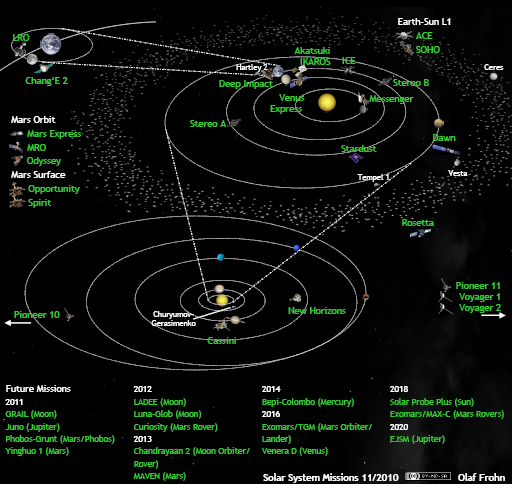
map of all current Solar System space missions

Emily Lakdawalla has her monthly post on the state of space exploration up once again and as always it’s an useful reminder that despite appearances, we are living in the future. One clue being sentences like ” I’m enjoying following the relatively active Twitter feed of Voyager 2, which also mentions the position of Voyager 1 once a day”. Who would’ve guessed in the dying days of the twentieth century that a decade later we would get status updates from a robot space explorer at the edge of our Solar System, through a medium usually portrayed as only being good for shallow gossip or self promotion?

It makes silly little arguments that the future died in 1998 because that’s when Disneyland embraced steampunk seem even more facile than they already were.

Fifty Essentials in Fifty Days 48: Essential Spider-Woman Vol. 01

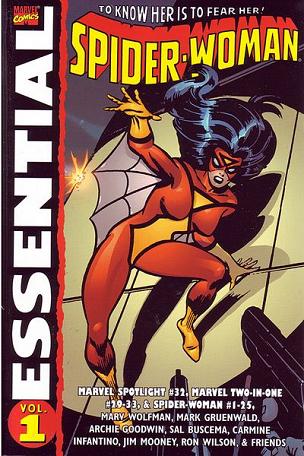
cover of Essential Spider-Woman Vol. 01


Essential Spider-Woman Vol. 01
Marv Wolfman, Mark Gruenwald, Michael Fleisher, Carmine Infantino and friends
Reprints: Marvel Spotlight #32, Marvel Two-in-One #29-33, Spider-Woman #1-25 (February 1977 – April 1980)
Get this for: quite good for a trademark grab — four stars

Spider-Woman, like fellow late seventies heroes Ms. Marvel and She-Hulk is one of those superheroes who you suspect to have only been created only to safeguard a trademark. This may be a bit too cynical and certainly her solo series was actually quite good, if suffering from some of the usual defects common to series with a female lead. One point that worked in her favour from the start is that she might share her name with Spider-Man, neither her powers nor herself were related to him; she was more than a weak copy of him. She managed a quite respectable run on her series, fifty issues and Essential Spider-Woman Vol. 1 collects half of it, as well as her first appearances in Marvel Spotlight #33 and Marvel Two-in-One #29-33.

Spider-Woman was created by Archie Goodwin and Sal Buscema, but it was Marv Wolfman who guided her through her early days, first in Marvel Two-in-One and the first eight issues of her own title. He makes her into Jessica Drew, a somewhat confused young woman, with barely any knowledge of her own past, which is explained by her having been in suspended animation for years, having almost died from radiation poisoning and been injected with a spider venom serum to save her. For the first two issues of her solo series she still runs around in England, where she was left after having teamed up with the Thing in Marvel Two-in-One, but from the third Wolfman relocates her in L.A., far away enough from other superheroes to not let them crowd her style.

Something a SHIELD agent supporting cast member by the name of Jerry Hunt does enough already, playing the clinging love interest disapproving of Jessica’s activities as Spider-Woman. He sticks around for about sixteen issues, though less and less so even when Wolfman was still writing it. He’s just annoying and dull and like Magnus, the mysterious older magician gentleman also hanging around Jessica, he takes away some of her lustre. Another thing that hampers her appeal in these early issues is how often Spider-Woman has to play the victim: be knocked out, tied up and having to be rescued by others, compared to what male heroes go through. Once Mark Gruenwald and later Michael Fleisher took over, this fortunately happened much less.

Villainwise Spider-Woman has a reasonable rogues gallery here, mainly with brandnew villains like the Brothers Grimm, the Hangman and the Needle, the Gypsy Moth, not to mention Morgain Le Fay, who would become her personal nemesis. Her villains tend to be either somewhat on the grotesque side like the lot I just mentioned, or more mundane gangsters and crooks. The latter start to dominate once Spider-Woman starts her career as a bounty hunter. Few already established villains paid a visit to Spider-Woman, the most important one being Nekra, the old Steve Gerber Daredevil villain, who hoped to use Spider-Woman’s powers for herself.

The stories are fairly simple, with few subplots. Characterisation changes a lot between writers, Marv Wolfman having established her as being sexually alluring to men but hideous to women, which Gruenwald did away with by getting her a special medicine that suppressed the pheremones that supposedly had this effect.

On the art front, the series starts with Carmine Infantino, who’s a long way down from his sixties DC heights, but still a consumate professional. There are a few fillins by Frank Springer and Trevor von Eeden as well, none very good. Sadly the best art is in the last issue presented here, by Steve Leialoha, whose fluid, stylised Michael Goldenesque art style works well with Spider-Woman.

Essential Spider-Woman Vol. 01 is a decent collection of stories, none of which really set the world on fire when first published and with the best of her series yet to come.

Fifty Essentials in Fifty Days 47: Essential X-Men Vol. 07

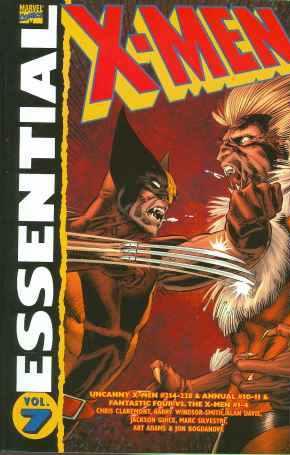
cover of X-Men Vol. 07


Essential X-Men Vol. 07
Chris Claremont, Marc Silvestri, Jon Bogdanove and friends
Reprints: X-Men #214-228, #Annual 10-11, Fantastic Four v X-Men (February 1987 – April 1988)
Get this for: X-Men at their nadir — three stars

Let’s talk about why the X-Men went sour. Because it did turn sour, didn’t it, at some point in Claremont’s long, long run on Uncanny X-Men. At some point the long drawn out subplots no longer intrigued and mystified, but annoyed, the relentless grinding misery and inability of the X-Men to win their battles started to grind you down as well and the title just seemed to devolve into an endless series of inconclusive battles with ill defined villains. Different people reach this point sooner or later with Claremont, for me rereading some of the stories in this volume it was reached here.

I have to be honest however. Back when I first started following the X-Men, I got going with issue 220, the start of the whole Adversary Saga that was in itself turn of the socalled Fall of Mutants, the big 1988 Summer event in the mutant titles. At the time, dropping in with little real knowledge of the X-Men, I loved this story. Rereading it in context, it now serves as the climax of a long, painful two years of stories in which the X-Men only got more and more hurt. Especially the Fantastic Four vs. the X-Men limited series in retrospect is excruciating in its doom and gloom.

In that miniseries the X-Men call on Reed Richard’s scientific expertise to help save Shadowcat, stuck in phasing mode and slowly disappearing, but he’s uncharacteristic unsure of himself, the result of a longterm psychological trap set by Doctor Doom. Things get worse, the X-Men and Fantastic Four come to blows, Reed’s teammates desert him and Shadowcat’s fate seems sealed… But that psychological trap of Doom’s — a pre-FF journal supposedly written by Reed that shows he planned to turn himself and his friends into the Fantastic Four rather than it being an accident — just doesn’t work for me this time. It’s out of character for the Fantastic Four to believe this so suddenly, or for Reed not to realise it’s a fake straight away. Meanwhile the antagonism between them and the X-Men doesn’t ring true either. For one, Claremont had Johnny Storm use the word “muties”, which just doesn’t fit his character at all. He may be a hothead, but not a bigot.

In the main title, the X-Men are still recovering from the Mutant Massacre and their battles with the Marauders and still in disaster recovery mode. They’re still only reacting to threats, not gaining anything, though slowly trying to rebuild the team. Even then things go wrong, as when they recruit Havok, yet lose his girlfriend, Polaris, to the Marauders. It’s incredibly frustrating to read issue after issue of this sort of halfwins or outright defeats for the X-Men, especially since Claremont is a good enough writer to still make you care for them. That’s the worst part, those glimpses of how good Claremont can be when not obsessed with doom and gloom.

The art in this volume is a mixed bag, with a series of guest artists — Barry Windsor Smith, Alan Davis, Jackson Guice — before The Uncanny X-Men settles with Marc Silvestri, whose very very scratchy, semi-realistic style is quite different from John Romita Jr.’s art in the previous volume, but as good in its own right. So is Jon Bogdanove, on the Fantastic Four vs. the X-Men limited series, who has a more “cute” style. It makes for a less united look to this volume, but then these were never intended to be collected together in the first place…

So yeah, a frustrating, annoying final volume of Essential X-Men to be reviewed in this series. Yet Claremont still manages to hook me here, the bastard.

Fifty Essentials in Fifty Days 46: Essential Silver Surfer Vol. 02

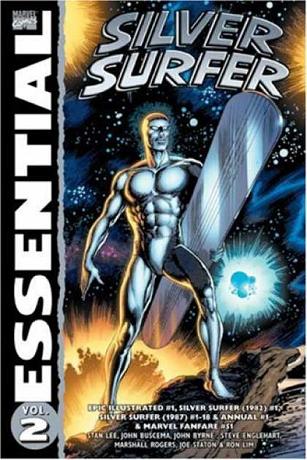
cover of Essential Silver Surfer Vol. 02


Essential Silver Surfer Vol. 02
Steve Englehart, Marshall Rogers, Joe Staton, Ron Lim and friends
Reprints: Silver Surfer Vol. 2 #1, Silver Surfer v3 #1-18, Annual 1
Get this for: the Silver Surfer is back in space — three stars

From one classic Steve Englehart series to another, not quite as classic one. The Silver Surver’s second series would be quite different from the original Stan Lee & John Buscema one, if only because Englehart freed him from his imprisonment at Earth in the very first issue. But the main difference was best summed up in an Amazing Heroes observation, that whenever in his original series the Surfer would wax philosophically about man’s inhumanity to man, in his new series he waxes hornily about Shalla Ball, Nova or Mantis…. Englehart made the Surfer more lighthearted, more cosmic than he had been in his old series, while, as the mention of Mantis suggests, also revisiting his own personal obsessions. Joined by his old Batman partner Marshall Rogers on the art, the 1987 Silver Surfer series is quite different from its 1968 predecessor and to me much more interesting.

But Essential Silver Surfer Vol. 02 does not quite start there. While sensibly not including the myriad guest appearances of the Surfer over the years, this volume does start with two stories featuring the old Surfer: a short story from Epic Illustrated and the Stan Lee scripted, John Byrne plotted and pencilled 1982 Silver Surfer one shot. The latter saw Reed Richards freeing the Surfer from his cosmic imprisonement on Earth, return to Zenn-La and his old love Shalla Ball, only to discover his planet almost destroyed and Shalla Ball a prisoner of Mephisto. He manages to free Shalla Ball and revitalise Zenn-La, but at the cost of his freedom, yet again. It’s a good story, but typical of everything that made the original series a failure in the end: the Surfer doesn’t work on Earth.

Englehart understood that and also understood the potential of having a proper space based series, something not really seen at Marvel before. In issue one he got the Surfer off Earth and free of Galactus, in issue two he cut his ties to Zenn-La and Shalla Ball and by issue three he had reintroduced Mantis, seen for the first time since she became the Celestial Madonna, as well as set up the storylines that would drive the series for its first year and beyond. Building on the loss of the Skrulls’ shape-shifting power established in the 1985 Avengers and Fantastic Four annuals, Englehart has the Skrull empire descend in chaos, with one of the pretenders of the throne launching the second Kree-Skrull War. Meanwhile the Elders of the Universe are gunning for the Surfer, wanting to keep him from helping Galactus, who they wanted to kill.

Why they wanted to kill him does not become clear until a few more issues along, as Englehart also draws in the Supreme Intelligence of the Kree and the Infinity Gems, here still called the Soul Gems, into the Elders’ plot. This seems to have run out of steam with #109, as Galactus eats five of the Elders while the other three are drawn into a black hole, but this turns out to be premature. In issue fifteen Ron Lim replaces Marshall Rogers and Joe Staton on the art, while Sue and Reed Richards are recruited by the Surfer to help Galactus recover from his “cosmic indigestion” caused by the Elders of the Universe he ate…

Ron Lim is well suited to the Silver Surfer, which was his breakthrough series as well. He has a good style for cosmic battles and I’ve always liked his art, buff as it is. Not that Marshall Rogers was bad, with his more gracious, elegant style. Inbetween them is Joe Staton, who cut his cosmic teeth on Green Lantern, including a long run with Englehart. I like his art, but not here.

Essential Silver Surfer Vol. 02 ends with a curiosity, an issue of Marvel Fanfare that published what was going to be the first issue of a twelve issue, double sized Silver Surfer limited series, before that metamorphed into a ongoing series. That limited series was also going to be written by Englehart, but with art by John Buscema and with the Surfer left stranded on Earth, but still meeting with Mantis and getting drawn in cosmic developments. It’s an interesting view of what could have been, but fortunately never came to pass.