Fifty Essentials in Fifty Days 34: Essential Fantastic Four Vol. 04

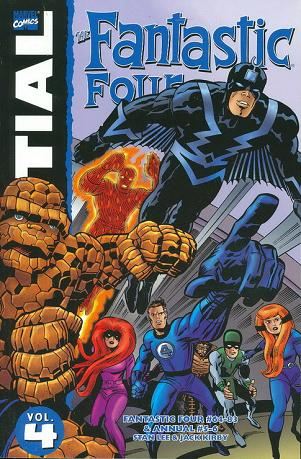
cover of Essential Fantastic Four Vol. 04


Essential Fantastic Four Vol. 04
Stan Lee, Jack Kirby and friends
Reprints: Fantastic Four #64-83 and Annual 5-6 (July 1967 – February 1969)
Get this for: Lee and Kirby at the peak of their game still — Five stars

I’m sorry, but I have to repeat the praise from last time: gods, Stan Lee and Jack Kirby were good together on The Fantastic Four. With the start of this volume they’ve already had more than sixty issues behind their belts and you’d expect that, especially after the creative burst of the last ten-fifteen issues that the pace would slacken a bit, but nothing is further from the truth. They keep on expanding the Marvel Universe, first with the coming of the Kree, including the Kree Sentry and Ronan the Accuser, then with the origin of what would later become Adam Warlock, finally with the discovery of Subatomica. Not to mention the birth of Sue and Reed’s son…

But there are also adventures with old friends, like the Inhumans and the Black Panther and old villains like the Mad Thinker and the Wizard return too. Apart from the Kree Sentry and Ronan, the only real new villain is Psychoman, introduced in Annual #5. There’s plenty of action and conflict here, but the focus does not lie on fighting supervillains, something which the Fantastic Four at any rate has never been about. The FF is at its best confronting some cosmic menace or going on a voyage of discovery, not handling the same villains that could also be menacing Iron Man next week.

There’s not much to say about the stories here, to be honest, that I haven’t said before. Lee and Kirby know these characters inside out, they know how they will respond in any situation they put them in. There’s always a bit of argument of who did what on these series and it’s no great secret that it was largely Kirby’s imagination that made The Fantastic Four so special. He gets to go wild again with Subatomica and the story introducing Him, who would later become Adam Warlock. His design work and sense of grandeur remain unsurpassed.

As does the rest of his art. It’s the cosmic decors and bizarre creatures and villains everybody remembers from Kirby, but his quiet moments are great too. He can get so much emotion from a few subtle lines in a character’s face, especially with the Thing, who wears his heart on his sleeve. You will never mistake one Kirby character for another. His story layout is excellent too, great sense of pacing and with everything he does in service to the story.

One thing that did annoy me about this volume was the neglect of the Invisible Girl, who had married Mr Fantastic the previous volume and who was now kept out of the action by her over anxious husband. It reflects the mores of the time that Sue, as a married woman, would need to be protected and kept away from danger but it comes over as incredibly sexist in retrospect. Things get worse when she’s pregnant. Obviously then she cannot join them on missions anymore, but the other three members keep her completely out of the loop for a time. There’s also Crystal, Johnny’s Inhuman girlfriend whose powers are arguably greater than any of the Fantastic Four, yet is completely wasted in most of the stories here…

That quibble aside, this is another perfect volume.
Fifty Essentials in Fifty Days 33: Essential Defenders Vol. 02

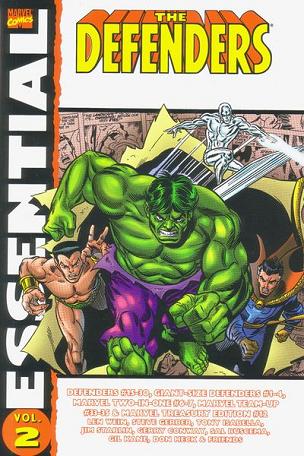
cover of Essential Defenders Vol. 02


Essential Defenders Vol. 02
Steve Gerber, Sal Buscema and friends
Reprints: Defenders #15-30, Giant-Size Defenders #1-5 and much more (July 1974 – December 1975)
Get this for: Gerber and Marvel’s only non-team team — four stars

The Defenders is one of the …odder… ideas for a title Marvel ever had. Take four heroes never known for being easy to work with, with nothing in common and make them into a “non-team”. Sure, the Silver Surfer, Hulk, Doctor Strange and Namor the Submariner all are “big guns”, but putting them together in one series, especially the Hulk? Hadn’t Marvel learned that lesson with The Avengers? And yet… It worked sort of, worked enough to get them their own series after a trial out in Marvel Feature but at least to me it never really gelled until a certain Steve Gerber joined the title…

Essential Defenders Vol. 2 contains the first half of Gerber’s run on The Defenders, but it starts with Len Wein on writing duties. Wein treats the Defenders as a fairly standard superhero team, having them e.g. fight Magneto and the Wrecking Crew. Once Gerber takes over things get weirder, more offbeat, slightly more existentialist. By this time only the Hulk and Doctor Strange remained of the original team, with Valkyrie and Nighthawk as new members, plus various co-stars, including Yellowjacket, Daredevil, Luke Cage and the Son of Satan. That core group of the Hulk, Doctor Strange, Valkyrie and Nighthawk works well together, especially with the Hulk softened up a bit to make him more of a teamplayer.

Now The Defenders used to be my favourite Marvel team back when I first started to read superhero comics and the Gerber stories collected here were one of the reasons why. Two stories in particular stand out. The first is the Defenders clash with the Sons of the Serpents, Marvel’s go-to club of dimwitted but dangerous racist tools. Here once again the twist at the end of the story is that the guy using them is *gasp* Black and only using them for their own personal gains, as it was more or less in their earlier Avengers appearances. What Gerber does differently is to pay more attention to the damage done by the Serpents, has more of an eye for the reality of America in the Seventies than earlier writers using the Serpents had.

The other story is the Guardians of the Galaxy story that ran from Giant-Size Defenders #5 to Defenders #29, which turned me into a fan of them as well. Especially interesting there is issue 26, which has a recap of how the far future of the Guardians came into being, complete with trademark Gerber social commentary — “we valued dry armpits and the three billion dollar aerosol industry over our flowers, our food and ultimately our health” — as the depletion of the ozone layer leads to the widespread use of bionics by the mid-eighties…. Gerber also manages to tie-in the old Killraven series into this future history by the way.

The volume ends with Gerber’s most famous creation, Howard the Duck teaming up with the Defenders in Marvel Treasury Edition #12, which I found to be a bit meh. Howard is an acquired taste and for the most part has aged badly, apart from in a few classic stories. He’s just too seventies. Gerber does much better with the Defender’s characters: more so than any other team you feel that the core members are friends just hanging out rather than coming together to fight crime, which I’ve always found appealing.

The art throughout the volume, with some exceptions including a great issue by Gil Kane, is by Sal Buscema, who is not at his best here. It’s serviceable, rather than good. His pedestrian art undermines some of the pizazz of Gerber’s writing; you’d want a more interesting artist to interpret his plots like on Man-Thing or Howard the Duck. On the other hand there is the fact that Sal Buscema’s style is easy to understand, clean and clear and for a somewhat more mainstream title like The Defenders this may be a more suitable style.

The best of Gerber’s Defenders is still to come and not in this volume, but it’s a great starting point for the series. Most of the bugs have been taken out of the series here and you get the start of what made The Defenders tick for so long.

Women writing science fiction!

What Martin said. But. Here’s my own record on reading female science fiction writers during the last ten years (2001-2010):

  • Serpent’s Reach — C. J. Cherryh
  • Pride of Chanur — C. J. Cherryh
  • To Say Nothing of the Dog — Connie Willis
  • The Sparrow — Mary Doria Russell
  • Frankenstein, or the Modern Prometheus — Mary Shelley
  • Shards of Honor — Lois McMaster Bujold
  • Tea from an Empty Cup — Pat Cadigan
  • Sideshow — Sheri S. Tepper
  • Picnic on Paradise — Joanna Russ
  • Dervish is Digital — Pat Cadigan
  • Sign of the Labrys — Margaret St. Clair
  • In the Garden of Iden — Kage Baker
  • Sky Coyote — Kage Baker
  • Diplomatic Immunity — Lois McMaster Bujold
  • Nine Layers of Sky — Liz Williams
  • Heavy Time — C. J. Cherryh
  • Hellburner — C. J. Cherryh
  • Mendoza in Hollywood — Kage Baker
  • Ammonite — Nicola Griffith
  • 1610: a Sundial in a Grave — Mary Gentle
  • Farthing — Jo Walton
  • The Secret of Sinharat — Leigh Brackett
  • People of the Talisman — Leigh Brackett
  • The Best of C. L. Moore — C. L. Moore
  • Cetaganda — Lois McMaster Bujold
  • Ha’Penny — Jo Walton

For comparison, the complete list of science fiction read in that time. that’s twentysix books by female authors out of a total of roughly 300 books, or less than ten percent. In other words, it would be a bit cheeky to join in the discussion about the real or percieved rarity of female science fiction writers and the lack of recognition they get considering how bad my own record is. There are reasons for this gender imbalance in my reading of course: most of my favourite writers just happen to be male, I at any rate tend to cluster my reading, with some writers (like Charlie Stross or Poul Anderson) getting a lot of repeat custom, which doesn’t help either. It’s not therefore that I deliberately avoid female science fiction writers, more that my unstructured reading for pleasure means my reading is biased unconsciously towards male authors.

If I want to do something about this, I have to consciously balance out that bias, by forcing myself to seek out women writers rather than just reading what I want. I don’t have to do that of course, but if I am worried about this gender imbalance in my favourite genre of fiction, I need to walk the walk as well as talk the talk.

So… Any suggestions?

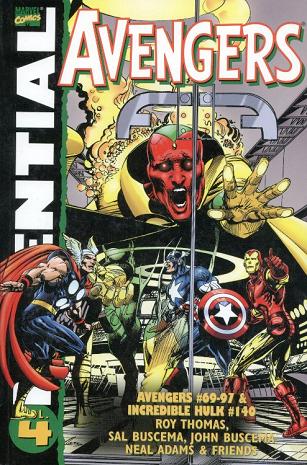
Fifty Essentials in Fifty Days 32: Essential Avengers Vol. 04

cover of Essential Avengers Vol. 04


Essential Avengers Vol. 04
Roy Thomas, John and Sal Buscema, Neal Adams and friends
Reprints: Avengers #69-97, Incredible Hulk #140 (October 1969 – March 1972)
Get this for: Roy Thomas’ best work — five stars

I learned two things from Essential Avengers Vol. 04: Roy Thomas’ dialogue was still pretty much influenced by Stan Lee and he was overtly fond of the word “stripling”. But this innocent peccadillo can be forgiven, as Thomas is the first writer to release The Avengers‘ full potential, unleashing the first classic cosmic crossover: the Kree-Skrull War! It’s the climax of an incredible volume, in which Thomas mixes both standard supervillain threats with more outlandish foes, keeps up the pace throughout but does not neglect the personal either.

The volume starts almost as strong as it ends, with the first great Kang the Conquoror/Grandmaster story, using the Avengers as pawns in their cosmic chess game, introducing the Squadron Sinister, the first of two Justice League of America pastiches. It’s a great, fun story which also reveals one of Thomas’ obsessions, WWII/Golden Age heroes, as the climax of the story takes place in Paris 1941 and features the Golden Age Captain America, Namor and the Human Torch, amongst others. A second great cosmic story is the twoparter with Arkon the Imperiator, the leader of a barbaric world from another dimension, who wants to destroy the Earth in a nuclear holocaust to save his own home planet.

As said, Thomas also has more mundane supervillains threatening the Avengers, with several old foes (the Grim Reaper, Living Laser, Swordsman, Whirlwind and the Man-Ape teaming up as the Lethal Legion to destroy the Avengers together. There’s also the threat of Zodiac, an Astrology based criminal army as well as Cornelius van Lunt, the businessman who seems to finance them. Zodiac is an enemy that returns a few times, first seen in #72, then again in #77 and for the third time in #80-82. They’re not the only ones to return to plague the Avengers once more: Arkon is another villain to pop up again.

The same goes for the JLA pastiches, as in issue 85 and 86 four Avengers travel to a parallel Earth where they meet the Squadron Supreme, with quite obvious stand-ins for several heroes from the Distinguished Competition: Hawkeye (Green Arrow), Thom Thumb (the Atom), Lady Lark (Black Canary), American Eagle (Hawkman), Dr Spectrum (Green Lantern) The Whizzer (Flash), Nighthawk (Batman) and Hyperion (Superman). Nighthawk also turns up in #83, the Rutland Halloween Parade as the costume worn by Tom Fagan. Rutland’s Halloween parade would feature in quite a few Marvel and DC comics books during the seventies, sometimes even forming unofficial crossovers as Fagan was a lifelong comic book and science fiction fan and friends with writers like Thomas, Len Wein and Steve Englehart. It’s one of those neat traditions that has sadly fallen by the wayside since.

Speaking of science fiction, this collection also features the two issue Harlan Ellison written crossover between The Avengers and The Incredible Hulk and sadly it hasn’t aged well. More attention seems to have been paid to horrible puns riffing on Ellison short stories than to a real plot, but at least it did introduce Jarella and the subatomic world she lived on to the Hulk. I can see why people would’ve been exited to see an established and well respected writer like Ellison dabbling in comics, a sign that comics had grown up, but almost forty years on it feels like stunt casting.

Something else that hasn’t aged well is Roy Thomas continuing attempt to put some relevance in The Avengers. So in issue 73-74 the Sons of the Serpents are used once again to talk about race matters and how both sides are equally wrong and manipulated by greedy men for their own gain. Issue 83 is no better, featuring an equally heavy handed approach to “women’s lib”, as several female superheroes decided the best way to advance feminism is to destroy the Avengers as male chauvinist pigs, under the influence of the Enchantress disguised as the Valkyrie. It’s all written from a well meaning liberal point of view, but it’s politically naive and ultimately supportive of the status quo and the myth that America is a land of opportunity for all, evidence be damned.

And then there is the Kree-Skrull War, running from Issue 89 to issue 97, one continuing story and if I remember correctly then the longest story ever told in a Marvel Comic. Thomas takes the two longstanding alien threats from Fantastic Four and Captain Marvel, mixes in the Inhumans as well as unsubtle analogies to the 1905ties communist witch hunts and of course his own obsession with Golden Age superheroes and makes it all work.

What helps a lot in selling it all is having Neal Adams coming aboard for the artwork. Not that the art has been bad up until then, with John and Sal Buscema spelling each other on art duties until then, but Adams kicks it up a notch. All three artists are good at showing the grandeur and the glory of the Avengers, each in his own way is more than able to visualise the battles and settings Thomas comes up with, but everything Adams does is just that little bit more special. It’s this that makes the Kree-Skrull War special, something every other Avengers writer will try to emulate and top from then on, rather than just another good Avengers story like e.g. the Kang-Grandmaster clash earlier in the volume.

So yeah, for some of the best of what The Avengers could be, this is the volume you need.

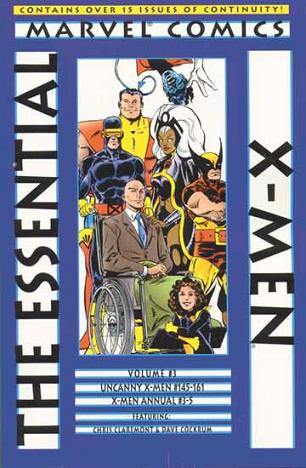
Fifty Essentials in Fifty Days 31: X-Men Vol. 3

cover of Essential X-Men vol 3


Essential X-Men Vol. 3
Chris Claremont, Dave Cockrum and friends
Reprints: Uncanny X-Men #145-161, Annual #3-5 (May 1981 – September 1982)
Get this for: more cosmic adventures with the X-Men — four stars

What a difference an artist makes. Was the previous volume of Essential X-Men all about John Byrne, in this volume Dave Cockrum is back and the X-Men change with him. Chris Claremont may have been the driving force behind The Uncanny X-Men for seventeen years, but he always adapts to his artists. With Byrne the stories were much more “realistic”, if that’s the right word to use about a series featuring mutant superheroes battling villains for the fate of the Earth or the Universe. As Cockrum comes aboard, the stories become more swashbuckling, less restrained and also somewhat less grim. Though to be honest, the X-Men still have difficulty winning their fights.

Claremont eases up a bit on the interconnectness of the stories in this volume, though various subplots do keep popping up from time to time. The most persistent of this is of course the whole issue of mutant prejudice, the reason why the X-Men existed in the first place. It’s far less in the foreground than under Byrne however. Apart from the X-Men’s climatic fight with Magneto leading up to issue 150, prejudice against mutants is kept in the background. With Cockrum back, the X-men fight menaces such as Doctor Doom and Arcade (#145-147), the mutant Caliban (148), Magneto (149-150), the Hellfire Club (151-152), Rogue (158), Dracula (159) and Belasco (160), the last two stories featuring artwork by Bill Sienkiewicz and Brent Anderson respectively. And of course, if Cockrum is back, the Shi’ar and the Starjammers can’t be far behind and indeed they feature in issues 154 to 157, with consequences lasting much longer.

Now the usual cliche about the X-Men under Claremont has always been about “heroes fighting to save a world that loathes and hates them for being mutants”, about fighting to prevent the future glimpsed in “Days of Future Past”. It all fits nicely with the original reason for the X-Men, of showing normal humans that mutants could be trusted and you wouldn’t think intergalactic space opera fits in with this and yet here we are again. There’s a plot against Lilandra, empress of the galaxy spanning Shi’ar empire and of course professor Xavier’s lover and Corsair of the Starjammers (Cyclops’ dad) comes to Earth looking for help, followed by a nasty new enemy: the Brood. They’re helped by an old Ms Marvel villain, Deathbird, also revealed to be of Sh’iar royal blood. It takes the X-Men three issues to defeat Deathbird and her co-conspirators, though they will be back in the last issue collected here, which is the leadin to the Brood Saga proper.

It’s not just space opera that the X-Men can be adapted to, as the two issues with Dracula and Belasco show, again feature enemies with no connection whatsoever with the supposed theme of Uncanny X-Men. The latter story however does showcase several of Claremont’s traits, to with his use of foreshadowing and his inability to let the X-Men properly win their fights. In the story Belasco kidnaps Illyana, Colossus kid sister, from the strange island in the Bermuda Triangle the X-Men now had made their headquarters. The X-Men go to her rescue and end up in Limbo, where they come across gruesome reminders of what might be their future: a Wolverine skeleton, a corrupt Nightcrawler in service to Belasco, an older Collossus who died impaled in Belasco’s palace. They manage to fight and win back Illyana, but when Kitty Pryude pulls her out, she lets go for a second and when she reaches her again, she has aged seven years — to find out what happened, you had to have read the Magik miniseries that Claremont would write later.

The X-Men then win the fight against Belasco, but he still has the last laught. Equally undecisive are their battles with Doom and Arcade as well as the Hellfire Club. They may be defeated, but are left alone to make more trouble later on. This is much more so the case than with any other superhero title, each of which has to strike a fine balance between giving villains their just desserts and leaving enough of them around to provide future menace. In the X-Men’s case it at times seems as if they’re never allowed to win their battles outright, always end up having to pay the price. It’s one of the things about Uncanny X-Men that would become incredibly frustrating to me over time, though here it has not reached that point yet…

Essential X-Men Vol. 3 ends with three annuals, slightly different stories with different artists, the first one featuring George Perez even. Each stands alone and offers some welcome change of pace for the X-Men. They round off the volume nicely.