Hitler’s Empire – Mark Mazower

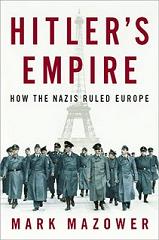
Hitler's Empire


Hitler’s Empire: How the nazis Ruled Europe
Mark Mazower
726 pages including index and notes
published in 2008

“Germany could have racial purity or imperial domination, but it could not have both.”

That’s the fundamental paradox that Mark Mazower uncovers in Hitler’s Empire: How the Nazis Ruled Europe. On the one hand, there is the Nazi’s obsession with making Germany a pure Aryan state, expelling or murdering the lesser races within its borders. On the other, their equally compelling obsession to rule Europe, or at least “reunite” all those parts of Greater Germany outside the German borders. But with the Anschluss of Austria, the annexation of the Sudetenland, the further invasion of what was left of Czechoslovakia, not to mention the invasion of Poland, it brought not just many more Germans, but also millions of Poles, Czechs, Jews and others under Nazi control. The question was, what to do with them and the somewhat accidental empire Nazi Germany had acquired.

Read More…

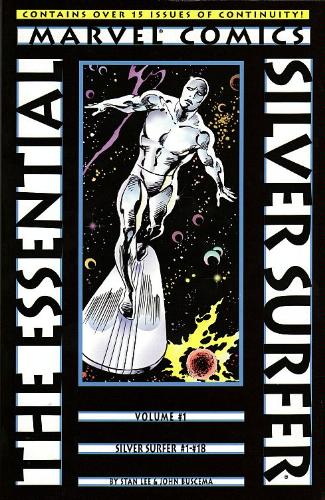
Fifty Essentials in Fifty Days 23: Essential Silver Surfer Vol. 1

cover of Essential Silver Surfer Vol. 1


Essential Silver Surfer Vol. 1
Stan Lee, John Buscema and friends
Reprints: Silver Surfer #1-18 (August 1968 – September 1970)
Get this for: whiny Silver Surfer is whiny — four stars

The Essential Silver Surfer Vol. 1 is one Essential collection I dreaded rereading, because I knew that it collected the original Silver Surfer series of the 1960ties, written by Stan Lee and drawn by John Buscema. I also knew that in Lee’s hands, the Surfer’s personality was a bit … melodramatic and self-pitying, shall we say? Throughout the series he’s flying around the world, his noble brow creases with the sorrow of being exiled on Earth away from his beloved Shalla Bal, amongst a hopelessly primitive race of barbarians suspicious of each other and of him. Every other issue sees him get caught up in a fight not his own, as people respond with aggression, hatred and fear against him. It is somewhat tedious reading just one issue, let alone all eighteen of that first series.

Now I’m sure the story of how the Silver Surfer came to be is well known enough not to tell again; how when Stan Lee got the first pages back for Fantastic Four #48 with the first appearance of Galactus, there was a second figure there, a silver figure on a silver surfboard added by Jack Kirby, how Lee got enamoured of him and give him a bigger role in the story and brought him back a few times as a guest star. His solo series was a logical outgrowth of this: the Surfer had always been popular in his appearances and for Lee it was a chance to do something different, from the heart. This was a prestige project for Lee, which is also why the first seven issues were doublesized, 68 pages rather than the usual 32.

Sadly it failed however. The series was no success and with the eight issue became a normal, 32 page sized comic, but only lasted for ten more issues. Issue 18 would be the last, ending on a cliffhanger. The unusual — and expensive — format cannot have helped, but I think the general mopiness of the Surfer himself was the greatest culprit. He was just too depressed and depressing and much more so than any other Marvel hero, seemed to exist in a state of stasis, never catching a break and nothing ever changing for him. He alternates between wanting to be accepted by humanity and wanting nothing to do with us and it’s all a bit tedious.

What makes up for this, more than made up for this even, is John Buscema’s art. I love his late sixties, early seventies style, also seen on Fantastic Four and Thor after Kirby had left those titles. His figures are all bold and imposing, his heroes standing widelegged and ready for action, his villains looming and smoldering with hidden menace. And while the men are handsome or brutish, his females are all beautiful. Buscema’s best work on the series may have been issue four, which saw the Surfer being manipulated by Loki to take on the Mighty Thor. Buscema has great fun drawing all the Norse gods as well as the battle between these two heavyweights.

The switch back to the normal thirtytwo page monthly comics format did not do the series well. Lee had less room for his (unsually even for him) verbose stories, while with the pressures of a monthly series the art started to suffer as well. In the first seven issues John Buscema had been inked first by Joe Sinnott, then by his brother Sal Buscema, both enhancing his art. From issue eight however he was inked by Dan Adkins and that combination is decidedly weaker. I’ve never liked Adkins, who I’ve never seen do anything interesting either as a penciller or an inker. Here he weakens Buscema’s penciling, overshadowing it with his mediocre inks.

Essential Silver Surfer Vol. 1 is the collection of a flawed series, interesting as such if somewhat of a slog to get through and much redeemed by the great artwork.

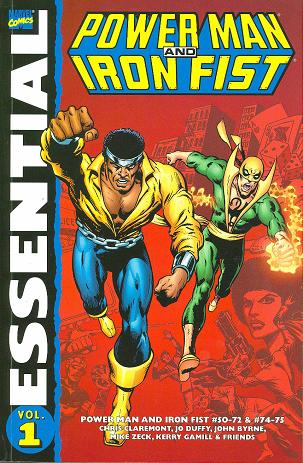
Fifty Essentials in Fifty Days 22: Essential Power Man and Iron Fist Vol. 01

cover of Essential Power Man and Iron Fist Vol. 1


Essential Power Man and Iron Fist Vol. 1
Chris Claremont, Jo Duffy, Trevor Von Eeden, Kerry Gammill and friends
Reprints: Power Man and Iron Fist #50-75 (April 1978 – November 1981)
Get this for: a series that should not work, but does — four stars

Right. Back in 1972 Marvel launched a series called Hero for Hire, starring Luke Cage, Marvel’s third Black superhero after Black Panther and the Falcon and the first African-American superhero to get his own title. Depending on your outlook this was either a noble experiment to broaden diversity in comics or a cynical attempt to cash-in on the blacksploitation craze of the early seventies. In any case it never was a great series — white writers trying to write a “gritty” Black hero within the confines of the Comics Code– but popular enough to be kept going for a few years.

There was also another seventies Marvel title born out of a craze, the Kung Fu craze in this case: Iron Fist, starring white boy Danny Rand who had learned the secret of the iron fist from the mystical city K’un-Lun. And when both titles got into problems in 1977, some bright spark got the idea to combine them. Iron Fist was cancelled, he and his creative team joined Power Man and with issue fifty it became Power Man and Iron Fist.

Essential Power Man and Iron Fist Vol. 1 starts with that issue by Chris Claremont and John Byrne: the first would stay on for a few more issues, the latter left after this one. After Claremont left as well Ed Hannigan took over writing duties for two issues, but with #56 Power Man and Iron Fist had the writer who would guide the title the longest: Mary Jo Duffy. She would make the series work, establishing the formula that would guide the later writers on the title while building on the work Claremont and Hannigan had already done. They had created the bare bones, Duffy would flesh it out.

Because really, this is not a title that should work. Power Man and Iron Fist had nothing in common until they were shoved together. The gritty inner city Luke Cage, born and bred in Harlem, never quite comfortable leaving his neighbourhood and the white multimillionaire boy who grew up in an extradimensional city and learned to fight there, somewhat naive about the Big City. It was pure commercial motives that mashed them together, but it worked. They might have been an odd couple but they complemented each other and also had the advantage of a strong supporting cast, including fellow heroes Misty Knight and Colleen Wing, Bob Diamond of another old kung fu series sons of the Tiger and others. The series also benefited from a strong sense of place: it’s recognisably New York and Harlem, but not the New York of e.g. Spider-Man or Daredevil. It does make use though of non-series specific supporting cast like D. A. Towers, somebody who could pop up in any late seventies/early eighties Marvel superhero title set in New York and often did. I miss this sort of thing.

Mary Jo Duffy (just plain Jo Duffy later on) is a writer who’s been somewhat overlooked. She has never quite has had the break to become as well known as say Kurt Busiek (to name another PM/IF alumnus), never quite had a hit series that was uniquely hers. Power Man and Iron Fist came closest. She does very well establishing a good mixture of soap opera and superheroic action that was the hallmark of late Bronze Age Marvel and there wasn’t any issue in this collection that was a chore to read. She has a good blend of supervillains and more mundane threats, sometimes overclassing our heroes completely, as with the Living Monolith in #56-57. No real classic villains, but no duds either.

The art throughout the volume is good. It starts on a high point with that one Byrne issue, moves through Mike Zeck, Sal Buscema and Lee Elias before settling in for a more extended run by Trevor von Eeden (who still has some Byrne influences visible here), which is followed by a fill-in issue by Marie Severin until finally Kerry Gammill sets in for the long haul. Gammill is an artist who like Duffy never quite made it into the big time, never an “exciting” artist, but certainly a good artist here. His realistic, no nonsense style, ably inked by Ricardo Villamonte, suits the series well. It’s completely in service to the story, never flashy but always good, decent work.

Essential Power Man and Iron Fist Vol. 1 is typical of the Marvel I grew up with: well crafted superheroics embedded in soap opera, set as much as possible in the world outside our window, no matter the amount of weird stuff going on in the foreground. It’s the sort of storytelling that’s hugely old fashioned now and no longer practised at Marvel. A pity.
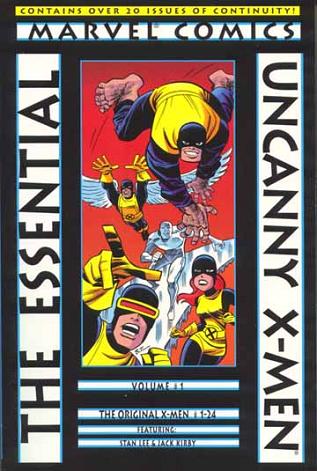
Fifty Essentials in Fifty Days 21: Essential Uncanny X-men Vol. 1

cover of Essential Uncanny X-men Vol. 1


Essential Uncanny X-men Vol. 1
Stan Lee, Jack Kirby, Werner Roth, Roy Thomas and friends
Reprints: Uncanny X-Men #1-24 (September 1963 – September 1966)
Get this for: The X-Men before they were famous — three stars

The X-Men debuted in the same month as that other Marvel superhero team, the Avengers. But whereas the latter team featured five heroes already known from their solo adventures, the X-Men, also with five members, had never been seen before. What’s more, unlike every other Marvel hero the X-Men had no origin, but where born with their powers, socalled mutants. From the start they were different, using their powers not to fight crime, though they did, but to protect the world from evil mutants, to find those mutants still unaware of their powers and to show normal people that mutants could be trusted. It was a far more science fictional approach than Lee and Kirby had tried in any of their other titles, even in the Fantastic Four.

I’ve read many of the earliest stories in this volume before and always found them a tad on the tedious side. This is sadly still the case now. The premise of the series is good, but how it’s worked out is not so much. As you know, there’s professor Xavier’s school, where he trains the X-Men and is on the lookout for potential mutants or mutant threats. The first eight-nine issues all follow the same pattern: some mutant menace makes himself known or is found by professor X, the X-Men try to defeat it but are outmatched, are rallied by Prof X and overcome it. So the first issue has the X-Men going after Magneto, in the second they tackle the Vanisher, in the third the Blob, in the fourth it’s Magneto again, with new allies the Brotherhood of Evil, followed with Magneto teaming up with Namor and so on.

Character wise, especially at the start the old prof is the most annoying character in the series: either the deus ex machina that solves every difficulty at the end of an issue, or the distant trainer/mentor exhorting his pupils to do better. The focus on the X-men’s training in the first seven issues or so doesn’t help either. Another annoying character is Scott Summers, pining for fellow student Jean Grey and whining endlessly about his deadly powers and how he needs to keep his self control.

Things liven up a bit when the The X-Men move into the double figures. In issue ten the X-Men find the Savage Land and meet Ka-Zar, in issue eleven the Stranger, followed by the introduction of the Juggernaut in a fine two part story. The introduction of the Sentinels comes straight after and takes no fewer than three issues to be told. This shift towards longer, multi issue stories works well for the X-Men: they’re much more fun. Gone is any pretence at the original mission of the X-Men though.

What also works out well for the X-Men is the shift in artists, from Jack Kirby to Werner Roth. Roth’s art style is somewhat cruder than Kirby’s, but suits the X-Men better. Kirby never seemed to get a good handle on them. His artwork is always no worse than good, but doesn’t gel the way it does with e.g. the Fantastic Four. Roth’s artwork doesn’t have the same technical proficieny of Kirby’s, but his fluid lines do seem to work better here. Another newcomer, Roy Thomas, gets to handle the writing duties from issue twenty, which also helps to freshen up the series. Unfortunately they’re only just starting to get up to steam together when the volume ends…

The X-Men was never the best Marvel Silver Age title and this is certainly not an essential volume. Interesting enough to read, but I won’t reach quickly for this again.