Fifty Essentials in Fifty Days 15: Essential X-Men Vol. 1

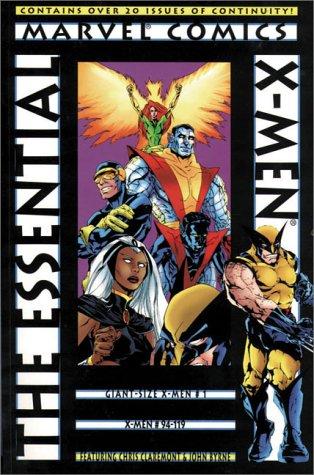
cover of Essential Essential X-Men Vol. 1


Essential Essential X-Men Vol. 1
Chris Claremont, Dave Cockrum, John Byrne and friends
Reprints: Giant-Size X-Men #1, Uncanny X-Men #94-119 (July 1975 – March 1979)
Get this for: the start of the X-Men revolution — four stars

Hard to imagine now, but once upon a time The X-Men were a failure, never having been more than a cult hit throughout the Silver Age, even becoming a reprint series with #67. It limped along for a couple of years, up until issue 93, while the team showed up here and there as guest stars in other titles, some members becoming Champions. The most successful was the Beast, who had his own solo series in Amazing Adventures before joining the cast of The Avengers. It all seemed over for the X-Men, but like good superheroes they came back in the nick of time and it all started with Giant-Size X-Men #1, the first issue reprinted here.

Giant-Size X-Men was followed by a renewed X-Men series, started with #94. While these first two issues were written by Len Wein, by #95 Chris Claremont had come aboard and he would remain the X-Men’s writer for some seventeen years. It takes him a while to find his voice and the first few issues are on the rough side, but it really doesn’t take long for the mutant juggernaut to start rolling. Claremont’s writing on X-Men revolutionised superhero comics and it’s here that it started: by the end of the volume the classic Claremont is established.

Some elements of it pop up even earlier. Both the most loved and hated characteristic of Claremont’s style is having long, drawn out plots and subplots, stacked on top of each other, with one menace fading into the background earning the heroes only a little respite before the next one, long foreshadowed, has to be fought. Here Claremont starts doing this as early as #96-97, the first of which foreshadows the return of the Sentinels, with #97 introducing the menace of Eric the Red, while Prof Xavier was plagued with strange dreams of a Galaxy far, far away. The first threat takes until #100 to be resolved and of course leads to the metamorphosis of Marvel Girl into Phoenix, which comes in handy for defeating the second villain, who turns out just to be a pawn of a mad emperor of the alien Sh’iar Empire, who in turn threatens to unleash the end of everything. It all gets fixed by #108.

Said issue incidentally features something I wish was still used in modern Marvel stories, the half page or full page looking in at the rest of the Marvel Universe while the heroes of the comic you’re reading are struggling to defeat the menace du jour. In this case you have Peter Corbeau onboard the Sunwatch space station briefing Mr Fantastic of the Fantastic Four, Beast and Captain America of the Avengers as well as then president Jimmy Carter via teleconference, explaining that yes, the strange blip felt at the end of the last issue was indeed the entire universe ceasing to exist for half a second and that if it happens again, the universe may not come back… This kind of scene always helped emphasise the seriousness of a threat, that it was not just the X-Men’s fate that mattered, but everybody’s. But it also helps build up a sense of interconnectness, that these adventures are not taking place in a vacuum.

From the start the X-Men are kept busy here; there are no quiet issues. After establishing the new team and sending them on their first mission in Giant-Size X-Men, they immediately have to defeat Count Nefaria’s threat of nuclear annihilation in the next two issues, deal with the death of a teammate, fight the sentinels over multiple issues, see Professor Xavier deal with futuristic nightmares, deal with old enemies gunning for them, first Black Tom and the Juggernaut waiting for them in Ireland, only defeated with the help of leprechauns (not their finest houre), then Magneto returns, but their fight with him is cut short as they’re swept up in the intergalactic adventure mentioned above. Once finished with that, Wolverine has to deal with the Canadian government wanting him back, before yet another old enemy turns up and makes the X-Men into funfair performers. The Magneto turns up again, kidnaps them to his secret base near the Savage Land, which blows up and leaves two sets of X-Men, as the Beast and Phoenix manage to return home, while the rest helps Ka-Zar fight a would be conqueror in the Savage Land, before being picked up by a Japanese vessel who drops them off in Japan just in time to fight Moses Magnum, which ends the volume. It’s all fast paced and incredibly busy, but Claremont always remains in control and keeps things understandable.

He’s helped in this by the art, which from Giant-Size X-Men #1 up to X-Men #107 is in the hands of Dave Cockrum, with the rest of the issues drawn by John Byrne. Quite different artists of course, with Cockrum having a much looser, cartoony and swashbuckling style, lending itself well to widescreen space opera, while Byrne is more realistic in his art. Byrne is also one of those artist who, like Jack Kirby have the effect on me that if I read a large run of their stories in one go, I start to see the world through their art. So now suddenly everybody on tv is standing around in those typical wide legged, slighty skewed Byrne poses… Both Cockrum and Byrne are wonderful artists here, well suited to Claremont, who adapts his stories to their strengths. Of the two I prefer Byrne, just because he does things for me Cockrum can’t.

Sadly, some of Claremont’s more annoying tics are also in evidence here, especially in the characterisation. There’s a lot of ill established antagonism between characters, which especially in the earlier issues was wearisome. There are also the first glimmers of another bad Claremont habit, the subtle and not so subtle references to the past lives of some of the X-Men, especially Wolverine. Some idiot plotting as well, where Claremont goes for the “make life more complicated for the characters through bad communication and drawing out of misunderstandings”. It’s bearable here, but I do remember at the end of his X-Men run, when it just became too annoying.

One other complaint I had was the misuse of Jean “Phoenix” Grey. Supposedly the most powerful person on the team, story after story has her being taken out easy or struggle to defeat villains she should have been able to take with one arm tied behind her back. The same goes for Storm, though to a lesser extent. Also very powerful, she again is kept out of action more than she should have been. If you have strong female heroes, use them, don’t find contrived ways to keep them out of action to keep the story going for longer…
Alanis would think it ironic

The visceral anger and loathing some science fiction fans can display when confronted with anything that’s different from “how we did things thirty years ago”. In this case it’s one Taral Wayne, complaining in The Drink Tank #259 (PDF) about the wrong people winning the Best Fanwriter and Best Fanzine Hugos. With the first award, Taral was offended that Frederik Pohl had won the award, because he didn’t consider him to be a fan and blamed the voters and voting committee for not realising this:

My point is this: Pohl spelled it out, right there in his blog, that these were early drafts for a new edition of the old book. How much more plainly must he tell us that this is not fanwriting?

I think we can say why the voters nominated a professional writer for his blog. Many had likely never seen more than a small number of fanzines, perhaps only con publications such as the Worldcon’s own progress reports. I’ll make a further guess that most of the voters have little appreciation for what fanzines do, beyond discussing science fiction. They can have no sense of fanzine fandom as a community, or of fanzines as a means of expression rather than information. It is self-evident that this must more or less be the case, since there are only two or three hundred fans involved in the fanzine network at any given time… but several thousand Worldcon members with a vote.

What puzzles me is why the Hugo committee permitted Pohl’s name to appear on the ballot. If the rules are to mean anything, his name had no business being there. But odds are that the committee members were no better informed about fanzines than the majority of voters.

What annoys me about Taral’s reasoning is that a) he doesn’t engage the quality of Pohl’s work, just argues his blog has to be disqualified as fan writing because it might end up as source material for a new autobiography and b) that he accuses the Hugo voters and administration of being ignorant. That last slur is the first thing every loudmouth trots out when the Hugo votes don’t got the way they want it and honours the wrong people. It’s never “the voters disagreed with me on the quality of the candidates for Best Novel, it’s always “Harry Potter should not have won because it’s fantasy, but the voters are so ignorant that they don’t even know it’s a science fiction award”. Bonus points if, like the example here, they themselves gets basic facts about the Hugos wrong. At least Taral does acknowledge that professional writers can and have been honoured for their fan work, even if he’s boneheaded about Pohl not being a real fan for the purpose of the award.

You can certainly argue whether Frederik Pohl deserved the award, but to say that his blog should be disqualified because he may some day be paid for the material he publishes there is stupid. But apart from that Taral has no argument: if posts about the earliest days of not just organised fandom but science fiction as a genre, days Pohl was around for, isn’t fannish enough to qualify, than what is?

(As an aside, thousands may have the right to vote in the Hugos, but only 558 people did for Best Fan Writer, so Taral’s two-three hundred fanzine fans could’ve easily swung the vote to a more deserving candidate had they agree with him and/or had a con membership. Also, I wonder how accurate his guesstimate is here, or whether he’s defining fanzines too narrowly. My guess is the latter.)

Speaking of fanzines, that was his other beef with this years Hugo winners:

The fanzine Hugo has been corrupted, just as the fanwriter Hugo has been. Last year, a webpage called Electric Velocipede encouraged its viewers to vote, and succeeded in taking the award from conventional media for the first time. The debate over whether or not a webpage is a fanzine is far from over. There are arguments for both views. But this year the issue was quite clear. The winner, StarShipSofa, is a podcast. Under what conceivable circumstances can a dramatic presentation be compared to the written media? To bring up apples and oranges is a tired cliché. Let’s use a different analogy. Allowing a podcast to compete with fanzines for the Hugo makes as little sense as judging between a Gene Kelly musical comedy and a lecture by Mark Twain.

(See? I was right)

As I said on File 770, this is a luddite attitude for a science fiction fan to take, confuses form with content and is clearly elitist to boot. As long as StarShipSofa does what expect from a fanzine, it’s a fanzine, one being done through voice rather than print, just like an audio book is still a book. If you look at the contents of any given issue it’s clear that whatever Star Ship Sofa is doing does not differ greatly from a print ‘zine. The format should not matter, the content should. And Taral isn’t just dismissive of audio fanzines, but also talks about whether or not a webpage can be a fanzine.

It’s this sort of attitude that I call luddite, with excuses to the historical luddites, whose attitude to technological progress was not half as unreasonably negative as this. There’s something absurd in having science fiction fans of all people reject creative uses of new technology, new and perhaps better ways to keep the conversation going.

#followalibrary on October 1st

A nice new Dutch originated, but worldwide initiative to make October 1st #Followalibrary Day on Twitter. The video below explains who, what, how and why:


It’s good to see such a creative, low cost promotion for something often seen as stuffy and oldfashioned as a public library. Especially now, when libraries are under threat in America and the UK as an easy target to cut spending on. It’s all a little less gloomy here in the Netherlands, but even so, in an age when we’re supposedly getting all our information of the internet anyway, the library is no longer the self evident public good it once was. Libraries are very vulnerable to misguided cost cutting attempts right now. Nobody will die if a library closes or limits its opening hours and people might grumble, but won’t get passionate about it the way they would if a local hospital would close.

Fifty Essentials in Fifty Days 14: Essential Marvel Two-in-One vol. 1

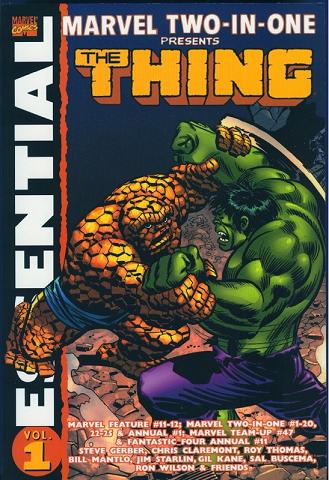
cover of Essential Marvel Two-in-One Vol. 1


Essential Marvel Two-in-One Vol. 1
Steve Gerber, Bill Mantlo, Sal Buscema and friends
Reprints: Marvel Feature #11-12, Marvel Two in One #1-20, 22-25 and more (January 1974 – March 1977)
Get this for: Seventies superheroics — three stars

We’ve already had a volume of Essential Marvel Team-Up, so now it’s time for that other classic teamup title: Marvel Two-in-One. Whereas the former had Spider-Man as its main character, Marvel Two-in-One had The Thing, Marvel’s second most sympathic character. It may seem a strange choice at first to have him as the lead — why not Mr Fantastic or the Torch instead — but it works. The Thing has many of the same qualities as Spider-Man: an everyman, powerful but kind, with problems all his power can’t solve and somebody who you can imagine having a beer with. What also helps is that you can put him in almost every situation and have it make sense, as this volume makes clear; something you can’t do with e.g. Daredevil.

Essential Marvel Two-in-One Vol. 1 contains the last two issues of Marvel Feature, #11-12, the first twentyfive issues (excluding #21) of Marvel Two-in-One plus the first annual, as well as crossover issues with Marvel Team-Up (#47) and Fantastic Four (Annual #11). Issue 21 was excluded because it featured Doc Savage, who Marvel no longer has the rights to. Marvel Feature was a failed tryout title that had also featured an attempt to revive Antman amongst others and it’s clear that this was used to try the waters so to speak.

The first nine issues of Marvel Two-in-One were written by Steve Gerber, picking up one loose thread from his Man-Thing stories: Wundarr, the Superman analog with the brain of a two year old turns up again and Thing becomes his uncle Benji, though he isn’t too pleased about it. Gerber also has teamups with some of his other characters: first the Guardians of the Galaxy, then Doc Strange and the Valkyrie from The Defenders. After Gerber left, Bill Mantlo took over the writing duties, with some fill-ins from people like Chris Claremont, Roger Slifer and Roy Thomas, the latter doing a crossover with his WWII teams Invaders and Liberty Legion. None of the writing, not even Gerber’s is particularly great, with most of the stories being simple “Heroes meet, misunderstand each other, spar a bit, then tackle the real villain together”. The real interest lies squarely with the featured heroes and villains.

Those featured here are a nice mixture of the well known and the obscure. Apart from the ones mentioned above, there’s Thor, Iron Man, Daredevil, Captain America and the Fantastic Four, but also Tigra, Scarecrow, the Golem, the Son of Satan and Morbius to name just a few of the more obscure. For some of these teamups you quickly suspect that they’re mostly done to close up some dangling plotlines from their own just cancelled series. Scarecrow is one of those, a horror hero that had had two previous appearances and had been intended for his own series, which never got off the ground; Marvel Two-in-One #18 concludes his story. As to the villains featured, few are that interesting: also rans like Miracle Man or the Puppet Master or the Basilik, as well as some new ones cooked up especially for the series like Sword of Judgement.

The art for the most part is not … the best … Marvel featured in that period. It’s mostly uninspiring but dependable artists like Herb Trimpe, Bob Brown, Ron Wilson and Sal Buscema, who are all capable of better work than is on display here. As is Gil Kane, normally a welcome sight in a volume like this, but his work in issue one and two is no more than adequate. The art does fit the stories, that’s the best you can say of it.

Marvel Two-in-One would get better much later on, especially when Mark Gruenwald was writing it and George Perez handled the art, but that’s a long way away yet from this volume. It is the sort of comics I grew up with, but for those who didn’t, you’re not missing that much here.

Fifty Essentials in Fifty Days 13: Essential Official Handbook of the Marvel Universe vol. 1

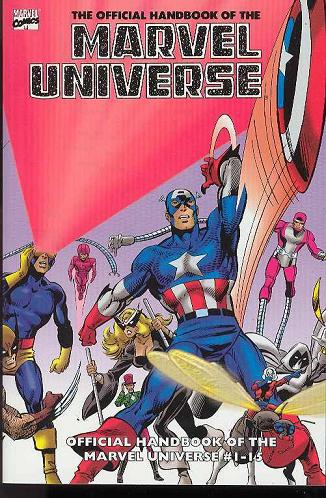
cover of Essential OHOTMU


Essential Official Handbook of the Marvel Universe vol. 1
Mark Gruenwald, Peter Sanderson, Eliot R. Brown and friends
Reprints: Official Handbook of the Marvel Universe Vol 1, #1-15 (January 1983 – May 1984)
Get this for: hardcore nerding — three stars

Okay, I’ll admit it, I’ve always liked The Official Handbook of the Marvel Universe far more than its DC Comics equivalent, Who’s Who in the DC Universe, largely because the former was far geekier and willing to actually explain things, while Who’s Who was always a bit poofaced. You’d never have a “Book of Weapons, Hardware, and Paraphernalia” in Who’s Who, but it’s here in Essential Official Handbook of the Marvel Universe vol. 1, a symbol of the nerd power of three men: Mark Gruenwald, Peter Sanderson and Eliot R. Brown.

OHOTMU, to give it its official acronym was a Gruenwald project, the first series running in 1983-1984, allegedly started not just because he was the kind of fan turned professional who actually cared about how much tonnes the Thing could bench press, but also because DC was going to bring out Who’s Who as part of their Fifty years anniversary celebrations in 1985. Back then the two companies were insanely competitive and especially Marvel, then with Jim Shooter as editor-in-chief seemed keen to scoop its rival. Personally I think this series would’ve been published even without this rivalry. Gruenwald was not the only one interested in a handbook showcasing all the well known and not so well known heroes and villains in the Marvel Universe. In the early eighties a whole generation of Marvel Zombies had grown up with Marvel and kept reading them when grown up, getting obsessed with the minutia of a shared universe. Today they would be browsing Tvtropes, back then they read OHOTMU.

The first series of OHOTMU collected here ran for fifteen issues, with the first twelve going from A to Z through the Marvel Universe, two Books of the Death and one Book of Weapons, Hardware, and Paraphernalia. Each entry is between half to two pages long, has a nice picture of the featured character posing for the camera, their vital statistics, a longish potted history of their appearance and some discussion of their powers. Gruenwald and co are not afraid to make things up if the original comics weren’t clear. Artwise, most artists then working for Marvel contributed, with e.g. John Byrne handling the characters from the titles he was the artist on.

A later version of the handbook estimated that there were roughly 2-3,000 or so significant characters in the Marvel Universe, those with two appearances or more and/or who did something interesting. A limited series of fifteen issues, though without advertising, has limited room and can’t cover them all, so it’s interesting who was picked. All the familiar faces are there of course: an Iron Man or Scarlet Witch will always have a place in such a series, but a villian like Belladona (seen in a few Spider-Man stories) or a group like the Champions of Xandar (featured in a Fantastic Four story, not so much. Reading a series like this then gives an interesting look in the Marvel Universe of almost thirty years ago. Not just by who gets featured, but also by who gets half a page, a full page or is important enough for two….

Obviously most of the information here is long out of date, but that’s not the point. It’s an interesting cross section of the Marvel U. at a certain point in time and for me part of its appeal also is that this is the Marvel I grew up with. You won’t miss much by not buying this volume, but to me this is indeed an essential volume.