Fifty Essentials in Fifty Days 14: Essential Marvel Two-in-One vol. 1

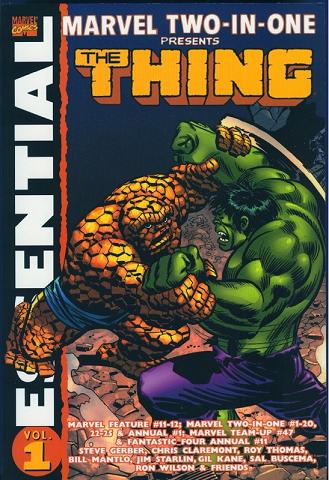
cover of Essential Marvel Two-in-One Vol. 1


Essential Marvel Two-in-One Vol. 1
Steve Gerber, Bill Mantlo, Sal Buscema and friends
Reprints: Marvel Feature #11-12, Marvel Two in One #1-20, 22-25 and more (January 1974 – March 1977)
Get this for: Seventies superheroics — three stars

We’ve already had a volume of Essential Marvel Team-Up, so now it’s time for that other classic teamup title: Marvel Two-in-One. Whereas the former had Spider-Man as its main character, Marvel Two-in-One had The Thing, Marvel’s second most sympathic character. It may seem a strange choice at first to have him as the lead — why not Mr Fantastic or the Torch instead — but it works. The Thing has many of the same qualities as Spider-Man: an everyman, powerful but kind, with problems all his power can’t solve and somebody who you can imagine having a beer with. What also helps is that you can put him in almost every situation and have it make sense, as this volume makes clear; something you can’t do with e.g. Daredevil.

Essential Marvel Two-in-One Vol. 1 contains the last two issues of Marvel Feature, #11-12, the first twentyfive issues (excluding #21) of Marvel Two-in-One plus the first annual, as well as crossover issues with Marvel Team-Up (#47) and Fantastic Four (Annual #11). Issue 21 was excluded because it featured Doc Savage, who Marvel no longer has the rights to. Marvel Feature was a failed tryout title that had also featured an attempt to revive Antman amongst others and it’s clear that this was used to try the waters so to speak.

The first nine issues of Marvel Two-in-One were written by Steve Gerber, picking up one loose thread from his Man-Thing stories: Wundarr, the Superman analog with the brain of a two year old turns up again and Thing becomes his uncle Benji, though he isn’t too pleased about it. Gerber also has teamups with some of his other characters: first the Guardians of the Galaxy, then Doc Strange and the Valkyrie from The Defenders. After Gerber left, Bill Mantlo took over the writing duties, with some fill-ins from people like Chris Claremont, Roger Slifer and Roy Thomas, the latter doing a crossover with his WWII teams Invaders and Liberty Legion. None of the writing, not even Gerber’s is particularly great, with most of the stories being simple “Heroes meet, misunderstand each other, spar a bit, then tackle the real villain together”. The real interest lies squarely with the featured heroes and villains.

Those featured here are a nice mixture of the well known and the obscure. Apart from the ones mentioned above, there’s Thor, Iron Man, Daredevil, Captain America and the Fantastic Four, but also Tigra, Scarecrow, the Golem, the Son of Satan and Morbius to name just a few of the more obscure. For some of these teamups you quickly suspect that they’re mostly done to close up some dangling plotlines from their own just cancelled series. Scarecrow is one of those, a horror hero that had had two previous appearances and had been intended for his own series, which never got off the ground; Marvel Two-in-One #18 concludes his story. As to the villains featured, few are that interesting: also rans like Miracle Man or the Puppet Master or the Basilik, as well as some new ones cooked up especially for the series like Sword of Judgement.

The art for the most part is not … the best … Marvel featured in that period. It’s mostly uninspiring but dependable artists like Herb Trimpe, Bob Brown, Ron Wilson and Sal Buscema, who are all capable of better work than is on display here. As is Gil Kane, normally a welcome sight in a volume like this, but his work in issue one and two is no more than adequate. The art does fit the stories, that’s the best you can say of it.

Marvel Two-in-One would get better much later on, especially when Mark Gruenwald was writing it and George Perez handled the art, but that’s a long way away yet from this volume. It is the sort of comics I grew up with, but for those who didn’t, you’re not missing that much here.
Fifty Essentials in Fifty Days 13: Essential Official Handbook of the Marvel Universe vol. 1

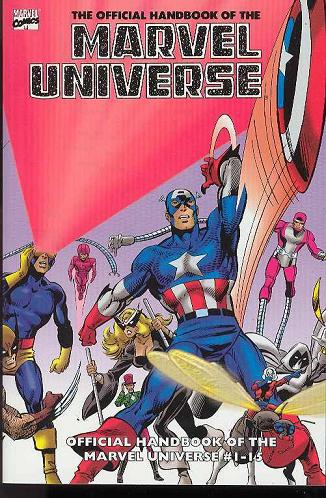
cover of Essential OHOTMU


Essential Official Handbook of the Marvel Universe vol. 1
Mark Gruenwald, Peter Sanderson, Eliot R. Brown and friends
Reprints: Official Handbook of the Marvel Universe Vol 1, #1-15 (January 1983 – May 1984)
Get this for: hardcore nerding — three stars

Okay, I’ll admit it, I’ve always liked The Official Handbook of the Marvel Universe far more than its DC Comics equivalent, Who’s Who in the DC Universe, largely because the former was far geekier and willing to actually explain things, while Who’s Who was always a bit poofaced. You’d never have a “Book of Weapons, Hardware, and Paraphernalia” in Who’s Who, but it’s here in Essential Official Handbook of the Marvel Universe vol. 1, a symbol of the nerd power of three men: Mark Gruenwald, Peter Sanderson and Eliot R. Brown.

OHOTMU, to give it its official acronym was a Gruenwald project, the first series running in 1983-1984, allegedly started not just because he was the kind of fan turned professional who actually cared about how much tonnes the Thing could bench press, but also because DC was going to bring out Who’s Who as part of their Fifty years anniversary celebrations in 1985. Back then the two companies were insanely competitive and especially Marvel, then with Jim Shooter as editor-in-chief seemed keen to scoop its rival. Personally I think this series would’ve been published even without this rivalry. Gruenwald was not the only one interested in a handbook showcasing all the well known and not so well known heroes and villains in the Marvel Universe. In the early eighties a whole generation of Marvel Zombies had grown up with Marvel and kept reading them when grown up, getting obsessed with the minutia of a shared universe. Today they would be browsing Tvtropes, back then they read OHOTMU.

The first series of OHOTMU collected here ran for fifteen issues, with the first twelve going from A to Z through the Marvel Universe, two Books of the Death and one Book of Weapons, Hardware, and Paraphernalia. Each entry is between half to two pages long, has a nice picture of the featured character posing for the camera, their vital statistics, a longish potted history of their appearance and some discussion of their powers. Gruenwald and co are not afraid to make things up if the original comics weren’t clear. Artwise, most artists then working for Marvel contributed, with e.g. John Byrne handling the characters from the titles he was the artist on.

A later version of the handbook estimated that there were roughly 2-3,000 or so significant characters in the Marvel Universe, those with two appearances or more and/or who did something interesting. A limited series of fifteen issues, though without advertising, has limited room and can’t cover them all, so it’s interesting who was picked. All the familiar faces are there of course: an Iron Man or Scarlet Witch will always have a place in such a series, but a villian like Belladona (seen in a few Spider-Man stories) or a group like the Champions of Xandar (featured in a Fantastic Four story, not so much. Reading a series like this then gives an interesting look in the Marvel Universe of almost thirty years ago. Not just by who gets featured, but also by who gets half a page, a full page or is important enough for two….

Obviously most of the information here is long out of date, but that’s not the point. It’s an interesting cross section of the Marvel U. at a certain point in time and for me part of its appeal also is that this is the Marvel I grew up with. You won’t miss much by not buying this volume, but to me this is indeed an essential volume.

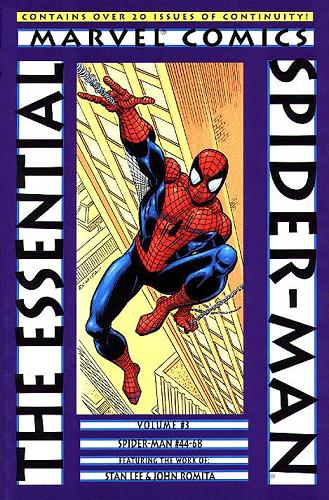
Fifty Essentials in Fifty Days 12: Essential Spider-Man vol 3

cover of Essential Spider-Man Vol. 3


Essential Spider-Man Vol. 3
Stan Lee, John Romita and friends
Reprints: Amazing Spider-Man #44-68 (January 1967 – January 1969)
Get this for: Lee & Romita on Spider-Man– four stars

After finishing off the Lee-Ditko run on Amazing Spider-Man with Essential Spider-Man Vol 2 yesterday, I thought I’d give the Romita run a try as well with Essential Spider-Man Vol 3, containing exactly two years of continuity. This is the period in which the foundations for the Spider-Man I grew up with were laid. There’s more soap opera, it’s taken more serious and some of the humour of the Ditko issues has gone. Where earlier Spidey’s troubles rarely lasted much beyond one issue, from now on he would barely be able to keep going with all the issues and hangups put on him. You can see the first glimmers of Bronze Age Marvel here, with its emphasis on shared continuity, large supporting casts and long running subplots. It all feels familiar to me in a way the Ditko issues did not.

On the art front, while it is clear to see the Ditko influences in Romita’s work here, his work is much more conventionally pretty and as he had cut his teeth on romance comics, his women are drop dead gorgeous in a way Ditko never could match. His male characters too are much more handsome than they were before. While stylistically I prefer Ditko over Romita — his fights were never as exciting as Ditko’s — his clear, clean artwork did provide Spider-Man with his definitive look, a reference point for every artist that came after him on Spider-Man.

What struck me reading this volume was that some of the momentum was gone; things seem more static, though Petey does finally move out from Aunt May’s house into a shared apartment with Harry Osborn and moves to college. There are fewer new villains (the Shocker and Kingpin being the exception) and more old ones making re-appearances, like Doctor Octopus, Mysterio and the Vulture. The stories aren’t bad by any means, but none have the impact of e.g. the Master Planner arc from the previous volume.

Spidey gets a lot more hip and happening too as Romita comes along, getting so sixties it’s almost embarassing. Lots of fun though. One big but subtle improvement castwise is the addition of Joe and Randy Robertson to the cast, the first regular Black supporting characters in comics. Or at least the first ones not to be embarassing racial stereotypes at least. No fuzz is made about them being Black either: Joe is introduced as the Bugle‘s new city editor, Randy as a fellow student of Peter’s at E.S.U.

The Lee – Romita Spider-Man is very different from the Ditko – Lee version, but almost as good. Reading these stories is not as exciting as reading the Ditko ones, but they do feel mighty comfortable, like taking in a nice hot bath. That’s not bad either.

Fifty Essentials in Fifty Days 11: Essential Spider-Man vol 2

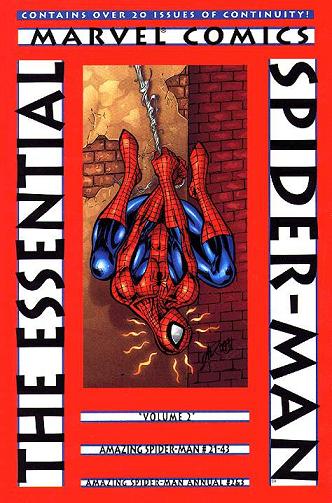
cover of Essential Spider-Man Vol. 2


Essential Spider-Man Vol. 2
Stan Lee, Steve Ditko, John Romita and friends
Reprints: Amazing Spider-Man #21-43, Annual 2-3 (Februari 1965 – December 1966)
Get this for: Lee, Ditko & Romita on Spider-Man– five stars

After finishing Essential Spider-Man Vol. 1 I needed to finish the rest of the Lee-Ditko run on Amazing Spider-Man, so onwards to Vol. 2 I went. This includes the last eighteen issues plus annual Ditko worked on the title, as well as the first few of John Romita as his replacement. The changeover from the stylistic mastery of Ditko to the much more conventional prettiness of Romita is jarring and when read straight after each other, Romita comes off looking the lesser artist, almost bland even. Not that he’s a bad artist of course, but he lacks the personal investment Ditko brought to Spider-Man.

The story of why Ditko left Amazing Spider-Man is well known of course: he objected to taking the Green Goblin and make him into somebody in Spidey’s supporting cast like Stan Lee wanted him to be as that would make for a better story, rather than having him just be a nobody as Ditko wanted as that fit his philosophy of crime (heavily influenced by Ayn Rand) better. Ditko quit with the issue in which Lee wanted the big reveal rather than compromise his principles, Romita was brought in and Spider-Man would never be the same again. So much of what would make Spider-Man Spider-Man later on was only brought in after Ditko left, the most important perhaps being a certain little gal called Mary Jane Watson! (One risk of reading these volumes back to back is having Lee’s speech patterns rub off on you. But that’s a risk I’m taking for you, the dedicated reader. (See what I mean?))

With Romita Spider-Man went even more into soap opera, lost some of the easy humour of the Ditko days as Peter Parker’s struggles were taken more seriously and the cast was expanded. For most of Ditko’s run there’s only a relatively small supporting cast: Flash Thompson and Liz Allen plus unnamed hangers on at Peter’s high school; Jolly Jonah Jameson, Betty Brant and Frederick Foswell at the Daily Bugle, plus of course Aunt May. Even Harry Osborn and Gwen Stacy only come into the picture at the end of the Ditko issues. With Romita on board, the cast becomes bigger and more important. It’s quite a difference.

Moving back to why Ditko left the series, it has been interesting to see, knowing his reasons, how he had been weaving his thoughts on crime and the losers who commit in the series before. In the previous volume there was the crime boss The Big Man, who Spider-Man suspected was actually Jameson himself only for him to turn out to be Foswell, while this volume has the saga of the Crime-Master, where Spidey is again wrong in his suspicions, now thinking Foswell has gone back to his old ways when it turns out it’s somebody he actually never saw and nor did we. In both cases it turns out our ideas of who could be this big, important villain don’t matter as they turn out to be nobodies, which is what Ditko wants us to learn about crime. With the Goblin he had been careful never to show his face before and was on his way to repeat this trick, but Lee had other plans. A pity in one way, though Lee had a good case that storywise, it’s more satisfying to have the revelation of the Goblin’s identity be more meaningful. In the end, because Norman Osborn is only introduced a few issues before anyway, any shock value of his being the Green Goblin is slight.

One of the strangest stories in this volume is issue 24, where Spidey thinks he’s going mad because he keeps seeing hallucinations while some psychatrist has written an op-ed in the Bugle that he must be insane to be Spider-Man. It’s not the story itself which is strange, as the logic behind the premise. Even before Spidey sees things, the mere mention that a psychiatrist has declared him insane was enough for him to doubt his sanity. That’s the kind of childlike logic more suited to a Superboy story, where any autority is always immediately believed by the hero and his friends, no matter how ludicrous.

Ditko or Romita, Spider-Man is addictive. I have to imagine what it would’ve been like to read these issues straight from the newsstand back in ’65, having to wait a month to read the conclusion of the Master Planner story, Ditko’s zenith on the series. So good to be able to just flip the page and start reading.

Fifty Essentials in Fifty Days 10: Essential Spider-Man Vol. 1

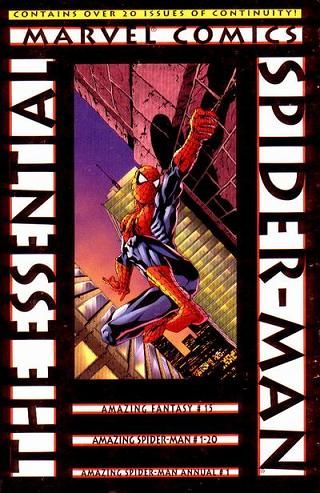
cover of Essential Spider-Man Vol. 1


Essential Spider-Man Vol. 1
Stan Lee, Steve Ditko and friends
Reprints: Amazing Fantasy #15, Amazing Spider-Man #1-20, Annual 1 (August 1962 – january 1965)
Get this for: Duh Lee & Ditko on Spider-Man– five stars

The problem with talking about the stories in Essential Spider-Man Vol. 1 is the same as with talking about the first Fantastic Four volume. Many of the stories have been reprinted, recapped, retold so often that you think you know them, until you read them all cover to cover in one sitting again and discover that actually, Lee and Ditko were quite funny.

Not to take away from the superheroics of course, as so many classic Spidey villains are introduced here — The Vulture, Chameleon, Doctor Octopus, Electro, Mysterio, Sandman, The Lizard, Scorpion and of course Green Goblin — but the best thing in these stories is the soap opera that takes place around it. It’s all much, much less serious than it would be later on. Lee and Ditko delight in making Peter Parker suffer for being Spider-Man; if it isn’t his aunt May’s health and money problems it’s the kids at school thinking him a coward or Jolly Jonah Jameson’s latest editorial turning the city against him again. But they don’t pile on the problems like later writers would do and always balance it with a sense of humour. Peter is still able to laugh at himself and his troubles. Some of the scrapes Spidey finds himself in are clearly played for laughs too, as with his team-ups/ongoing rivalry with the Human Torch.


Last page of Amazing Spider-Man 07

Ditko’s art is a great help with this: fluid and expressive, especially with faces. It’s his composition and exaggerated, elongated figures that tend to get the attention, but the way Ditko can show subtle emotions in his faces here is just as impressive. This is something that’s sadly been lost with Ditko over the years as he’s withdrawn in his Randroid fantasies and his art became somewhat of a parody of himself. But here it’s alive and well and never as developed elsewhere. Compare e.g. with the Dr Strange stories Ditko worked on at the same time, where soap opera and characterisation where much less important. The page on the right is the last page of Amazing Spider-Man #7, a nice example of how Ditko can portray both subtle and broad emotion on the same page naturally. It reads even better in black and white, where you’re not distracted by the colours.

On the whole I’ve found that Ditko is an artist whose work, even though meant for colour publication, benefits a lot from black and white representation, much more so than some artists (as do Gil Kane and Jack Kirby). Some artists depend on colour, work with it to give coherence to their drawings, while with Ditko his style is much more clear if left uncoloured.

I should not forget Ditko’s feel for action either. His fight scenes are great, with constant movement, figures jumping around, goons flying everywhere, punches thrown, Spidey ducking and weaving through four, five villains, caught mid-way through a jump, with the action always towards the reader. He creates a feeling of energy and movement few other artists can match while never using layout trickery or even much sound effects (something rare in Silver Age Marvel anyway). Lee meanwhile, of course plasters his dialogue all over this action, but does so without obscuring it or stating the obvious. It’s completely unnatural, but the way Lee brings it, it feels like the most normal thing in the world to comment out loud in the middle of a fight on what you’re trying to do and what your opponent is doing. If you want one example, go find Spider-Man #19 and Spidey’s and the Torch’s fight with Sandman and the Enforcers.

It is all great, great stuff and anybody should take the time to at least read through these — and the eighteen more Lee and Ditko would do together.