Fifty Essentials in Fifty Days 07: Captain America Vol. 01

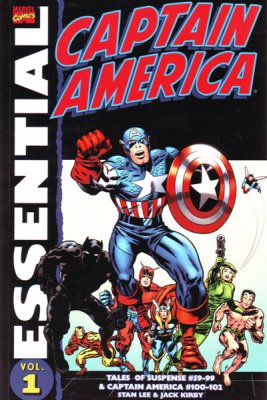
cover of Essential Captain America vol 1


Essential Captain America Vol. 1
Stan Lee, Jack Kirby, Gil Kane and friends
Reprints: Tales of Suspense #59-99, Captain America #100-102 (November 1964 – June 1968)
Get this for: Classic Captain America — five stars

Believe it or not, Captain America is my favourite Marvel superhero, largely due to Mark Gruenwald’s long run. What I like about Captain America is how leftist a patriot he is, a Roosevelt democrat and man of the people, punching out Hitler a year before America entered the war, always representing more the ideals of America than its government, in as far as a four colour hero can represent anything when he spents most of his time fighting leftover nazis, grotesque monstrosities wanting to rule the world and other sci-fi menaces…. Captain America is one of those characters who, like Spider-Man or the Thing always make a story better, almost as if writers try extra hard when they are working with them.

Essential Captain America Vol. 1 reprints Captain America’s complete run in Tales of Suspense, plus the first three issues of his own title. None of this I have read before and I therefore had no idea what was in store. Silver Age Marvel comics can be a bit hit and miss, especially the split titles like Tales of Suspense so I wasn’t expecting too much, but this was excellent. It’s clear Stan Lee has an affinity for Cap, as does Jack Kirby, who provides the majority of the art here, with only short spells by John Romita, Jack Sparling and Gil Kane interrupting his run. Inkers on the other hand change much more, from Chic Stone to Frank Giacoia to Dick Ayers to George Tuska to Joe Sinnott to Syd Shores, each making their own interpretation of Kirby’s pencils.

Artwise, what makes this volume extraordinary is the evolution in Kirby’s art. At the start of the volume he has already moved on from the clean, slightly slick understated look it had in e.g. early Fantastic Four comics, with more exagerration in movement and typical Kirby poses. By the end it’s full on Kirby, weird ultracomplex machinery, impossible anatomy, hunched poses, odd viewpoints, Kirby Krackle and all. Inbetween you can see one style mutating into the other. At each point along the way the same boundless energy slams from the page. Captain America is an action orientated strip even more so than the usual silver Age Marvel title and Kirby delights in showing Cap dodging bullets, slamming into villains and sprinting across the page to defuse a bomb in time.

The first issue is a case in point, in which Lee and Kirby introduce Cap to a new audience. Cap is minding his own business at Avengers Mansion, when a gang of toughs decide that this is the one night thye can rob the place with impunity, Cap being just a “glorified acrobat”. What follows is a quick demonstration in how tough, fast and strong he is. It’s great stuff.

Storywise Captain America took some time to find its feet, the first couple of stories being rather pedestrian, before Lee puts Cap back into World War II for ten issues, then moving back to the present for the first of several Red Skull storylines, this one featuring the menace of the Sleepers, rather silly looking giant robot menaces scheduled to wake up on Der Tag, tweny years after the end of WWII. Which rubbed my face in the strange fact that more time has now passed since these stories were first published than had passed between WWII and them. Captain America as a revived World War II hero was a much different idea when the people creating his stories had lived through it themselves than it is now. Back then the idea that Cap could regularly run into people who had remembered him from seeing him in action in France or Germany back during “the Big One” was quite natural, while by now Marvel’s floating timeline has progressed so far that you could’ve had the same effect by making him a veteran of the First Gulf War!

One of the things I feared starting this volume was that every other story in here would feature either Baron Zemo or Red Skull as the villain, which fortunately is not the case. Zemo only appears twice, while the Red Skull is used more, but each time he appears is special. Other villains include Batroc Ze Leaper, the Tumbler, the Adaptoid and Super-Adaptoid as well as the menace of Them, not to mention A.I.M. and MODOK. Cap’s allies include Nick Fury (and quite a few shared storylines with his own title in Strange Tales), the mysterious and lovely SHIELD Agent 13, Rick Jones and the Black Panther.

Great fast paced action, clever plotting and even some subtle (and not so subtle) characterisation — all that and Kirby at his peak, what more do you want?

Fifty Essentials in Fifty Days 06: Godzilla Vol 1

cover of Essential Godzilla vol 1


Essential Godzilla Vol. 1
Dough Moench, Herb Trimpe, Tom Sutton and friends
Reprints: Godzilla #1-24 (August 1977 – July 1979)
Get this for: Godzilla and nothing else — two stars

The Essential Godzilla is about as inessential as you can get, twentyfour issues of mediocre licencensed comics done by people clearly phoning it in. There’s nothing in here that makes it stand out from any other seventies Marvel title, apart of course from having a big green lizard as its hero. Nobody but the most diehard Godzilla collector needs this, but if like me you can get this cheap, you may still get some enjoyment out of its goofiness.

Because goofy it is, having a series starring Godzilla but set in the Marvel Universe rather than in its own continuity. Marvel used to do that quite a lot, starting with Conan where the connection was largely implied, whereas later toy based series like Rom, The Micronauts and
Shogun Warriors were an explicit part of the Marvel Universe. Their villains popped up elsewhere, they teamed up with other Marvel heroes and their plotlines would be wrapped up elsewhere. Godzilla wasn’t the most succesful of these titles but still managed to last two years, which is not too bad.

Godzilla‘s creative team was Doug Moench as writer, with Herb Trimbe as penciler and a succession of inkers including Fred Kida and Jack Abel as the art team, with Trimbe being replaced with Tom Sutton for two issues. Now Trimbe is not the sort of artist who actually has fans, lacking the creativity of a Kirby or Ditko, the style of a Steranko or Byrne or even the ability to create good art period. For most of his work at Marvel the best you can say that it’s servicable, helps tell the story and perhaps of most interest to his editors, dependable. He’s always been able to adapt to the reigning housestyle, (with ridiculous results in the Extreme! nineties) and his work here shows nicely what the Marvel style in the late seventies was. It’s a style that’s in the service of the plot, slightly dull and in Trimbe’s case at least very dependent on colour which in black and white makes his artwork less coherent. (In general, having read a half dozen essentials in close succesion now I can see that the better an artist, the better his work translates back from colour to b&w.)

The idea behind the series is that Godzilla has left Japan and is rampaging through America, with a special SHIELD team led by Dum-Dum Dugan on his heels attempting to capture him. Apart from Dugan other SHIELD regulars like Gabe Jones and Jimmy Woo are also present, while three new characters are introduced as well: Dr. Yuriko Takiguchi, Godzilla expert, his assistent Tamara Hashioka and his grandson Robert Takiguchi. The good doctor is there to wax wise on Godzilla, Tamara is a love interest for Jimmy Woo and little Rob is the only one who’s further developed. He’s unfortunately also a little whinger, completely obnoxious and after a few issues you wish Godzilla would step on him, what with his crying about the poor monster while whole cities are demolished by it. Godzilla himself is of course an innocent, peaceful until harassed, in the grand tradition of the Hulk.

The plots revolve either around SHIELD’s efforts to capture and imprison Godzilla somewhere or around some villain either framing Godzilla for his crimes or attempting to use him for them. Often other monsters are involved, as in issue #4 and #5 which introduced Doc Demonicus, who has bred his own little herd of mutated creatures like Batragon, half bat, half dragon. There’s also Red Ronin, a giant robot samurai armed with a laser shield and sword, hijacked by Rob to protect Godzilla from the Americans who ends up first fighting Godzilla, then teaming up with him against a trio of alien monsters wanting to enslave the Earth. These fights are the highlight of the series; the plots themselves are no great shakes and characterisation is sketchy.

Not really worth the twenty bucks Marvel wants for this, since you can read this in an hour or so, but if you can pick this up secondhand it’s a fun enough read.

Unions without borders

It’s been clear for some time now that the Dutch unions, especially the FNV (of which y.t. is a member too) have shook off their complacency and are becoming more militant. The cleaners strike of earlier this year was a good example of this. The union went into a traditionally unorganised sector and instead of just going on a membership drive actually fought and won a battle with the cleaning companies through high profile targeted strikes. It proved to the cleaners what a union can do for them but also what they can do for themselves; that they are the union.

Another part of the resurgence in union militancy is a renewed focus on international labour. There has always been solidarity with foreign unions of course, but too often Dutch unions have only fought their own corner. this too has been changing and a good example happened yesterday, at UPS. The FNV organised an harassement action in which members called the UPS service lines with complaints about the company’s behaviour in Turkey. Some 157 workers there who had become members of the Turkish union Tümtis have recently been fired by UPS, which the FNV members rang up to complain about.

It’s a good example of both the way in which the FNV has become creative at how to pressure employers and companies and how it’s looking beyond its own problems.

Fifty Essentials in Fifty Days 05: Fantastic Four vol 01

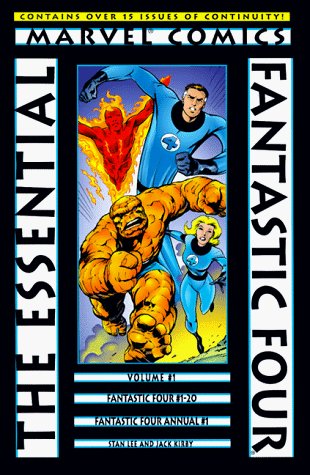
cover of Essential Fantastic Four vol 1


Essential Fantastic Four Vol. 1
Stan Lee, Jack Kirby, Dick Ayers and friends
Reprints: Fantastic Four #1-20 and Annual 1 (November 1961 – November 1963)
Get this for: the birth of a legendary comics run — Five stars

One of the first essential volumes published back in October 1998, The Essential Fantastic Four vol. 1 contains stories that should be familiar to any longtime Marvel fanboy or girl. If you haven’t read them in reprints, they have been referred to so much that it feels as if you’ve read them. Myself, I guess I’ve read roughly half of the issues collected here before and knew about most of the others. So I tought I knew what to expect even though it had been years since I’ve last read these stories. I remembered them as slightly on the dull side, typically early Marvel where you can see the potential (as with The Hulk yesterday) but it isn’t quite realised yet.

I was wrong.

Reading these first twenty issues, plus the annual in one sitting made me realise how good Lee and Kirby were right from the start. Even the origin story, repeated ad nauseam over the decades is fresh when you read the original. Lee starts the story with a bang and never lets up, building the tension from the start. Jack Kirby’s art is more subdued than Classic Kirby, more realistic and low key. And even if “Central City” is mentioned here, it’s clear the action takes place in New York. Throughout the stories here there is a sense that they do not take place in a vacuum, but in the world outside your window, fantastic as the adventures, settings and villains are. What it reminds me of is Tintin, or Carl Barks’ Uncle Scrooge, two other adventure series that have a strong sense of reality about them, even if one stars a never aging boy reporter and the other pantless anthromorphic ducks. Quality wise too these Lee + Kirby stories are on a par with Tintin’s or Barks’ best.

The art is so good here, so fluid and full of grace but always in service to the story. Kirby has great fun depicting the Fantastic Four using their powers: the Thing’s brute force, the Torch playing with fire, the Invisible Girl’s use of her power to gain the upper hand on villains dismissing her as a professional hostage and especially Mr Fantastic’s stretching. His compositions are great as well — just look at the covers, especially issue 12.

Meanwhile Lee’s writing sparkles: there’s no dull plot in the bunch, he has as much fun getting the FF’s characters right as Kirby has in showing the work: the Thing’s gruff exterior hiding a pussycat, Mr Fantastic being one step ahead of his team mates but caring deeply for them, the Torch’s hotheadedness and the Invisible Girl’s worrying. As per usual with Lee, he uses a thousand words where somebody else could’ve done it with ten, but it never grates here as it did with The Incredible Hulk. The dialogue is witty, there are few unnecessary captions or thought balloons and it all flows as naturally as the art does.

And the villains here are great: the Mole Man, Skrulls and Super Skrull, Namor the Submariner, Miracle Man, The Puppet Master, the Mad Thinker, Rama Tut and of course Doctor Doom. Doom appears in five of the twenty stories here yet never bores. Each time he returns he gets better. The Submariner is the same and even the Puppet Master, so incredibly boring when used by almost everybody else is great here.

But you know what the best thing about this volume is? As great as these Fantastic Four stories are, they will only get better!