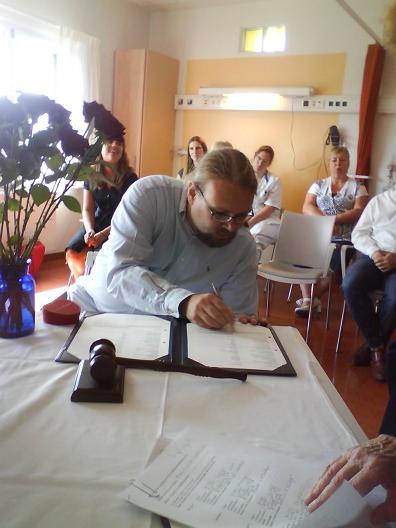
I promised you pictures last Tuesday — here’s me signing the wedding certificate. No good photos of S. yet unfortunately.
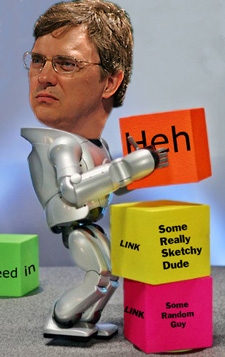
Brad Reed reports on libertarian transhumanism in which internet blowhard and proud government sponsored individualist Glenn Reynolds features prominently:
Writing over at the Cato Institute, meanwhile, mortal non-cyborg law professor Glenn Reynolds acknowledges that the creation of godlike robo-humans might have negative consequences for both the environment and the poor souls who choose to remain in their current flesh-bag forms.
“The empowerment of ordinary people is a good thing, but it also carries with it the dangers inherent in empowering bad people,” he writes. “In a world in which individuals have the powers formerly enjoyed by nation-states, an already-shrinking planet can get pretty small.”
So how does Reynolds propose to remedy this? Does he think maybe we should make it illegal to inject the screaming hobo at the local 7-11 with matter-creating nanobots? Why, no! He thinks we should resign ourselves to the fact that the Earth is doomed and instead work on blasting off into space before we all die, since “humanity won’t survive the next thousand years unless we colonize space.”
Reynolds elaborates on this theme in an essay for Popular Mechanics, going into greater detail about the dangers the Singularity could pose for humanity. Among them: nanobots that emit mind-control drugs, computer worms that infect and kill our new robobrains, and even the possibility of putting “world-killer weapons into the hands of anyone having a bad-hair day.” Reynolds admits these things might be potentially bad, but he thinks we ought to go through with them anyway since the free market will naturally create a demand for remedies to nanobot-enhanced cocaine addicts that can fire cruise missiles from their fingers.
As Reed says, transhumanism, with its emphasis on how individuals could become superhuman is the perfect fit for the type of childish rightwing libertarianism practised by the likes of Kurtzweil and Reynold, a way to evade all your obligations to society forever. It’s sadly not a new or even uncommon strain in sf fandom — from the start there have always been people who genuinely thought fans were slans, better than normal people and who swanted to remove themselves from the common herd. Even in the infancy of science fiction in the forties there were nutters like Claude Degler who wanted to create a master race of fans by getting them to breed in his special lovecamp in the Ozarks.
But the real coupling of science fiction with of rightwing libertarian science fiction only took place from the seventies and can probably be blamed on one guy: Jerry Pournelle. If you’ve read his and Larry Niven’s Footfall, where you have a team of thinly disguised science fiction writers (Pournelle and friends basically) advicing the US president during an alien invasion, that’s more or less how he would like things to be in real life. A product of Boeing as much as of Analog, Pournelle was the seventies version of Glenn Reynolds, arguing for space colonisation as essential to America’s defence and the future of the human race. He was thick with the Team B loonies, the same sort of people who three decades later would rage about the Islamist threat but where then predicting a Soviet victory in the coming Third World War, less than a decade before the USSR collapsed…
Pournelle then established this political tradition of which Reynolds is the latest example, a tradition that mixes personal greed with a technocratic vision of the future and a deep dislike of having to deal with other people… L5 colonies for the best and brightest were the answer in the seventies, brain downloads today.
Charlie Stross has made a little list of where computer science went wrong:
I’m compiling a little list, of architectural sins of the founders (between 1945 and 1990, more or less) that have bequeathed us the current mess. They’re fundamental design errors in our computing architectures; their emergent side-effects have permitted the current wave of computer crime to happen …
Let’s not quibble about the examples Charlie gives, but assume that he is right to say that these are what makes computer crimes of all sort possible. But does it matter? Or should we just look at computer crime as an unfortunate cost of actually being able to do something useful with computers? Of the six specific “sins” Charlie mentions (von Neumann architecture, String handling in C, TCP/IP lacking encryption, The World Wide Web, User education and Microsoft) at least three are the way they are because that’s what made them useful in the first place. Von Neumann architecture, where data and code are stored in the same memory and can be freely mixed made it much easier to program computers, hack them to do all kinds of tricks and squeeze the most out of limited means — not so important now perhaps, but very important even a few decades ago. TCP/IP being simple and largely unsecure makes it easy to setup and use; it’s a “good enough” solution to the problem of coupling disparate computers and networks together. The World Wide Web is again something that worked from the start and could evolve itself towards ever increasing complexity, as the hackability that does make it vulnerable to attack also meant it could be extended quite easily to scale up and deal with new demands.
Even Microsoft, evil as it is and crappy as much of its software still remains, is the way it is because it has consistently tried to give people useful hacks rather than properly designed vapourware. Ironic as it is, I’ve always had the sneaking suspicion MS DOS and Windows did as well as they did because they were so open and easy to hack around in compared to their competitors.
As Charlie admits, the most secure mainstream computer today is perhaps the IPad, in which basically you can only do what Steve Jobs allows you to do: a consumer device like your television more than a real computer. Any fule knows that security comes at the expense of usability: the more secure a computer the less you can do with it, certainly the less you can use it in unexpected ways. The other side of the medal is that with increased freedom comes greater vulnerability.
On the other hand, even if the right choices had been made way back when, does anybody doubt that with our reliance on computers and the internet in our daily lives and businesses, computer crime would be any less? You use something, it will be abused.
Amsterdam has a problem. The city may be popular with tourists, but they all stay in central Amsterdam rather than sampling the delights of Amsterdam’s other neighbourhoods. This has been troubling the city council for years but now they think they’ve found the solution: marketing!
As Jeroen Mirck reports, the Amsterdam Tourist & Convention Board has decided that branding and marketing neighbourhoods should be the key to winning over tourists. Some of the names suggested: ‘Amsterdam Docklands’, ‘Green Plantation’, ‘Swinging Melting pot’, ‘Little Amsterdam’, ‘Kinetic North’. Yes, they sound better in Dutch, but not much.
Not all neighbourhoods have gotten their own brand suggestions yet — the ones above are for parts of the city already relatively popular and gentrified. The more troublesome areas of Amsterdam have been left out of this consultation exercise so far, though the marketeers had a “hilarious” suggestion for Amsterdam Zuid-Oost, traditionally the part of the city with the most Black people: Soweto.