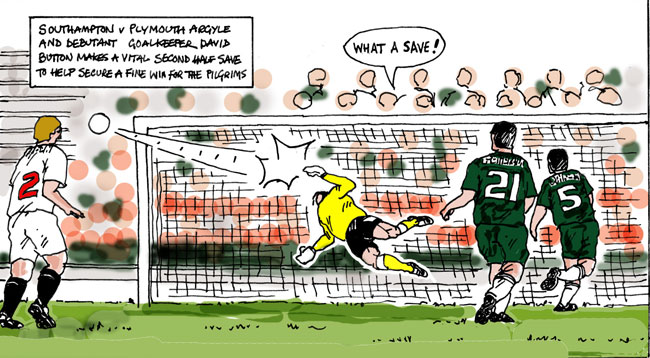
Roy of the Pilgrims?!

Last week Plymouth Argyle played its first match in League One after having been relegated last year and actually won the game, but there was something else strange about the game as well: no press photographers allowed at Southampton. So The Plymouth Herald got amateur cartoonist (and city historian) Chris Robinson to do the reporting instead. One of the results you see above — not bad at all, with a nice old skool Roy of the Rovers feel to it. Not quite an coincidence that, as Robinson says he let himself indeed be inspired by that strip. And it’s not only a nice piece of nostalgia and a clever solution to a stupid club rule, but also a great refutation of Scott McCloud’s idea that you can’t have sequential art in a sequence of one…

Love and marriage…


Television warned me about it, but I’m going to try it anyway. Dutch bureaucracy and medical realities willing S. and I will get married in the next two weeks. Not so much from a deep seated romantic need for a marriage as an symbol of our love (though that is nice) but to make sure our legal situation is stabilised just in case. As y’all know, S. has been going through a very rough patch this year after the kidney transplant what with opportunistic infections and other calamities, so now that she’s fully recovered from the previous bout the doctors want to schedule a long overdue cleanup operation. I won’t go into details, but the idea is that if the operation is succesful it will break the cycle of infection-recouperation-reinfection, by tackling several sources of infection at the same time. It’ll mean S.’s basic health level will be up, helping her cope better with the anti-rejection drugs while still able to fight off new infections. But it’s heavy duty surgery, things can go wrong and we want to make sure that if somethings happen, everything that needs to be arranged can be arranged with the least amount of legal hassle. It’ll make it that much easier to actually undergo the operation, scheduled for less than two weeks from now…

The hospital has been incredibly helpful, the doctor in charge having contacted the city council to help arrange an emergency wedding, which could be held in the hospital itself, and I have an appointment first thing monday sharp to see if we got all the paperwork to actually be able to marry, something already complicated as the Dutch bureacracy seems to ask for certain documents actually unknown to their English counterparts. Oh well, my job the last few years has largely been about convincing well meaning but rulebound civil servants to things my way, so how hard can it be (famous last words).

So no flowers, no ring, no big party, just get it done and dusted, get S. out of hospital hopefully to not return there soon and we’ll see about a proper party sometime next summer, when her family can be there as well (we hope).

German millionaires not impressed with Gates

It seems I’m not the only one unimpressed with Bill Gates’ robber barons for a better tomorrow initiative. Der Spiegel gauges the reaction of various German millionaires, interviewing Hamburg-based shipping magnate and multimillionaire Peter Krämer, who echoes my criticism:

Krämer: I find the US initiative highly problematic. You can write donations off in your taxes to a large degree in the USA. So the rich make a choice: Would I rather donate or pay taxes? The donors are taking the place of the state. That’s unacceptable.

SPIEGEL: But doesn’t the money that is donated serve the common good?

Krämer: It is all just a bad transfer of power from the state to billionaires. So it’s not the state that determines what is good for the people, but rather the rich want to decide. That’s a development that I find really bad. What legitimacy do these people have to decide where massive sums of money will flow?

SPIEGEL: It is their money at the end of the day.

Krämer: In this case, 40 superwealthy people want to decide what their money will be used for. That runs counter to the democratically legitimate state. In the end the billionaires are indulging in hobbies that might be in the common good, but are very personal.

Even if done without ulterior motives, philantropism on such a massive scale is troublesome when it’s a small elite deciding which cause is worthy enough to support. It remains just another way in which somebody like Buffet or Gates can exercise their power. Far better for society as a whole if it was made impossible to garner such huge wealth in the first place. A large part of the fortunes of these billionaires is after all build on the very backs of the people they are now wanting to help.

Sueing nazis told to fuck off

The owners of the extreme right clothing brand Thor Steinar have lost their court battle against anti-fascist parody brand Storch Heinar:

Storch Heinar

Media Tex had alleged that the brand had been damaged by the humorous label. But Judge Horst Rottmann said there was no danger that the two could be confused.

Furthermore, Storch Heinar creator Mathias Brodkorb, an MP for the centre-left Social Democrats in the Mecklenburg-Western Pomerania, was protected under the country’s freedom of speech laws, the court said.

Sehr gut.

The sanctions on Iraq were wrong too

I wasn’t one of the people, the very few people even on the left, who from the start insisted on the immorality of the sanctions imposed on Iraq after its invasion of Kuwait. I’m ashamed to say I never thought much about it until much later, when Bush’s the younger’s war on the country became imminent. It just never appeared on my radar as an issue, nor made much of an impact in the newspapers here. Only when the sanctions were argued as an alternative to war back in 2003 I formed an opinion about them and for a moment I bought into the idea that it might be a good compromise alternative to the war, before coming to my senses. Now Andrew Cockburn’s review of Invisible War: The United States and the Iraq Sanctions by Joy Gordon makes it clear I should have been much more skeptical much earlier:

Most of the time, those overseeing the blockade were able to go about their task without public reproach. Every so often a press report from Baghdad would highlight the immense slow-motion disaster in Iraq, but for the most part the conscience of the world, and especially that of the American public, remained untroubled. Administration officials reassured themselves that any hardship was entirely the fault of Saddam, and that in any case reports of civilian suffering were deliberately exaggerated by the Iraqi regime. As one US official with a key role in the Unscom weapons inspections said to me in all sincerity at the time: ‘Those people who report all those dying babies are very carefully steered to certain hospitals by the government.’ In spite of reams of child mortality statistics collected by various reputable outside parties, such as the World Health Organisation, it was impossible to convince him otherwise.

Very occasionally, a ray of truth would shine through. In 1996, the 60 Minutes correspondent Lesley Stahl interviewed Madeleine Albright, then US Ambassador to the UN. Albright maintained that sanctions had proved their value because Saddam had made some admissions about his weapons programmes and had recognised the independence of Kuwait (he did this in 1991, right after the war). Asked whether this was worth the death of half a million children, Albright replied: ‘We think the price is worth it.’ Years later, as Gordon observes, Albright was still ‘trying to explain her way out of her failure to respond more effectively to what she described as “our public relations problem”’. Her attempts to justify the policy were echoed by other sanctioneers, such as the State Department official quoted by Gordon who maintained that ‘the US is conducting a public good which it has done a poor job of selling to other countries.’

[…]

Gordon puts all this in context. ‘Under the Oil for Food programme, the Iraqi government skimmed about 10 per cent from import contracts and for a brief time received illicit payments from oil sales. The two combined amounted to about $2 billion … By contrast, in 14 months of occupation, the US-led occupation authority depleted $18 billion in funds’ – money earned from the sale of oil, most of which disappeared with little or no accounting and no discernible return to the Iraqi people. Saddam may have lavished millions on marble palaces (largely jerry-built, as their subsequent US military occupants discovered) but his greed paled in comparison to that of his successors.

The economic strangulation of Iraq was justified on the basis of Saddam’s supposed possession of nuclear, chemical or biological weapons. Year after year, UN inspectors combed Iraq in search of evidence that these WMD existed. But after 1991, the first year of inspections, when the infrastructure of Iraq’s nuclear weapons programme was detected and destroyed, along with missiles and an extensive arsenal of chemical weapons, nothing more was ever found. Given Saddam’s record of denying the existence of his nuclear project (his chemical arsenal was well known; he had used it extensively in the Iran-Iraq war, with US approval) the inspectors had strong grounds for suspicion, at least until August 1995. That was when Hussein Kamel, Saddam’s son-in-law and the former overseer of his weapons programmes, suddenly defected to Jordan, where he was debriefed by the CIA, MI6 and Unscom. In those interviews he made it perfectly clear that the entire stock of WMD had been destroyed in 1991, a confession that his interlocutors, including the UN inspectors, took great pains to conceal from the outside world.

On a more theoretical note, the fact that sanctions could continue for so long under three presidents without real reason other than the fact that they existed is a good example of how real world “conspiracies” work. Most, if not all the facts about the futility of the sanctions were known almost from the start, as was the fact that the stated reasons why they should continue were never the real reasons. Yet criticism and awareness of these issues throughout their existence has been confined to the socalled loony left, with the official storyline being swallowed uncritically by everybody else. Including by me.