The sanctions on Iraq were wrong too

I wasn’t one of the people, the very few people even on the left, who from the start insisted on the immorality of the sanctions imposed on Iraq after its invasion of Kuwait. I’m ashamed to say I never thought much about it until much later, when Bush’s the younger’s war on the country became imminent. It just never appeared on my radar as an issue, nor made much of an impact in the newspapers here. Only when the sanctions were argued as an alternative to war back in 2003 I formed an opinion about them and for a moment I bought into the idea that it might be a good compromise alternative to the war, before coming to my senses. Now Andrew Cockburn’s review of Invisible War: The United States and the Iraq Sanctions by Joy Gordon makes it clear I should have been much more skeptical much earlier:

Most of the time, those overseeing the blockade were able to go about their task without public reproach. Every so often a press report from Baghdad would highlight the immense slow-motion disaster in Iraq, but for the most part the conscience of the world, and especially that of the American public, remained untroubled. Administration officials reassured themselves that any hardship was entirely the fault of Saddam, and that in any case reports of civilian suffering were deliberately exaggerated by the Iraqi regime. As one US official with a key role in the Unscom weapons inspections said to me in all sincerity at the time: ‘Those people who report all those dying babies are very carefully steered to certain hospitals by the government.’ In spite of reams of child mortality statistics collected by various reputable outside parties, such as the World Health Organisation, it was impossible to convince him otherwise.

Very occasionally, a ray of truth would shine through. In 1996, the 60 Minutes correspondent Lesley Stahl interviewed Madeleine Albright, then US Ambassador to the UN. Albright maintained that sanctions had proved their value because Saddam had made some admissions about his weapons programmes and had recognised the independence of Kuwait (he did this in 1991, right after the war). Asked whether this was worth the death of half a million children, Albright replied: ‘We think the price is worth it.’ Years later, as Gordon observes, Albright was still ‘trying to explain her way out of her failure to respond more effectively to what she described as “our public relations problem”’. Her attempts to justify the policy were echoed by other sanctioneers, such as the State Department official quoted by Gordon who maintained that ‘the US is conducting a public good which it has done a poor job of selling to other countries.’

[…]

Gordon puts all this in context. ‘Under the Oil for Food programme, the Iraqi government skimmed about 10 per cent from import contracts and for a brief time received illicit payments from oil sales. The two combined amounted to about $2 billion … By contrast, in 14 months of occupation, the US-led occupation authority depleted $18 billion in funds’ – money earned from the sale of oil, most of which disappeared with little or no accounting and no discernible return to the Iraqi people. Saddam may have lavished millions on marble palaces (largely jerry-built, as their subsequent US military occupants discovered) but his greed paled in comparison to that of his successors.

The economic strangulation of Iraq was justified on the basis of Saddam’s supposed possession of nuclear, chemical or biological weapons. Year after year, UN inspectors combed Iraq in search of evidence that these WMD existed. But after 1991, the first year of inspections, when the infrastructure of Iraq’s nuclear weapons programme was detected and destroyed, along with missiles and an extensive arsenal of chemical weapons, nothing more was ever found. Given Saddam’s record of denying the existence of his nuclear project (his chemical arsenal was well known; he had used it extensively in the Iran-Iraq war, with US approval) the inspectors had strong grounds for suspicion, at least until August 1995. That was when Hussein Kamel, Saddam’s son-in-law and the former overseer of his weapons programmes, suddenly defected to Jordan, where he was debriefed by the CIA, MI6 and Unscom. In those interviews he made it perfectly clear that the entire stock of WMD had been destroyed in 1991, a confession that his interlocutors, including the UN inspectors, took great pains to conceal from the outside world.

On a more theoretical note, the fact that sanctions could continue for so long under three presidents without real reason other than the fact that they existed is a good example of how real world “conspiracies” work. Most, if not all the facts about the futility of the sanctions were known almost from the start, as was the fact that the stated reasons why they should continue were never the real reasons. Yet criticism and awareness of these issues throughout their existence has been confined to the socalled loony left, with the official storyline being swallowed uncritically by everybody else. Including by me.
Once more around the sun

Completed another year on this planet and the best present I could get today would be if Holland was forever excluded from any attempts to host either the Worldcup or the Olympic Games. For some reason best known to themselves the national football association and the lobbying circus surrounding that august organisation have decided we all would love to have the Worldcup come to the Netherlands in 2018 or 2022, a prospect that fills me with about as much horror as the periodic threats of a new Olympic bid for Amsterdam do. Holland is too small for these events, even if we co-host with Belgium. Getting ready for a worldcup means upgrading a lot of stadiums to capacities they will never ever use again, saddling the responsible clubs (or more like, their respective city councils) with an expensive white elephant. Economically most of the big money would be earned by FIFA and drained away abroad (untaxed of course), the big sponsors would demand exclusivity and local firms would notice little or nothing of the games. The big carrot hold in front of us is tourism, but we’ve got those coming out of our ears anyway and it’s a well known fact that big sporting events like this chase away as many tourists as they lure, as South Africa saw this year and Beijing did in 2008. Hosting a Worldcup or Olympic Games would cost a lot of money for dubious gains and what’s worse, the costs would be borne by society as a whole, through public investment while the gains would be limited to a few big businesses. A perfect microcosm of contemporary capitalism perhaps, but not in my backyard.

On a more personal level, being thirtysix today feels no different from being thirtyfive and 364 days yesterday and what with all the stuff we’ve had to deal with this year I’m not feeling particularly birthday like. Not depressed either, just not finding it that important — much more important was that S. could finally come outside for five minutes today for her first fag in weeks, having caught a case of chicken pox on top of everything else and having had to stay in quarantaine until today. The doctors are now optimistic about the possibility of quickly scheduling her hopefully last operation, which would “clean up” some of the issues the kidney transplant left behind, help lower risks of infection and yank up her resistance a bit without endangering the donor kidney. She may actually be free of the hospital this year — a far better present than physical gift, but don’t let that stop you…

Metal Monday: crossing the T

From feast to famine… Too many bands starting with an “S” to feature them all, but when it comes to “T” it’s another cup of it altogether. Two possibilites, Testament and Therapy?, though undoubtly fine bands both I’ve never really gotten into, even if they’re probably the best known metal bands of the lot. There’s also Thin Lizzy, though I’m not sure I would classify that as hard rock, let alone heavy metal, as the BNR Metal pages have done. Still it gives me an excuse to feature one of my favourite sing along to the stereo turned up to eleven songs:


Moving on to a slightly more embarassing band to like: NWOBHM influenced hair band Twisted Sister:


Brainiac begs to differ — You can stop rock ‘n roll — with a caravan!


After that particular brand of naffness, let’s go for something a bit darker. We all thought we were oh so edgy for liking Type O Negative, not just for its anti-Christianity and slight aura of e-ville but also because they supposedly broke the ultimate taboo of using nazi symbols….


Christian Woman:


And in remembrance of lead singer Peter Steele, who died this april — Everything Dies:


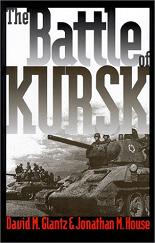
The Battle of Kursk – David M. Glantz & Jonathan M. House

The Battle of Kursk


The Battle of Kursk
David M. Glantz & Jonathan M. House
472 pages including index and notes
published in 1999

Kursk is a name most people probably only know from that Russian submarine that sank some years ago. Much fewer people know what that submarine was named after: one of the bloodiest and most important battles of World War II. The Battle of Kursk was fought in 1943, the largest tank battle of the war and was the last battle in which the Germans had the strategic initiative. After Kursk it was the Russians who held the upper hand and the Germans who had to defend. What’s more it was the first battle in which the Russian forces managed to stop the German blitzkrieg
It’s also a battle loved by war nerds, as it got the German panzer army at its peak taking on endless waves of Russian T-34s and Su-76s on the endless steppes and is so much more interesting than the infantry slog of Stalingrad…

However much of what we used to know about Kursk has come from German sources, as Soviet archives have only come available since the end of the USSR. So it has always been about the heroic deeds of the panzer commanders against the endless Slavic hordes so to speak. The emphasis has largely been on the Germans plans for the battle, on what went wrong for them and especially in the memoirs of those particpated, how it was not their fault that the battle was lost but Hitler’s. The Battle of Kursk is one of the first books on the battle to make full use of Soviet archives as well as German ones, giving a much more complete picture of the battle.

Read more

Dust in the Wind


Caught this on one of the five thousand or so interchangable music channels our cable company thinks we need. So rare to find a Dutch language song that’s actually interesting and good enough to show the world. Most Dutch artists either go for local succes or pastiche rock.