Astro City goes to the movies

Kurt Busiek’s Astro City has been oiptioned by Working Title:

Working Title Films partners Tim Bevan and Eric Fellner have made a deal to turn Kurt Busiek’s graphic novel series Astro City into a live action feature. The deal gives the prolific comic book writer Busiek his first chance to write the script. Launched in 1995, the series has a Sin City anthology vibe, set in a world crammed with superheros and super-villains. Stories are told from the vantage point of those heroes and villains, as well as the humans who get caught between them. Heroes range from Samaritan, The Hanged Man, The Apollo Eleven–a group of astronauts mutated during a moon landing–to Winged Beauty, a feisty feminist who always saves women first. The series has won multiple Eisner and Harvey Awards for Busiek, who created the series with artists Brent Anderson and Alex Ross.

Don’t puzzle too much about that Sin City reference; that’s just the last sort of arty superheroesque movie to make it big in Hollywood, so it’s de rigeur to mention with this sort of project… I’m not sure how well Astro City will work on the big screen: it depends very much on the story adapted. Seeing Kurt himself involved is a good sign; he’ll know how to go about it.

Back when Astro City started, in 1995, I dedicated my first website to it, which for a while was one of the best visited sites at my uni, especially after Kurt mentioned in an early issue. You can see the remains at kbac.orcon.net.nz. I haven’t really kept up with the series after I got fed up with comics in 2000; I should start again.
Types of skepticism

In the midst of a discussion about woo, medical science and the (misplaced?) priorities of people like Ben Goldacre at Daniel’s site, he asks an interesting question:

What interests me is that the strategy of marginalising the “anti-vaxers” and treating them as fringe loonies who didn’t have to be listened to worked so much worse in the medical sphere than similar strategies worked against “conspiracy loons” in the political sphere.

While I’m not sure his characterisation of the MMR “controversy” is accurate, it is interesting to see how quickly these fears about the MMR jab causes autism were taken up by the media and respectable, mainstream politicians and media commentators. This in contrast to e.g. the runup to the War on Iraq, where the quite obvious guff about Saddam’s WMD was barely questioned until years after the fact, with those skeptical of the evidence being given little hearing. Why is it that one type of skepticism, no matter how ill-founded, found an eager audience in the British media, while another type of skepticism, with much more evidence for it was dismissed as conspiracy theory?

Because one story slotted right into existing rightwing media narratives while the other doesn’t. The tabloids, especially the Daily Mail have always been suspicious about government propaganda about health care, mistrustful of the NHS and medical science and friendly towards alternative treatments. Having real true “scientific” evidence that the NHS and Labour were poisoning our children with autism was too good to pass up. Meanwhile, why would these same tabloids be skeptical about a war they supported anyway?

Metal Monday: Queen of the Rÿche

Okay, so heavy metal is a deeply silly musical genre at the best of times anyway, two parts pretension and juvenile angst to one part cock rock, with the best metal bands deeply aware of how silly it all is. But when you mix progrock influences in it, that’s when it gets really bad. And by bad I mean good, if you’re not too embarassed by bands taking themselves a little bit too serious. It helps to have a sense of humour and irony about these things, though not too much or you’re just another goddamn hipster tourist. If you want to enjoy a band like Queensrÿche, you need to embrace them wholeheartedly, no matter how uncool they are.

Because they can be a mite over the top and given to concept albums. Especially on Operation Mindcrime, all about a junkie rescued from the gutter to be a political assassin and how he breaks his brainwashing…. From the album came the livetour, which was as much a stage play as a proper concert. It was during the local radio station’s annual metal top fifty countdown (“Vara’s Vuurwerk Vijftig” if that means anything to y’all) that I first heard this and I was immediately sold. What can I say: I’m a sucker for properly done bombast and bathos.

“Kill Her. That’s all you have to do”.
“K-kill Mary?”
“She’s a risk. Oh, and get the priest as well”.


Next message saved Saturday at 9:24 p.m.
Sorry, I’m just
It’s starting to hit me like a um…
Um…two ton heavy thing


Anybody Listening?


Jet City Woman — always reminds me of Bubblegum Crisis which I had discovered at the same time:


Paolo Bacigalupi: threat or menace?

Every few years or so a science fiction writer comes along who becomes the darling of the critics, especially mainstream critics deigning to notice the genre, but whose qualities on closer inspection seem to be mostly so much hot air. Stephen Baxter was one of those writers, praised by Locus for his hard science fiction, winning award after award in the nineties, but never doing anything for me. Today it’s Paolo Bacigalupi, praised for his realism and worldbuilding and his non-western settings. His first novel, The Windup Girl just won the Nebula and Locus Awards. All good stuff, right, but why when reading descriptions like the one below and this from a positive review do I feel queasy?

In essence, Emiko has been designed to be a supremely beautiful, compliant geisha. Obedience has been built into her DNA. Her skin has been made ivory smooth by reducing the size of her pores. Never intended to function in a tropical climate, Emiko has nonetheless been callously abandoned in Bangkok: Her patron decided “to upgrade new in Osaka.” She was then bought by the unscrupulous Raleigh, a survivor of “coups and counter-coups, calorie plagues and starvation,” who now “squats like a liver-spotted toad in his Ploenchit ‘club,’ smiling in self-satisfaction as he instructs newly arrived foreigners in the lost arts of pre-Contraction debauch.”

If not out and out racist (and of course, filtered through Michael Dirda’s review), this is orientalist to say the least, delving into the old stereotypes of the Far East and justifying it with genetic mumbo jumbo. It may just be an unfortunate element in this story, but then there’s his traveling through China story in Salon:

I’m not proud of it, but I’m a great liar when I travel. I smile and lie and things are smooth. Every once in a while I don’t just lie to smooth the way, I lie for fun. Once, I told a taxi driver in Beijing that I’d been studying Chinese for a week. This, after having painfully studied the language for four years and lived and worked (and lied) in Beijing for another year. I think I even told him that Chinese was an easy language to learn. Perhaps most people wouldn’t think that’s funny, but it was the only time a Chinese person ever told me my Chinese was very good and really meant it.

My restaurant companion looked at me more closely and asked, “And what do you think of the Chinese people?”

Cold and heartless, but nice if you’re in their clique of friends. “They’re great, too,” I said.

Which makes me go hmmm again. It’s all a bit dodgy even without the genetically engineered elephants powering factories and the huge metal springs serving as batteries…

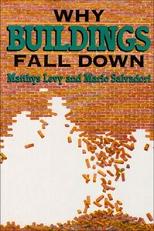
Why Buildings Fall Down – Matthys Levy and Mario Salvadori

Why Buildings Fall Down


Why Buildings Fall Down
Matthys Levy and Mario Salvadori
334 pages including index
published in 1992

It’s been a real pleasure to read this book. I read a lot of non-fiction, as you may have seen here over the years, but it’s rare that I come across a book that explains a difficult subject as lucidly and understandable as this one. Why Buildings Fall Down, as is obvious from the title, attempts to explain the science behind catastrophical structural collapses by examining various famous and not so famous disasters and tries to find common causes for them. The principle author, Mario Salvadori was a structural engineer with decades of experience in building things that don’t fall down and he and Matthys Levy are very good in translating this experience for the interested layperson like myself.

A great deal of the credit for the clarity of this book however lies also with the illustrator, Kevin Woest. Wherever the technical descriptions in the text get a bit too complicated for me, there was a drawing illustrating it perfectly. Such drawings have an advantage over using photographs, as with photos there’s always too much unimportant detail and often a muddiness in black and white. Woest’s drawings strip away everything that’s not necessary to illustrate a given concept, his art functioning as a plate of clear glass between the reader and the concept. It takes real skill to do this and do this properly.

Read more…