Hero for Hire

Think of this video as Isaiah Mustafa’s audition for the role of Luke Cage masquerading as an Old Spice blipvert:


I would love a wellmade Powerman movie, but it might turn out to be another Daredevil. As a character Luke Cage was originally nothing more than a watered down, code safe blackploitation cash-in, but still strong enough to carry his own title for fifty issues and the one he shared with his friend the white fictional martial arts artist for another seventyfive. Doing a film with him can be done, as long as it is recognisably set in New York and manages to walk a fine line between too mundane and too outrageous. You don’t want it to become just a blackploitation homage, but neither do you need the full on superheroics of a X-Men movie for example.

The Fantasy Masterworks – how many have you read?

An easy post to start off the weekend. A wweek ago I asked how many science fiction masterworks y’all had read, today it’s the turn of the Fantasy Masterworks. Somewhat less succesful than the first series, only fifty books were released in it. This relative lack of succes may be explained by the schizophrenic nature of the series. Most of the books published were well known and much loved genre classics, by writers like Dunsany, Leigh Brackett or Zelazny, but the more modern books tended towards the more literary end of the spectrum, with writers like Jonathan Carroll , Sheri Tepper or John Crowley. Nothing wrong with that, but not everybody’s cup of tea.

Some strange choices there as well: Song of Kali is not a good book, let alone a Fantasy Masterwork. (Who was it who said something like “this book does to India what the Black Death did to Europe”?) You could also argue that some of the books here are more at home amongst the science fiction masterworks, but that’s always going to be the case.

Anyway, here comes the bragging. As per usual, in bold are the ones I’ve read, italic means I’ve got them in my library and both means the obvious.

1 – The Book of the New Sun, Volume 1: Shadow and Claw – Gene Wolfe
2 – Time and the Gods – Lord Dunsany
3 – The Worm Ouroboros – E.R. Eddison
4 – Tales of the Dying Earth – Jack Vance
5 – Little, Big – John Crowley
6 – The Chronicles of Amber – Roger Zelazny
7 – Viriconium – M. John Harrison
8 – The Conan Chronicles, Volume 1: The People of the Black Circle – Robert E. Howard
9 – The Land of Laughs – Jonathan Carroll
10 – The Compleat Enchanter: The Magical Misadventures of Harold Shea – L. Sprague de Camp and Fletcher Pratt
11 – Lud-in-the-Mist – Hope Mirrlees
12 – The Book of the New Sun, Volume 2: Sword and Citadel – Gene Wolfe
13 – Fevre Dream – George R. R. Martin
14 – Beauty – Sheri S. Tepper
15 – The King of Elfland’s Daughter – Lord Dunsany
16 – The Conan Chronicles, Volume 2: The Hour of the Dragon – Robert E. Howard
17 – Elric – Michael Moorcock
18 – The First Book of Lankhmar – Fritz Leiber
19 – Riddle-Master – Patricia A. McKillip
20 – Time and Again – Jack Finney
21 – Mistress of Mistresses – E.R. Eddison
22 – Gloriana or the Unfulfill’d Queen – Michael Moorcock
23 – The Well of the Unicorn – Fletcher Pratt
24 – The Second Book of Lankhmar – Fritz Leiber
25 – Voice of Our Shadow – Jonathan Carroll

Three women in the first twentyfive entries; that’s better than the science fiction masterworks series already.

26 – The Emperor of Dreams – Clark Ashton Smith
27 – Lyonesse I: Suldrun’s Garden – Jack Vance
28 – Peace – Gene Wolfe
29 – The Dragon Waiting – John M. Ford
30 – Corum: The Prince in the Scarlet Robe – Michael Moorcock
31 – Black Gods and Scarlet Dreams – C.L. Moore
32 – The Broken Sword – Poul Anderson
33 – The House on the Borderland and Other Novels – William Hope Hodgson
34 – The Drawing of the Dark – Tim Powers
35 – Lyonesse II and III: The Green Pearl and Madouc – Jack Vance
36 – The History of Runestaff – Michael Moorcock
37 – A Voyage to Arcturus – David Lindsay
38 – Darker Than You Think – Jack Williamson
39 – The Mabinogion – Evangeline Walton
40 – Three Hearts & Three Lions – Poul Anderson
41 – Grendel – John Gardner
42 – The Iron Dragon’s Daughter – Michael Swanwick
43 – WAS – Geoff Ryman
44 – Song of Kali – Dan Simmons
45 – Replay – Ken Grimwood
46 – Sea Kings of Mars and Other Worldly Stories – Leigh Brackett
47 – The Anubis Gates – Tim Powers
48 – The Forgotten Beasts of Eld – Patricia A. McKillip
49 – Something Wicked This Way Comes – Ray Bradbury
50 – The Mark of the Beast and Other Fantastical Tales – Rudyard Kipling

And four more women in the last twentyfive. Still nowhere near enough, but still better than in the other series.
Who would want to be Harlan Ellison now?

Harlan Ellison. Harlan Ellison. Some years ago I bought a collection of his work, but didn’t read it right away. By the time I did read it, he had grabbed Connie Willis’s tit when she was the guest of honor at the Hugo Awards. Thus, when I finally read it, every story ended, for me, in “and then he grabbed Connie Willis’s tit at the Hugo Awards.”

“I Have No Mouth but I Must Grab Connie Willis’s Tit.”

— laurenpburka.

Last week the news broke that Harlan Ellison had left the internet, again. Never comfortable with it in the first place, a fairly innoceous post at Io9 drawing attention to his rare books sale drove him over the edge and off the net for the third or forth time this decade. Since HE rarely ventured outside the confines of his stone age website I doubt few beyond the coterie of dedicated fans assembled there would’ve know or cared he was on the net in the first place.

For somebody who was used to having his spats divide fandom this must be awful, but the sad fact is that Ellison has outlived his own fame. His heyday was before Star Wars when science fiction was still small; his best work is three to four decades old, his new work negligible. Anybody who started reading science fiction or entered fandom since 1990 (or even 1980) need never have encountered him, other than through secondhand stories like in the quote above.

Ellison always had an ego and was capable of backing it up as well, but looking back his knack for self promotion made him seem much important than he really was. Objectively he was a good science fiction writer with at least a dozen or so classic stories to his name, responsible for at least one important anthology (Dangerous Visions), while also having some success as a screenwriter for both television and movies, as well as an accomplished essayist. He has had a career he can be proud of, but so have hundreds of other writers. It’s quite possible to be well read in science fiction and never have touched an Ellison story.

Which is the essential tragedy of being Harlan Ellison in 2010. While he has slowly changed from an angry young man into a cranky old geezer, his fans and detractors aged along with him, while new generations of fans and readers never got to know him other than as some old guy with anger management issues.

Harvey Pekar and the Unrepentant Marxist

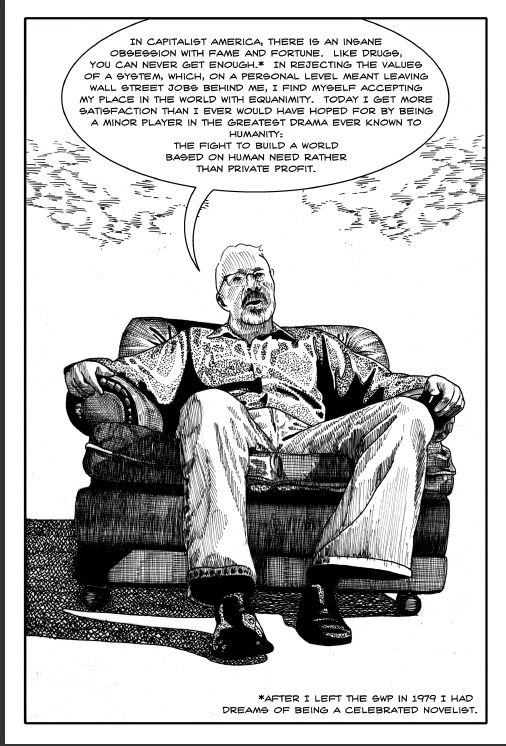
final page of the unreleased biography of Louis Proyect as written by Harvey Pekar

Louis Proyect remembers Harvey Pekar and what might be his last ever project:

Harvey is not much of a talker–at least he wasn’t that night up at my place. He had a tendency to interject “ya knows” into just about every sentence and seemed a bit out of it. So, to pass the time I began telling him about my past. Growing up in the Catskill Mountains resort area when people like Sid Caesar were coming up. Living above the Kentucky Club and hanging out with Jewish boxing legend Barney Ross, a greeter at the club, on the sidewalk where he would show me how to put up my dukes. Joining the SWP and going to Houston where I had a relationship with a woman comrade who had just quit her job as an exotic dancer. Dropping out of the SWP after a Chaplinesque stint as a spot welder. And all the rest.

[…]

Speaking on my own behalf, I would say that “Unrepentant Marxist” is a terrific book largely due to the incredible work done by artist Summer McClinton. The book is written in a kind of Jewish stand-up comedian style with lots of political observations familiar to anybody who reads this blog, including my evolution since 1981 after coming into contact with Peter Camejo, who is a major presence in the book. Ironically, I had plans to send Harvey a copy of Peter’s memoir in the next day or so. I should add that one of the last times I heard from Harvey was the day that Peter’s obit appeared in the NY Times.

I have no idea what is going to happen with this book but—believe me—I will not rest until it can be read by the public. I don’t have much use for publishing houses, or any other capitalist firm for that matter, and will make sure to remind them that this book was important to Harvey Pekar, one of the outstanding dissident voices of our era.

Louis has mentioned this comix biograpy before, but seeing that page has really whetted my appetite. It’s been interesting if sad to see how widely known Harvey Pekar was, not just for the American Splendor movie or the Letterman appearances, but for his comics. He was a central and singular figure in the development of American comics, his influence undeniable on the generations of “alt comics” cartoonists that came after him, especially those that went the (auto)biographical route. He also proved that you could do serious, personal work in comics as a writer in partnership with an artist — or even a second writer, as in Our Cancer Year with Joyce Brabner and Frank Stack as illustrator. All this means he would obviously be remembered by the wider comics community, but appreciations have also sprung out outside of it, as bloggers like Louis and Roy Edroso remembered him yesterday.

As for myself, I haven’t read as much of his work as I should’ve, apart from the abovementioned Our Cancer Year, not out of lack of interest so much as out of a simple lack of opportunity. For a much more knowledgeable appreciation of Harvey Pekar and his work than I could give, see Tom Spurgeon.

James P. Hogan 27 June 1941 – 12 July 2010

Via James Nicoll comes the news that science fiction writer James P. Hogan died yesterday. I’ve got mixed feelings about this. Though he never was a favourite of mine, I did like Inherit the Stars and its first two sequels, yet his descent into kookery and crank science was noticable even then. Embarassing enough that he believed in Immanuel Velikovsky’s theories about the Solar System, which would’ve Venus as a “cosmic egg” birthed by Jupiter whose passage through the Solar System to its current position caused the Biblical plagues in Egypt, worse when he moved on from that relatively innocent belief into disbelieving that HIV causes AIDS, that evolution and climate change are real, but it became truely awful once he got skeptical about the Holocaust as well. He long remained circumspect in stating this skepticism other than to defend the right of various odious rightwingers and nazis to deny the Holocaust, but recent remarks left on his website leave no real doubt about his beliefs:

But when an entire nation is accused of murder on a mass scale, claims that are wildly fantastic, mutually contradictory, and defy common sense and often physical possibility are allowed to stand unchallenged, truth is openly declared to be irrelevant, no evidence for defense is admitted, and even defense attorneys for the accused can be charged and imprisoned as being guilty of the same offense. Need it be said that truth does not need this kind of protection?

Which is why the momentary twinge of sadness I’d normally feel in these circumstances is muted with the relief that at least I don’t have to read about his latest embarassements anymore. I don’t think Hogan actually embraced Holocaust denial out of evil, like those neonazis who are all too willing to celebrate it in private but know it’s good p.r. to disbelieve it in public. Even if not actively evil himself though, his advocacy did help evil, make it easier to pretend Holocaust Denial is a respectable if controversial position to make, that the existence of the Holocaust is something that can be debated rather than historical fact. His stance on other socalled controversies as mentioned above isn’t that innocent either. We’ve seen the damage climate change denial has done to slow down the fight against it and you can image how much damage can be done by denying the link between HIV and AIDS, when you already have widespread folk beliefs helping speed up infection rates e.g. in various African countries.

As such Hogan could function as the poster child for engineer’s disease, a terrible warning for what can happen if intelligent, clever people think they’re much more cleverer than they really are, too clever to believe the “obvious lies of the scientific establishment”. Hogan was trained as a design engineer but quickly moved into sales as his first career, before he started writing science fiction. It’s the perfect background for catching the crackpot bug. Not trained in doing science but rather in enginering, not smart enough or too arrogant to understand his own limitations, clever enough to spot the flaws in pop science stories but again not clever enough to realise that these stories are not the whole truth. It was this misplaced skepticism and overestimation of his own abilities that started innocent enough but led him to some very dark places.