The Science Fiction Masterworks – how many have you read?

A bunch of lunatics have decided to review all the books in the Gollancz Science Fiction and Fantasy Masterworks series. These series were actually started by the Millennium publishing group about a decade or so ago, but taken over by Gollancz a few years later. Before that it had published its own short series of masterworks, all in the classic yellow Gollancz Science Fiction jacket. (It used to be I could spot any likely sf book in the local library just by looking out for that colour…)

Anyway, this is why there are two list of science fiction masterworks down below. The first list are the original Gollanzc novels, the second list the true Millennium/Gollancz series. It would’ve been a bit much to also add the Fantasy Masterworks, which are another fifty titles or so and which is no longer being added to. As per usual, in bold are the ones I’ve read, italic means I’ve got them in my library and both means the obvious.

  • I – Dune – Frank Herbert
  • II – The Left Hand of Darkness – Ursula K. Le Guin
  • III – The Man in the High Castle – Philip K. Dick
  • IV – The Stars My Destination – Alfred Bester
  • V – A Canticle for Leibowitz – Walter M. Miller, Jr.
  • VI – Childhood’s End – Arthur C. Clarke
  • VII – The Moon Is a Harsh Mistress – Robert A. Heinlein
  • VIII – Ringworld – Larry Niven
  • IX – The Forever War – Joe Haldeman
  • X – The Day of the Triffids – John Wyndham

A fairly conservative list of established classics that nobody can have great problems with. Some traditional work from Niven and Heinlein, some British classics from Clarke and Wyndham, some New Wave.

  • 1 – The Forever War – Joe Haldeman
  • 2 – I Am Legend – Richard Matheson
  • 3 – Cities in Flight – James Blish
  • 4 – Do Androids Dream of Electric Sheep? – Philip K. Dick
  • 5 – The Stars My Destination – Alfred Bester
  • 6 – Babel-17 – Samuel R. Delany
  • 7 – Lord of Light – Roger Zelazny
  • 8 – The Fifth Head of Cerberus – Gene Wolfe
  • 9 – Gateway – Frederik Pohl
  • 10 – he Rediscovery of Man – Cordwainer Smith
  • 11 – Last and First Men – Olaf Stapledon
  • 12 – Earth Abides – George R. Stewart
  • 13 – Martian Time-Slip – Philip K. Dick
  • 14 – The Demolished Man – Alfred Bester
  • 15 – Stand on Zanzibar – John Brunner
  • 16 – The Dispossessed – Ursula K. Le Guin
  • 17 – The Drowned World – J. G. Ballard
  • 18 – The Sirens of Titan – Kurt Vonnegut
  • 19 – Emphyrio – Jack Vance
  • 20 – A Scanner Darkly – Philip K. Dick
  • 21 – Star Maker – Olaf Stapledon
  • 22 – Behold the Man – Michael Moorcock
  • 23 – The Book of Skulls – Robert Silverberg
  • 24 – The Time Machine and The War of the Worlds – H. G. Wells
  • 25 – Flowers for Algernon – Daniel Keyes

Multiple Dicks but only one woman in the first twentyfive books in the series. Much “legacy” science fiction (Wells, Stapledon, Matheson, Stewart) and a tendency towards the more literary end of science fiction, though all established enough to not be controversial. Some strange choices though — why The Book of Skulls as the first Silverberg?

  • 26 – Ubik – Philip K. Dick
  • 27 – Timescape – Gregory Benford
  • 28 – More Than Human – Theodore Sturgeon
  • 29 – Man Plus – Frederik Pohl
  • 30 – A Case of Conscience – James Blish
  • 31 – The Centauri Device – M. John Harrison
  • 32 – Dr. Bloodmoney – Philip K. Dick
  • 33 – Non-Stop – Brian Aldiss
  • 34 – The Fountains of Paradise – Arthur C. Clarke
  • 35 – Pavane – Keith Roberts
  • 36 – Now Wait for Last Year – Philip K. Dick
  • 37 – Nova – Samuel R. Delany
  • 38 – The First Men in the Moon – H. G. Wells
  • 39 – The City and the Stars – Arthur C. Clarke
  • 40 – Blood Music – Greg Bear
  • 41 – Jem – Frederik Pohl
  • 42 – Bring the Jubilee – Ward Moore
  • 43 – VALIS – Philip K. Dick
  • 44 – The Lathe of Heaven – Ursula K. Le Guin
  • 45 – The Complete Roderick – John Sladek
  • 46 – Flow My Tears, the Policeman Said – Philip K. Dick
  • 47 – The Invisible Man – H. G. Wells
  • 48 – Grass – Sheri S. Tepper
  • 49 – A Fall of Moondust – Arthur C. Clarke
  • 50 – Eon – Greg Bear

Two women this time, more Dicks, more Clarke and Wells. The Aldiss entry is again a minor work.

  • 51 – The Shrinking Man – Richard Matheson
  • 52 – The Three Stigmata of Palmer Eldritch – Philip K. Dick
  • 53 – The Dancers at the End of Time – Michael Moorcock
  • 54 – The Space Merchants – Frederik Pohl and Cyril M. Kornbluth
  • 55 – Time Out of Joint – Philip K. Dick
  • 56 – Downward to the Earth – Robert Silverberg
  • 57 – The Simulacra – Philip K. Dick
  • 58 – The Penultimate Truth – Philip K. Dick
  • 59 – Dying Inside – Robert Silverberg
  • 60 – Ringworld – Larry Niven
  • 61 – The Child Garden – Geoff Ryman
  • 62 – Mission of Gravity – Hal Clement
  • 63 – A Maze of Death – Philip K. Dick
  • 64 – Tau Zero – Poul Anderson
  • 65 – Rendezvous with Rama – Arthur C. Clarke
  • 66 – Life During Wartime – Lucius Shepard
  • 67 – Where Late the Sweet Birds Sang – Kate Wilhelm
  • 68 – Roadside Picnic – Arkady and Boris Strugatsky
  • 69 – Dark Benediction – Walter M. Miller, Jr.
  • 70 – Mockingbird – Walter Tevis
  • 71 – Dune – Frank Herbert
  • 72 – The Moon Is a Harsh Mistress – Robert A. Heinlein
  • 73 – The Man in the High Castle – Philip K. Dick
  • 74 – Inverted World – Christopher Priest
  • 75 – Cat’s Cradle – Kurt Vonnegut
  • 76 – The Island of Dr. Moreau- H.G. Wells
  • 77 – Childhood’s End – Arthur C. Clarke
  • 78 – The Time Machine – H.G. Wells
  • 79 – Dhalgren – Samuel R. Delany – (July 2010)
  • 80 – Helliconia – Brian Aldiss – (August 2010)
  • 81 – Food of the Gods – H.G. Wells – (Sept. 2010)
  • 82 – The Body Snatchers – Jack Finney – (Oct. 2010)
  • 83 – The Female Man – Joanna Russ – (Nov. 2010)
  • 84 – Arslan – M.J. Engh – (Dec. 2010)

Three women in the last thirtyfour books of the series. Still not very much and a lots of repeats again in the authors that appear. A bit too conservative in the end, even if every book in the series is worth reading.

Now I know how the Germans felt all those years

Giovanni van Bronckhorst scores in the semis

For the longest part in the Worldcup Holland was barely noticed. The world press talked about how badly England and France and Italy did and how Germany had a good youthfull team but which was not quite up to winning the title and how it was going to be Brazil or Spain finally or perhaps even Argentine for the win. Even after winning every game in the group phase, after winning the next match against Slovakia not much attention was paid — Brazil would puliverse the Dutch was the general opinion. It was only after Brazil was beaten like a redheaded stepchild that the press sat up and took notice.

Suddenly I know how the Germans felt through all those tournaments when they were cruising towards yet another title and everybody condemned them for not playing proper football. Because suddenly Holland as well is accused of not playing our usual beautiful football and only winning by making it impossible for others to play, by diving and cheating. The comments on this
Guardian thread are typical.

It’s gratifying. Let them moan, as long as Oranje wins I’m not bothered.

UPDATE: we’re in the finals. So long suckers.

Hard cases make bad law even in football

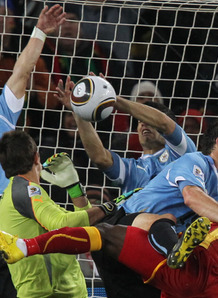
Suarez proves he's a worldclass keeper

Suarez’s Hand of God lite has once again put the refereing and rules of football in the spotlight. This time the referee made the correct decision to send off Suarez for his handball but was it Asamoah Gyan who twatted the penalty, which meant Ghana didn’t win the regular game but lost in penalties. Our sense of fair play is outraged by this, that somebody can blatantly cheat and get punished for it yet still get his team in the semi-finals. Together with several other high profile incidents like England’s disallowed equaliser against Germany which sent them out of the Worldcup there’s been somewhat of a clamour for changes in the rules, you may have noticed.

First there was the call on FIFA to finally introduce proper goal line technology and television replays, after that disallowed England goal and an Argentine goal against Mexico that was blatantly offside but not spotted by the refs, both on the same day. In both cases the goals were turning points in the game and if not for the decision they could’ve taken a different turn. Had there been goalline detectors to show the ball had crossed the line in the first case, or had video replays been officially available to the refs in the second, these injustices would’ve been prevented.

With Suarez, the outrage is focused not on the decision, but on the sanctions. Somehow after Uruguay went on to win their game on penalties, having Suarez sent off and a penalty awarded just did not seem enough. Various pundits, fans and interested bystanders instead would’ve liked to have seen not a penalty, but a goal awarded in situations like this. That way we would be certain cheaters aren’t rewarded.

These calls are understandable, but misguided. Lawyers have a saying: hard cases make bad law and that goes for football as well. Handballs are a dime a dozen, but situations like we saw in Uruguay-Ghana game are incredibly rare. In more normal situations, where a handball might have prevented a goal but the game is far from over anyway, to punish a team with a goal and a sending off is too harsh — a penalty will suffice and is usually succesful anyway. Guaranteed goals also go against the spirit of football in which only actually scored goals count and which doesn’t deal with goals that should have been scored. That’s part of the charm and frustration of football.

The need for more technology I sort of share, but I can also understand why people other than Sepp Blatter disagree with that. Again, the two examples above are so rare and so blatant it’s not that likely they will be repeated often. In fact, technology wasn’t actually needed in either of them, just referees which weren’t halfblind and looking the other way.. For more ordinary, less obvious situations the question is how to integrate this sort of technology in the flow of the game. It’s easy to use video playback to retroactively disallow a goal, but if a referee has disallowed a goal and the game goes on, how do you go from there? Would we really want to make football into a more static game, ala rugby or American football, where coaches can challenge decisions on the field?

Metal Monday – reports of my death

O is for Obituary, another Florida based Death Metal band, who first got together in the eighties — and really what else there was to do in Tampa Florida in the eighties? They played around for a couple of years before releasing their debut in ’89, but what a debut. Slowly We Rot was a masterpiece, one of those records you have to play loud on headphones to get the sound reverbing round your skull and the bass guitar echoing on your ear drums for days after. The title song especially was great, starting off slow and doom laden and then the song speeds up for the vocals and the hall erupts. I dare anybody not to start moshing to it:


From their second album Cause of Death comes “Find the Arise”, another personal favourite:


Only found two good videos this week I’m afraid; more next week.

Books read June

Only five books this month — blame the football in the second half of the month, the hot weather and having to take care of my girlfriend coming back from hospital.

As Used on the Famous Nelson Mandela — Mark Thomas
Comedian Mark Thomas looks at the international arms trade.

The Origins of the British — Stephen Oppenheimer
An exhaustive look at the genetic evidence for where the British came from and when they arrived. Surprise, it’s not quite what’s being taught in school…

Fleshmarket Close — Ian Rankin
Sometimes you need a properly depressing police procedural to get you through the day. Rankin’s Rebus stories are always good for that.

Firewall — Henning Mankell
But for a real dose of existentialistic angst with your detective story, go to Henning Mankell.

The Reconstruction of Nations — Timothy Snyder
An interesting if difficult in places case study of the interaction between history, memory and the modern idea of the nation, looking at how Poland, Lithuania, Belarus and the Ukraine evolved from a early modern state based around elite consensus into four separate ethnically basded states build on support from the masses.