Did Luis Suarez cheat?

Yes, yes he did. But hang on, Dave Brockington disagrees:

No. He did the rational thing. It was perhaps not the sporting, moral, or ethical choice, and definitely the cynical choice, but given the nature of the match, he made the correct decision.

If he doesn’t act, the ball goes in, and Uruguay are out. Plain and simple. If he acts, there’s a small chance that he does not get spotted by the referee (again, see USA v Germany 2002). If he does get spotted and correctly sent off, there’s a chance that Ghana miss the penalty. The odds of both of those events occurring in that order are slim, but as luck would have it, did indeed occur. Suarez didn’t cheat, he operated within the rules of the game. Odds are Ghana would have converted the penalty, and we wouldn’t be discussing this. However, they didn’t, and continued to miss a couple more during the shootout.

In the ensuing 100+ comment thread a lot of people agree with Dave, making the comparison with basketball, where apparantly it’s accepted practise when you’re losing to start fouling a few minutes from time to break your opponent’s streak. You make the foul, you take the punishment if caught, it’s all in the rules and you’re not a cheater.

It’s the same sort of logic used by speeders everywhere. A co-worker of mine just the other day explained he was more than happy to pay the occasional fine for the priviledge of being home sooner, all part of the system and no great crime. The same again goes for tax cheats, who’d argue that fiddling the tax man is the rational thing to do and if you’re caught, pay the fines and fiddle again next year. And of course it turned out the entire financial system was populated by people who thought that the rules did not apply to them…

This sort of supposedly rational tradeoffs — where punishment is seen purely as the potential cost of a transaction rather than as a sanction — hollows out systems. If actions like Suarez’s last night are seen as understandable, even laudable or the right thing to do in the circumstances, this means more people will attempt it, rather than playing within the spirit of the game. Doing the convenient thing rather than the right thing might be endemic in basketball, but I don’t want to see it happen in football — or at least not more than it already has. What Suarez did was cheating, he didn’t make a rational tradeoff but got punished for breaking the rules and hopefully Holland will kick Uruguay out of the tournament next Tuesday…
Two-One

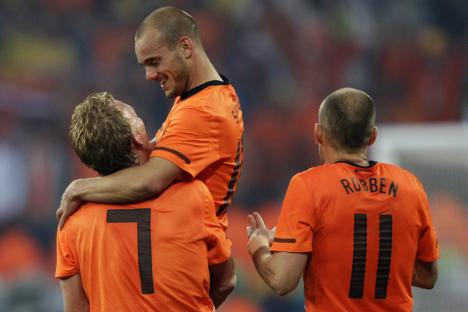
Oranje celebrates the win over Brazil

Bloody hell.

Is the Dutch team out to kill off half the Netherlands through a heart attack? A lousy first half, the Brazilians scored, another huge chance was fortunately saved by the keeper, once again keeping Holland in the game, all Dutch attacks stranded in the Brazilian defensive wall, it looked hopeless. I thought we were out of the game.

But then the second half… We came back on the field with the same team and I knew that we were doomed. But then… A great equaliser, an equally great second goal, the Brazilians one man down and Oranje looked and played so much better. Credit where credit is due, Brazil kept threatening and there were times when it did look like they would equalise. Luckily, they didn’t and we’re through to the half finals…

G20 does Toronto

Civil liberties suffered, yet Black Block weenies could still riot. Two stories that caught my eye from Toronto, that show how ridiculous police repression and misrepresentation has become. Before the G20 meeting it had been announced that not just the places the great and good would meet would out of bounds, not just the security fence supposed to protect it, but that anywhere within a radius of five metres from the fence would be verboten. Walk close to the fence and you could be arrested without course, based on an old World War II era law supposed to deal with enemy sabotage. Funny thing is, this widely announced five metre rule did not exist:

The rule seemed straightforward when the news broke last Friday that the Ontario government made a regulatory change to a little-known act in secret.

Come within five metres of the summit security fence and you’d better have some identification or risk arrest.

The temporary regulation, which was passed in secret June 2, did decree that all streets and sidewalks inside the fence were a public work until 11:59 p.m. Monday. Under the Ontario Public Works Protection Act, that allowed police to search people trying to enter that area.

But there was no power to search people coming within five metres of the fence, said ministry spokeswoman Laura Blondeau.

“The area designated by the regulation as a public work does not extend outside the boundary of the fence,” Ms. Blondeau said.

Asked Tuesday if there actually was a five-metre rule given the ministry’s clarification, Toronto Police Chief Bill Blair smiled and said, “No, but I was trying to keep the criminals out.”

In the grand scheme of things this may sound like only a little fib, compared to all the other security measures in place for the G20, the ones that were legal. However, it does show how easy it is for any police force to go beyond the already over broad powers handed to them by a compliant government and parliament. It’s not just Canada either, as this story of a young photographer being arrested for taking pictures of an army cadet parade in Romford shows. Again it shows police officers making up laws to attack behaviour they disagree with or find suspicious without it being actually illegal.

Back to the G20. Despite the intense security measures and the hordes of police on the streets, the socalled Black Bloc “activists” still managed to rampage through the city without consequences, as the eyewitness account in the video below shows.


While violent wankers got no hindrance from the police, unrelated proper peaceful demonstrators were attacked and afterwards the “threat” they presented was monstrously inflated:

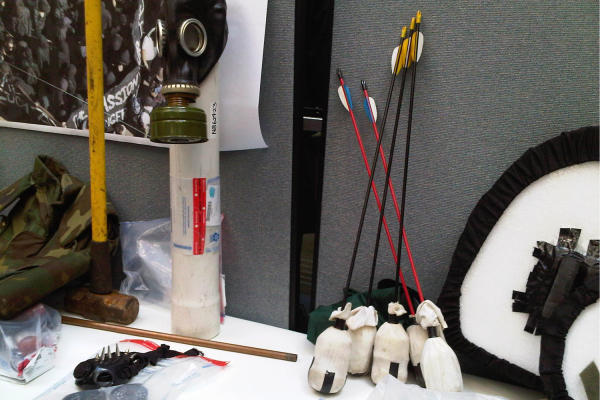
Chief Bill Blair, who told reporters the items were evidence of the protesters’ intent, singled out arrows covered in sports socks, which he said were designed to be dipped in a flammable liquid and set ablaze.

LARP weapons show as evidence of terrorism at the Toronto G20

However, the arrows belong to Brian Barrett, a 25-year-old landscaper who was heading to a role-playing fantasy game when he was stopped at Union Station on Saturday morning. Police took his jousting gear but let Mr. Barrett go, saying it was a case of bad timing.

In addition to the arrows – which Mr. Barrett made safe for live-action role playing by cutting off the pointy ends and attaching a bit of pool noodle covered in socks – police displayed his metal body armour, foam shields and several clubs made of plastic tubing covered with foam and fabric.

That’s right, the “weapons” above where from some poor LARPer, Live Action Role Player caught up in the G20 circus! Ridiculous but evidence again for how much police forces will lie to justify their actions. As said, this is something that’s ingrained in many if not most police officers, but it also serves a higher, more political goal. The story about the G20 protests thanks to this strategy of stringent security, threat inflation and police repression has never been about the merits of the protests, but only about whether all these precautions were needed and if the police didn’t go too far. It has become a law and order story, rather than a political one.

1.3 million people out of work to pay for the banker crisis

The Guardian has gotten its hands on some unpublished, official estimates at what will happen when the UK government’s proposed budget cuts get enacted: 1.3 million jobs lost in public and private sector both:

Unpublished estimates of the impact of the biggest squeeze on public spending since the second world war show that the government is expecting between 500,000 and 600,000 jobs to go in the public sector and between 600,000 and 700,000 to disappear in the private sector by 2015.

The chancellor gave no hint last week about the likely effect of his emergency measures on the labour market, although he would have had access to the forecasts traditionally prepared for ministers and senior civil servants in the days leading up to a budget or pre-budget report.

A slide from the final version of a presentation for last week’s budget, seen by the Guardian, says: “100-120,000 public sector jobs and 120-140,000 private sector jobs assumed to be lost per annum for five years through cuts.”

Supposedly the private sector will jump to the rescue by creating more jobs than are being lost this way. This while the markets are flat and businesses are barely surviving rather than growing. Any fule can see that if the government, the one remaining source of investment also throws in the towel, there’s nowhere new jobs can come from…

Paul Krugman meanwhile warns for a third depression that won;t go away quickly, thanks to:

So I don’t think this is really about Greece, or indeed about any realistic appreciation of the tradeoffs between deficits and jobs. It is, instead, the victory of an orthodoxy that has little to do with rational analysis, whose main tenet is that imposing suffering on other people is how you show leadership in tough times.

And who will pay the price for this triumph of orthodoxy? The answer is, tens of millions of unemployed workers, many of whom will go jobless for years, and some of whom will never work again.

As I said before, that’s what happens after thirty years of indoctrination about the power of the markets, the need for small government & balanced budgets and the inability and illegitimacy of government intervention in the economy. There’s a learned helplessness amongst our political elites, who not just are incapable of thinking of alternatives, but are now unaware that neoliberal capitalism isn’t a law of nature.