Geert Wilders not wanted anywhere

So Geert Wilders may have won the elections last week, but it seems for now he’s getting nowhere in organising a coalition. Negotiations with the other big winner and currently biggest party in parliament, the VVD are going slow, while the CDA, the party he wants for the third partner is so far still politely but firmly declining to talk. What’s more, many of the CDA’s members are vehemently opposed to any coalition with Wilders, as they find his politics and ideology abhorrent. And without the CDA it will become very difficult to form any coalition with Wilders in it. The other big party — the PvdA — is right out, having been diametrically opposed to him before and during the elections, while all other parties are just too small.

Which puts Wilders in a difficult position. If he wants to get in government he’ll have to make big concessions to the VVD and CDA, disappointing his voters. If he decides it’s not worth it, he will again disappoint his voters. They after all were led to believe that if he won the elections, he would get down to business and not let anybody stop him. Another four years or so in opposition may find his votes drained away again. This is what happened to the SP after the 2006 elections, when it became the third largest party in parliament and the biggest winner of the elections, yet excluded from government, so it will prey on Wilders’ mind a lot. Also preying on his mind, what happened to the LPF, Pim Fortuyn’s party after they won the elections in 2002, who did get into government but squabbled so much it lasted less than a year and virtually annihilated the party….

The good election results for Wilders therefore are proving to be a double edged sword, as they have created expectations that will be difficult to fulfill. Good news for those of us who dislike him and his islamophobic ways.
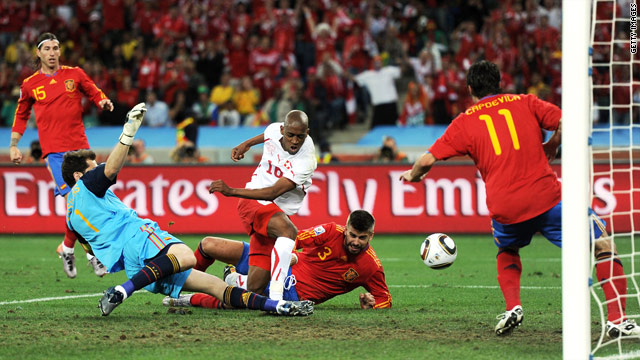

If I cannot have football, I do not want your revolution

Swiss player Gelson Fernandes scores a scrappy goal against Spain

On the whole Terry Eagleton’s opinion piece on football is quite sensible, sketching out how the beautiful game functions in our capitalist societies. It stumbles at the end though, as he slips in the necessity of abolishing it if we want to be “serious about political change”:

If the Cameron government is bad news for those seeking radical change, the World Cup is even worse. It reminds us of what is still likely to hold back such change long after the coalition is dead. If every rightwing thinktank came up with a scheme to distract the populace from political injustice and compensate them for lives of hard labour, the solution in each case would be the same: football. No finer way of resolving the problems of capitalism has been dreamed up, bar socialism. And in the tussle between them, football is several light years ahead.

[…]

With football, by contrast, there can be outbreaks of angry populism, as supporters revolt against the corporate fat cats who muscle in on their clubs; but for the most part football these days is the opium of the people, not to speak of their crack cocaine. Its icon is the impeccably Tory, slavishly conformist Beckham. The Reds are no longer the Bolsheviks. Nobody serious about political change can shirk the fact that the game has to be abolished. And any political outfit that tried it on would have about as much chance of power as the chief executive of BP has in taking over from Oprah Winfrey.

Football serves as a safety valve, as something that gives meaning and a common purpose to the lives of countless people in a society where so many other communal ties have been deliberately broken. In that sense Eagleton is correct to see it as something that helps prop up capitalism, a modern variant of Rome’s panem et circenses. But he’s wrong to therefore assuime that football needs to disappear before a revolution is possible. That’s just confusing a symptom for the disease. In our hypercapitalist world anything and everything is co-opted and used by capitalism for its own ends. It’s therefore easy to, as Eagleton does here, confuse the trees for the forest. The problem isn’t that football has been co-opted, but that there is a capitalist system to do so.

Which doesn’t mean that we should just accept capitalism’s influence on football (or other sports), but that if we want to fight this influence, we have to do so because of the love for the game itself, not out of some abstract desire for a world revolution. Because that trick never works.

CotD: family time

If there’s anybody who could convince me Christianity is not just a scam for suckers run by frauds or a way to get greedy fatheads to feel superior to people less lucky than them, it’s Fred Clark. Since 2003 he’s been tireless in showing that you can be a Christian and be smart, compassionate and — not unimportant — have a sense of humour. All of which are on show in his ongoing critique of the Left Behind series, about what happens when the x-tian Apocalypse finally happens and which so far has only managed into making the end of the world as we know it sound dull. Fred is excellent in taking the mickey about the writing and plotting of the books, but even better in skewering the little morality tales the authors indulge in. The following quote comes from
his latest post on the series, in which Fred moves from dissecting one trite moral about putting family over work and how in the real world few of us might have that luxury to addressing his readers directly about this:

For those who can afford them, I suppose these moralistic platitudes are true. But only for those who can afford them. If you’re such a person, then: 1) You might want to follow Rayford’s example and deliberately set aside time with your family free from the demands and distractions of your career; and 2) You should also thank your lucky stars that the universe has conspired to allow you to be one of the very, very few people in such a position. (Don’t ever forget this. I’m sure you’re very gifted and you’ve worked very hard. Good for you. But billions of people work much, much harder and have little to show for it. And plenty of gifted people never get the breaks you’ve gotten. There’s a reason it’s called a “fortune,” you know.)

It’s something that struck me, as I have been lucky in being able to spend so much time this year in dealing with my partner’s medical problems and that the people at work have been so understanding about this. Part of this however isn’t due to fortune, but has been due to hard work and a long struggle; not mine, but those of workers and socialists before me, who won all the rights and benefits I am now profiting from. That solidarity and common struggle is one of the things the righrwing x-ianity Fred blogs about has also undermined, with its preaching of the idea ofindividual wealth as a sign of having the right morals

Metal Monday: M.O.D., Manowar, Mucky Pup Oh My!

Quite a few good metal bands are filed under “M”: Metallica of course, as well as fellow thrash metal giants Megadeth, M.O.D. (Billy Milano’s jokey follow-up to S.O.D.), Manowar (power metal for fantasy readers), My Dying Bride, Motorhead, Morbid Angel, Mercyful Fate and Mucky Pup. Yes, Mucky Pup, the band which shot to fame through a Bloom County song writing contest Burke Breathed ran for Bill the Cat’s then band (don’t ask). This was the result:


Bonus appearance by Adam Curry. Mucky Pup was actually the first hardcore band i’d ever heard, through my brother, who had taped their 1989 album A Boy in a Man’s World. Still can recite most of the lyrics by heart, though the tape was lost years ago and I’ve only recently found a copy of the record again. Fun band, fun music. Moving away from Mucky Pup’s happy hardcore, My Dying Bride with its synth laden, slow, slow doom metal could not be more different. Again introduced to this by my brother, I like them as much as I like Mucky Pup, evne if their musical styles are diametrically opposed:


This goes on for over twelve minutes in the album version… From their 1995 album The Angel and the Demon, this is “The Cry of Mankind”. Love to play this late at night, when it’s dark and all the old fears are waiting at the window… Some people may find it all horribly overblown. A chance of pace now, get ready for some hi-octane NWOBHM courtesy of Motorhead, featured in the best episode of one of the best sitcoms ever, The Young Ones — here’s “Ace of Spades”:


Now some naff metal. Manowar is a band dedicated to fulfilling all the cliches about metal listening, Tolkien reading geeks and their fantasy life, with their songs about awesome adventures and sword fights and heroes returning from the death and motorcycles and stuff, but I can’t help but like them. Especially this, the first song of them I ever heard, during the annual top fifty countdown the sole Dutch heavy metal radio show at the time did. This is “Battle Hymn”


Morbid Angel is the third most selling Death Metal band in the world, which must in part be because they found a winning formula early on and never varied it much. This is one of the better early songs, “Blessed Are the Sick”:


Let’s end with a bit of Megadeth, Beavis and Butthead style:


Eh-heh heh eh heh heh.

Camp Concentration – Thomas M. Disch

Cover of Camp Concentration
Camp Concentration
Thomas M. Disch
325 pages
published in 1968

Camp Concentration is a classic New Wave science fiction novel, but one I’ve never read before. I’ve always been a bit scared of Disch, due to his reputation as a “difficult” and pessimistic writer. These are qualities I’ve only recently started to appreciate, together with a renewed interest in New Wave science fiction. The New Wave was a time when science fiction went through a real literary revolution, as a new generation of writers started to question the genre’s core assumptions, first in the UK and then in America, where the New Wave went into a more political direction. Camp Concentration embodies this revolution perfectly.

It’s central idea, of political prisoners injected with a specially altered syphilis virus to make them hyperintelligent in order that they can design new superweapons for the American military, completely subverts science fiction’s traditional belief in technological progress. What’s more, any kind of dark thrill that could be had from this scenario is quickly undermined as well, as we never see the any sign of anything like that going on at all. Instead we get alchemy.

Read more…