Leave Robert Green alone, you meanies

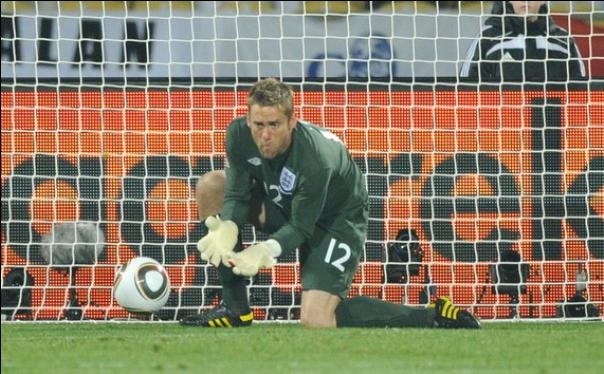
Goalie Robert Green manages to not quite catch the ball

Okay, so it was a bitter disappointment that England could not win its first match in the Worldcup, especially against the USA, which should’ve been a piece of cake. And okay, so the goal that cost England victory was one of the classic bad goals that will be a staple of late night BBC 3 clip shows for decades to come, but it’s still wrong to blame Green for it:

  • The goal wasn’t a mistake, it was an accident, something that has happened to better goalies than Green, one of those things you can’t really control. You stop the ball, it bounces awkwardly, you’re left staring as it bounces over the goal line: it happens.
  • The goal wouldn’t have been a problem if the English strikers at the other end hadn’t consistently failed to score after Gerrard’s beautiful six minute opener. There were chances enough, but both Hesky and Shaun Wright-Phillips shot straight at the keeper, which doesn’t help. Had there been evne one more English goal Green’s fumble wouldn’t have mattered.
  • Finally, all the guff about Green looking nervous and vulnerable was only visible in hindsight: had the fumble not happened, would it have been noticed?

English football fans and especially the press have a tendency to grasp at any flaw to predict England’s dooomed. This becomes a self fulfilling prophecy of which Green is now the latest victim. Stop pressuring him and he might just make good his mistake..

Ronal-Doh


Nike might be an awful money grabbing child labour using multinational, but they do know how to make a great commercial capturing the essence of both football and the various stars on display. Ronaldo dreaming of a giant Michael Jacksonesque statue of himself? Perfect.

The Night Sessions – Ken MacLeod

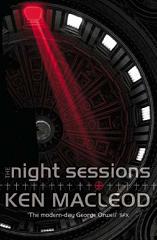
Cover of The Night Sessions


The Night Sessions
Ken MacLeod
324 pages
published in 2008

It was only when Ken ran a blurb on his blog for a promotion event for his new novel, that I realised that I hadn’t read his previous one The Night Sessions yet. So when my sweetie was running an Amazon order anyway and asked me what I wanted as a gift, this is what I asked for. Glad I did too, as it is of the usual high quality I expect from Ken.

You could call The Night Sessions a thematic sequel to The Execution Channel. That novel took place at the height of a decades long extension of the War Against Terror, while this takes place some decades after the end of what’s now called the Faith Wars in the US/UK, the Oil Wars anywhere else. Ended in a defeat for the coalition of the willing, it led to serious political repercussions in the west: the UK has disintegrated, the US is undergoing a second civil war (something Ken has used before) and in Scotland, as elsewhere religion is well and truly disestablished. There’s not just a separation of church and state, but an official constitutional police of no cognisance: the state doesn’t recognise priests, vicars, bishops, mullars or other religious offices, not even on the level of acknowledging their titles. It’s a world that fits in with Ken’s current hardline secularist attitude, as witnessed by his blog.

Read more…

And now to get a coalition

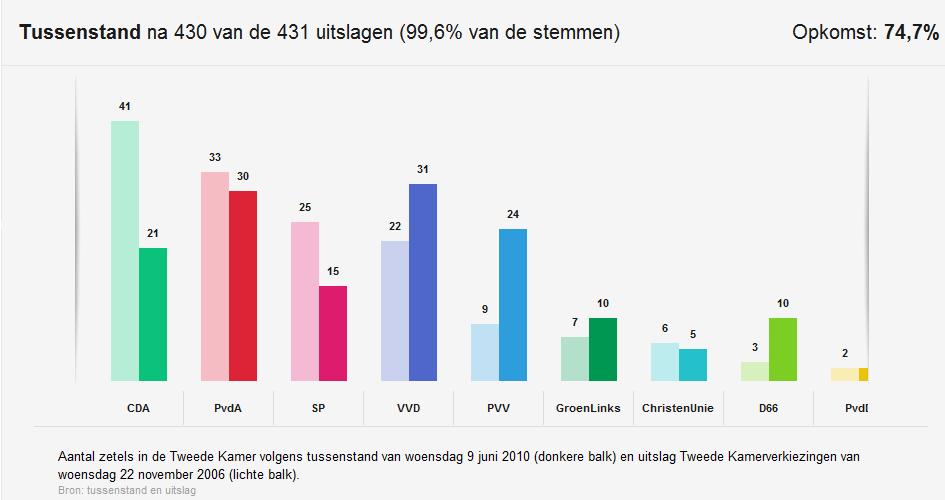
2010 Dutch election results

The graph above shows the end results of Wednesday’s parliamentary elections. Unlike what it looked like on the night itself, the right now does have a slim majority in parliament, which makes my on the night prediction that the most likely coalition will be a rightwing one look right. However, as we Dutch know, a lot of things can happen in the post-election coalition negotiations and it is by no means sure that we will end up with such a government.

In this context it was quite funny to see how stressed the English became last month when faced with a hung parliament and the prospect of a *gasp* coalition government. Where they were annoyed a new government took a week to form, we are skeptical that Mark Rutte’s promise of a new government before 1 July will be kept. If it is, Rutte will have played a strong part in it, as he’s the leader of the VVD, the rightwing party that for the first time in its existence emerged as the largest party in parliament. This however is not entirely due to the VVD’s own strength, but rather more to the extreme divide between voters. Traditionally we’ve had two to three big parties dividing most of the votes between them; now there are five or six, depending on your definition. The VVD therefore needed to win less seats to become the biggest.

Which also explains the difficulty Rutte or anybody else will have in forming a new government. Usually it’s possible to form a coalition with only two parties, or two big ones and a little one to make up the numbers. After this election however, at least three big parties are needed.

On the right, it would be natural for the VVD to go into coalition with the PVV, Wilders’ party, but will still need the CDA to make up the numbers, even if the CDA was the big loser of this election. Now the CDA has never been too embarassed by this sort of circumstances to not try and get into power, but with Balkenende gone and all the soul searching that such a loss brings with it, it’s anybody’s guess whether they will actually want to or like to sit this one out. It all depends on what they can get, obviously.

The other big question hanging over a rightwing coalition is the PVV’s relation with the VVD, of which Wilders used to be a member. There is some personal antagonism there, even if economically their politics are largely the same. Finally, there’s also the worry about how the PVV will hold up under the pressures of government — everybody is looking at what happened to the LPF, Pim Fortuyn’s party when they won the elections just after his assassination. Wilders has done a lot to ensure the problems the LPF had won’t happen to his party, but even before the elections some faultlines appeared and it’s the question whether he has done enough.

Moving on to the centre, it is also possible that there will be a coalition between CDA, PvdA and the VVD, but hardly likely considering the bad blood between CDA and PvdA and the exclusion of the PVV, which goes against the unwritten rules of Dutch coalition making. You don’t exclude such obvious winners, though that did happen to the SP in the 2006 elections. A PvdA, VVD and PVV coalition is the next option, though how sensible it would be for the PvdA to be wedged in between two rightwing parties is anybody’s guess. Let’s not even mention how much the PVV and PvdA are opposed to each other anyway. Last option here is a monster coalition with both PvdA and VVD, joined with left-liberal D66 and very christian-democrat CU, what’s called “Paars-Plus”, in recognition of the nineties VVD-PvdA-D66 governments.

Then there’s the leftwing. This is the most fractured part of the political spectrum, with the PvdA at thirty seats, the SP as second biggest with half that, followed by D66 and the green GroenLinks at ten each and finally the PvdD (the animal rights party) with two. They’re stuck at sixtyseven seats then, not enough to form a majority government and impossible to keep together anyway with so many parties. Not going to happen.

My money therefore is on a PVV-VVD-CDA coalition, which is going to be awful, as that would be a government where the CDa was the most leftwing party in it… It will mean a government united in its desire to enforce budget cuts and “liberalise” the economy further, demolishing the welfare state further. Even worse, all the Islamophobic rhetoric the PVV has engaged in now has a chance of becoming law, though both VVD and CDA would be likely to temper it somewhat. We won’t see the deportation of all Moroccan-Dutch people, but there will perhaps be laws against their religion and harassement of them. You don’t need sweeping changes in law to make the lives of a lot of people more miserable.

On a positive side, actually being in government may actually destroy the PVV LPF-style, or at least moderate them once it becomes clear it’s easier to shout than to govern. Best case scenario sees an implosion of the PVV followed by a collapse of the coalition, new elections and another roll of the dice..
Second Foundation – Isaac Asimov

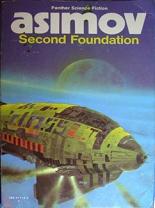
Cover of Foundation


Second Foundation
Isaac Asimov
187 pages
published in 1953

Second Foundation is the third and last novel in the Foundation series, which popularised the notion of a Galaxy spanning empire in space opera. Originally published in 1951-53 and based on short stories from the forties, the series is now almost sixty years old, something to keep in mind when reading it. The series was revolutionary when it was first published, popularising not only the Galaxy spanning human empire, but also all the bagage associated with it. Asimov famously took Edward Gibbons’ Decline and Fall of the Roman Empire and transplanted it amongst the stars, with the background assumption that only an galactic empire could guarantee peace, yet it’s inevitable that it will decline into decadence and ultimately fall into barbarism. This became a staple of fifties and sixties space opera, with lesser writers uncritically using this for their own stories of galactic derring-do. It’s a very old fashioned concept now and its familiarity lesses the impact of the Foundation series.

The same goes for psychohistory, Asimov’s other great invention in the series, the use of mass psychology to predict the future actions of a large enough group of humans, with “large enough” being an entire Galaxy worth. What with quantum mechanics and the uncertainty principle and chaos theory and all the other half remembered scientific factoids we’ve all absorbed over the past six decades or so, the idea that a group of scholars could predict human history now sounds absurd. And yet… As Donald Kingsbury showed with his 2001 novel Psychohistorical Crisis — which you could call Foundation fanfic — that these ideas in themselves are still valid, can even now be used to create an interesting story. The question therefore is, if approached with an open mind, is the original foundation series still owrht reading in its own right and not just as a historical artifact?

Read more…