Fields of Conflict – Douglas Scott, Lawrence Babits & Charles Haecker

Cover of Fields of Conflict

Fields of Conflicts is a collection of essays on battlefield archaeology, based on papers presented on a conference of the same title as the book, held in 2004. Battlefield archaeology as a separate discipline is a relatively recent development, even if military history is of course of quite ancient vintage. Astounding as it may seems, battlefield archaeology only got started in the early eighties, with a groundbreaking research paper on the Little Bighorn battlefield. Though it seems obvious in retrospect to apply archaeological techniques in researching battles and battlefields, battlefields are such ephemeral sites, battles rarely lasting more than a day, while archaeology traditionally focused on sites that had been inhabitated for centuries, that it’s no wonder it took so long for somebody to do so. That somebody was Douglas Scott, also one of the editors of this volume and you realise the impact of his research by seeing how often in the essays collected here it is refered to.

In fact, Douglas Scott is so influential that I’ve seen him on the History Channel showcasing his Little Big Horn research a few years ago, which was the first time I heard of battlefield archaeology. It was fascinating to see how it was possible to almost track the movement of single soldiers on the battlefield by hunting for the detritus they left behind in the course of the battle. Fields of Conflicts shows how much can be known of even obscure battles this way, through creative use of archaeological techniques and especially metal dectoring, but also how much still remains unknownable as well. It’s a fascinating read even for armchair historians like myself, a glimpse in how the real professionals handle these problems.

Read more…

Amsterdam garbage strike: a new workers offensive

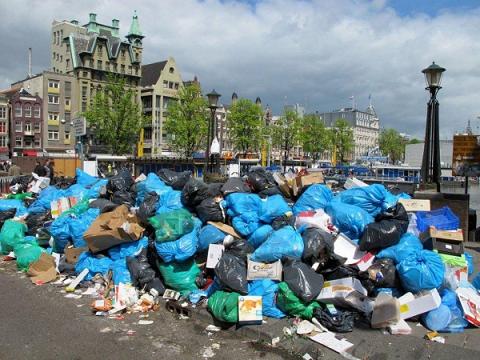
garbage piling up in Amsterdam

As I warned last month, the municipal garbage collectors in Amsterdam went on strike following Queensday, though waiting until after Memorial and Liberation Day. A week later and the garbage has started to pile up everywhere, both in the streets and at every collection point. This isn’t helped by those assholes who decide to profit from the strike by dumping commercial waste as well. Luckily the weather has been cold enough that stench hasn’t been a problem yet, though with the promise of warmer weather next week and the strike continuing all that rotting garbage may become a health hazard…

The garbage strike is just one tool the unions are using to try and get the joint municipal employers back to the negotiation table; earlier the parking ticket collectors had a one day strike (very popular) and there have been a few big demos as well. It’s a sign of the growing militancy and changing role of the unions how quickly they’ve used such an aggressive tactic however.

It didn’t used to be this way. For years, if not decades, the unions had become little more than negotiating partners for business and government, operating on a policy of compromise in what has become known as the “poldermodel“, with strikes becoming rare and ritualised pressure tools. It meant a certain amount of social stability, but the price was a growing irrelevancy of the unions to the average worker who did not see the need for union membership anymore, or at best saw it as equivalent to membership in a fitness club. As socialists like Anton Pannekoek warned about more than eighty years ago, unions had become just another tool to manage and control workers.

But in the past decade this has slowly changed. Partially this has been forced upon the unions, as the political climate in the Netherlands changed and became more openly rightwing, but not entirely so. There’s also been an internal radicalisation, a growing willingness to fight rather than compromise, as well as the realisation that the unions needed to change to become relevant again, could not longer permit themselves the luxury of only defending rights already won. One result has been a growing internationalisation of union struggles, for example in the fight to stop the EU-wide liberalisation of sea ports. The other has been a revamp of tactics and methology, heavily influenced by the experiences US unions have had in organising workers in traditionally weak and vulnerable trades, like the hotel cleaners as immortalised in Ken Loach’s Bread and Roses. A lot of these lessons were on display in the earlier cleaners strike I’ve reported on before, were the struggle was organised together with the (non-unionised) cleaners themselves, and instead of impossible mass strikes various companies were surgically targeted.

The current civil servant strike is done in the same spirit, with a series of short, smart actions rather than one long strike. So you had a public rally first, to get people’s blood up, followed by a one day strike by parking ticket collectors to hurt the city councils in their wallets, followed by the garbage strike to make it both public and impossible to ignore. Behind that and less visible in both strikes, as well as elsewhere are less visible and actually quite oldfashioned methods to get workers organised, by union activist actually going to a workplace and talk with workers there, persuade people to become unionised, get a nucleus of such workers to organise the rest of the workforce and if necessary use the same sort of smart, targeted strikes to force concessions from the bosses. And the best thing about this is that finally the unions have stopped doing purely defensive strikes, defending rights already fought for and won decades earlier, but have gone on the offensive, winning rights for those groups of people not having them yet.

Enschede ten years ago today.


Enschede seen from the air after the fireworks disaster

Ten years ago today it was a very hot day and I was at a barbeque with some friends when the news came on, as somebody got an text message on his mobile about something big happening in Enschede. This was still before mobiles, let alone internet capable mobiles and blogs and all other modern news sources became ubiquitous, so we hurrried inside to see the images on the special news broadcast. It was horrible, twentythree people killed and a whole neigbourhood destroyed and left looking like something last seen in World War II, as witnessed by the picture above.


What caused the disaster was a fire in a fireworks storage at the SE Fireworks company, located just on the edge of the neighbourhood. The fire got out of hand, got to the fireworks and these in the end exploded. As the video above shows, the force of the explosion was incredible. The responsibility for the disaster has never been satisfactorily established, with a new investigation having been promised only this week again, but having a fireworks factory on the outskirts of a suburb cannot have helped…

Whites only at Dutch football club Quick 1888

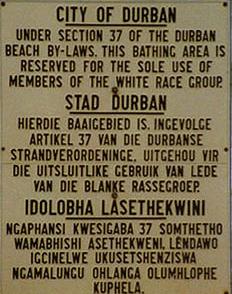
aparheid sign from the old South Africa

From 24 Oranges:

Nijmegen youth football club Quick 1888 […] has adopted a discriminatory policy by “putting children of foreign descent who apply for membership on a waiting list, while accepting native Dutch youth members.” Apparently, parents of non-native children don’t help out with football, don’t have cars to drive the kids to games or have to work on Saturdays.

That was the first I heard of this story; googling gave me the full story from the Dutch papers. Quick 1888 is an amateur club with a rich past, started as a cricket club and branched out into football, having some success before Dutch football went professional, now happily playing in the amateur leagues. Apparantly they now have about eighty percent members of “non-Dutch origin” (allochtoon as the charming Dutch phrase has it), especially in the junior teams. Apparantly having so many allochtonen is a problem for the club as, so the club says, they are less involved, less likely to volunteer, more difficult to communicate with and supposedly there’s also more trouble with them off and on the playing field. Hence the decision to select new members on origin, to get to a 50-50 percent balance of allochtonen and autochtonen. What’s more, this policy was actually undertaken on advice of the Dutch football union!

It is of course breathtakingly racist to enact such a policy, illegal as hell as well, but a more unofficial policy of selection is not uncommon; as the club itself notes, most other clubs in Nijmegen are pretty white already. You would think that all things being
equal you would get roughly the same numbers of white/non-white players at the various clubs, not one club having most of the non-white players and the other clubs few if any… One innocuous explenation could be that Quick 1888 for one reason or another was the first club that a few allochtone players joined and hence become more attractive to others until most of these players were at Quick 1888, few elsewhere. Or it could be something slightly more sinister. Anybody who’s not a child knows how easy it is for a group to discourage outsiders from joining without ever having to articulate explicit policies for doing so.

That Quick 1888 found it both necessary to form such a policy and did not expect much controversy about it is a sign of the changed political climate in the Netherlands. We’ve long been a nation that’s much less tolerant than we like to think we are, but much of our intolerance was hidden, not talked about, only visible to the people it was aimed against. With the rise of Pim Fortuyn and later Geert Wilders this taboo was broken, to the point where it became normal to talk about e.g. “kut Marokkaantjes” (little Moroccan c*nts) in a debate about street crime. Many autochtoon Dutch people have always been likely to believe the reasons the club gave for this policy anyway, feeding into long existing prejudices about foreigners,; the difference is that these now can be openly articulated, rather than remain unspoken in polite society.

This is not to say that I don’t believe Quick 1888 is lying about the problems it has had in the past few years: lack of voluntarism, communication difficulties with parents not speaking Dutch or more criminality; I’m sure these were very real problems. But thinking these problems can be solved if only more white people became members is deeply wrong. These are symptoms of a failing club, one in which the (white) administration/long term volunteers (coaches, technical staff, field maintainers, canteen staff) have become alienated from the larger (non-white) part of its membership. It won’t be the first time that has happened. What is needed is fewer white people in charge and a more creative approach to solving those problems, not blaming allochtonen.