Not to be outdone by either the Limeys or the Yanks, the Luftwaffe in Afghanistan releases its own fan video, featuring horrid yet strangely compelling German techno and YMCA style dancing…
Frank Frazetta 1928-2010
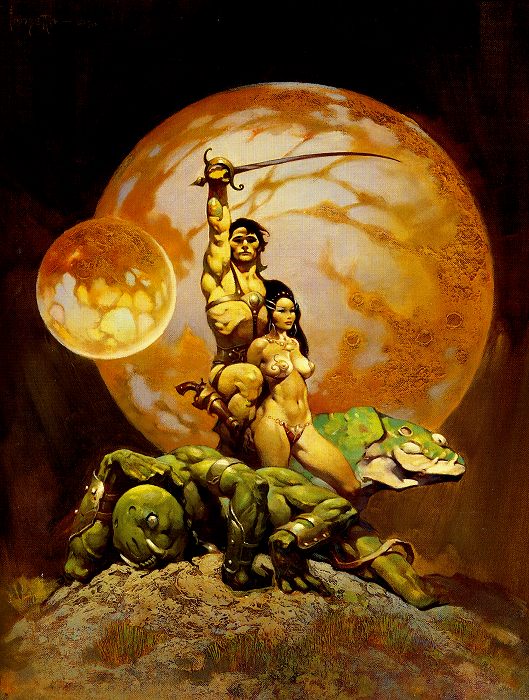
Coming across his work in the 1960s and 1970s, amid those decades’ absolute disconnect from the recent past and outright suspicion of junk culture, was a specific revelation for their being so very little out there like it. Frazetta’s work was one of the few consistent, visually accomplished gateways to somewhere else, a way of escape available to a generation of kids that was psychologically preparing to die when someone set the skies on fire. Frazetta’s were potent images, strange, of obvious skill and stuffed with conflicting messages. There were the soft women and the more dread, powerful ones. Men faced off against monsters but also nature, and in some cases their own savage impulses. There was light like the light we were used to but also strange colors, light like no one had seen but that Frazetta somehow understood. They weren’t inviting fantasies, but formidable ones, foreboding, aspirational rather than something that coddled or flattered you. If you went through the wardrobe into Narnia, events would likely fall into place, and you were pretty sure you could’ve handled that ring, but if you went to one of the worlds Frazetta painted something was going to eat you or stab you or have your soul. These were fantasies you steeled yourself towards rather than fell into. And so it was with Frank Frazetta’s art: it frequently impressed, it almost always inspired.
From The Comics Reporter excellent obituary of Frazetta, I think this paragraph captures the appeal of his art quite well. It was lush, exciting, exotic, but also a bit scary. Frazetta is of course often dismissed as no more than a panderer to the worst kind of adolescent wishfulfilment, but to do so is to miss both his obvious craft chops, as well as yes, his artistic talent.
Metal Monday: Indian!
Heavy metal is immensily popular in large parts of the world outisde Europe and North America; surprisingly so for a genre of music often seen as only belonging to white suburban scum. Yet bands like Maiden regularly sell out giantic stadiums all over South America, as well as all over India, as Rajan Datar discovered for BBC Radio Four:
With the collapse of The Iron Curtain in the 1980s, a new frontier was open for Western Music acts to exploit. For years, fans in Eastern Europe had been starved of live performances by Western bands and singers due to the difficulties involved in trying to perform in countries cut off by ideology and politics. So where is the new frontier now? Perhaps bands should look east? With the rise of India and China as economic powerhouses, complete with growing middle classes, are these now the new territories for bands and artists to target as they seek new audiences and revenue streams?
Presenter Rajan Datar follows legendary British band Iron Maiden as they head to Bangalore for a sold out festival appearance. With exclusive access Rajan hangs out backstage with singer Bruce Dickinson, who not only fronts the band, but is also the pilot of the specially-converted plane which they use to travel the world whilst on tour. He speaks to the promoters who are trying to make India the new destination of choice for Western music artists and hears from fans who have travelled for days from all parts of the sub continent to be at the concert. He also discovers, with surprising results, which musical genres sell in India and which don’t.
The actual programme is much less obsessed with filthy lucre than the description makes it sound; the best part is when it’s once again confirmed that Bruce Dickinson is a sweetie, as he calls out to the Indian fan the programme had been following. Worth checking out.
Meanwhile, over in Germany, it’s Power Metal that used to be king, with Helloween its masters. Naff as only a German band trying to make serious music can be, but I still have a not too secret linking for them. This is “I Want Out”:
I already linked to another “classic” song of theirs back in October 2007, but here are two more. First, “Dr. Stein” in a so new it’s still wet 2010 version:
Then, “Keeper of the Seven Keys”, the obligatory pseudo-fantasy story each metal band had to do in the eighties. Includes lyrics for optimal enjoyment:
Jimbo is on a rampage again
Via Making Light and Fanwank I see that Jimbo Wales, the founder of Wikipedia, has gone on one of his periodic rampages, deleting everything that could be construed as pornographic images, after catching some (predictable) flak from Faux News:
It began in early April, when Larry Sanger, arguably co-founder of Wikipedia, announces that he Reported Wikipedia to the FBI, alleging some of the hosted images violated the law.
There was brief discussion of this, but not much happened until this week, when Jimbo Wales decided to make it policy to purge some content from Wikimedia Commons, Wikipedia’s image host. Jimbo Wales isn’t actually in charge of Wikipedia anymore, but he states that the Foundation will be issuing a statement shortly. It includes the wonderfully double-think line,
Although there is a common saying that “Wikimedia Commons is not censored,” this statement should not be interpreted to imply that we do not make editorial judgments about the appropriateness of content. We do, all the time, and we must.
And continues to him saying that “explicit sexual content and other imagery without serious merit [must be] deleted.”
Admins are concerned about this, and begin editing the proposal, trying to make it into a workable policy. Eventually, it’s edited into a policy with fairly widespread support, which excludes non-photographic works, allows works of historical, artistic, or other merit, and so on.
…And that’s when Jimbo begins deleting 19th century artworks, diagrams and sketches meant to explain sexual acts, and so on. When Wikipedia has a bot which automatically removes all uses of a file when it’s deleted, making it extremely hard to put files back.
It is not the first time Jimbo has gone on an unilateral delete spree, dictating content and policy from on-high, bypassing the normal channels for dispute resolution. Two examples I myself was (briefly) involved with were the blanking of the article on John Byrne when Byrne complained about it and the difficulties with Giovanni Di Stefano, who seemed to have pressured Jimbo to wipe away perfectly uncontroversial accusations against him. Both cases were lowkey enough that Jimbo got away with his dictatorial behaviour, but with this he seemed to have bitten off more than he can chew; there’s now a proposal put forth to take away much of his powers. This can only be a good thing, as a international, volunteer driven, “open source” project like Wikipedia should not be hampered by the whims and fears of one man.
The box that changed Britain
BBC Four has a “season” of programmes about the sea all last week and this week, with today an interesting documentary about containers: The Box that Changed Britain. Most of it is about the technology and its development, but it did at least touch on the human side of containerisation. Actually, for a BBC documentary it’s surprisingly honest about the bad effects containerisation had on the dockworkers and industry in general in Britain. Effects that were not inevitable, but the result of deliberate decisions made by industrialists and politicians.
The introduction of containers transformed the backbreaking labour of loading and unloading ships, reducing the small armies of workers needed to a bare handful, which should’ve been a good thing, but cost a great deal of hardship nonetheless. After all, in a world where the workers do not own the means of production, any invention that reduces the need for labour means people getting fired and thrown into inadequate social safety nets. It’s therefore not surprising, as the documentary shows, that the British dockworkers unions were largely hostile to containerisation, at least on the terms of the bosses. Their work might have gotten easier, but fewer people had to be employed and the work itself, while physically easier, was factorised, made less independent and more controlled, again seen in the scenes set in modern container ports showing how rigidly controlled the unloading/loading schedules are.
That’s not even counting the indirect impact of containerisation, as it made international trade so much easier and cheaper it put Asian countries into direct competition with Europe and America. Again, this is not necessarily a bad development, the transformation of national into international industries, but in a capitalist world the only way most of us profit from it is in supposedly cheaper prices and more choice in our consumer tat.