Unfortunately, not yet available at your local Ikea and it needs slightly more than just an allan key: the flatpack trebuchet.
Can comics be scary? Yes.
Richard Cook asks: can comics be scary?
Yes. Next question?
Asking whether or not comics can be scary is as boring and pointless as asking whether comics can be literature. Especially when you do it, like Cook does, by comparing comics to another medium, in this case film, and earnestly explain that comics are not able to do the same things movies do:
There’s certainly no way that comics can be scary in the same way that movies are scary. Comics can’t use mysterious noises or creepy music (textual representation of sound is a poor substitute). Also, since movie-goers instinctively understand that the world of the film extends beyond the view of the camera, horror films routinely have their monsters lurk just outside the frame. And they can startle the audience by having the monster (or a fake-scare cat) pop out from outside the camera’s view. In comics, establishing clear spatial relationships from one panel to the next is difficult enough without also having to imply that there’s something lurking off-panel. And the “temporally static” nature of comics makes it impossible to startle readers with anything popping out.
But the greatest advantage that horror movies have over comics has less to due with the technical differences between the media, and more to do with how the average person watches a movie. Over the decades, Hollywood and the theater chains trained audiences to watch movies in a certain way: you turn out the lights, ignore everyone else in the room, and stop thinking. Movie-goers become completely immersed in the narrative, and horror films exploit this immersion like no other genre. As an example, when the soon-to-be victim wanders through a dark hall to investigate a strange sound, the camera forces the viewer to follow the victim and vicariously experience everything they see and hear.
A mess of baseless assertions and naive reasoning there. You could argue in the exact same way that movies are completely unsuited for horror. How can you be scared when you’re watching the action on a silver screen metres away from you, always aware of that rectangular area, amongst dozens or hundreds of other peoplea ll sitting there munching popcorn? How can you immerse yourself fully that way when the music and camera swings always remind you of the artificiality of what you’re seeing?
There’s of course a long and venerable tradition of analysing comics in movie terms, but it becomes a crutch when you start to use it to determine what comics can and cannot do. It’s self evident that comics can scare people and the evidence can be found just by asking comics readers what comics scared them — in my own case both the X-Men “Days of Future Past” storyline as the Defenders story about hell on Earth scared the pants out of me when I first read them. There’s an equally long and venerable tradition of arguing about whether comics is a fully grownup medium capable of holding its place amongst its more succesful and respected cousins. But these discussions in the end always come down to personal opinions and tastes.
Far more interesting is to go beyond these very basic questions and look at how comics do things. If we assume that yes, comics can scare people, how do they do that? Given that you can’t use scary music and sound effects or any of the other tricks available to movies, how do you force a reader into immersion, then startle them? That’s something I would love to see experts (Steve Bissette or Curt Purcell perhaps) give their opinions on. Let’s find out how comics scare people than worry whether they can.
Sexual c*nt-honey
An early contender for the worst sex scene in literature 2010 award (Literature is used here in its widest possible meaning.):
She towered over him, aggressive, powerful, dominant, totally in charge, her jewelled hands on naked, swaying, circling hips, the smile of the jailer etched on her face as she eyed him like a cat eyes a cornered mouse. Saark’s gaze slowly strayed, from the sexual cunt-honey dripping from her quivering vulva, to the large rubies on the rings that circled her fingers.
From a very entertaining review of Andy Remic’s Kell’s Legend. Remic you may remember was last seen whinging about too many negative reviews; now we know why.
A clean victory
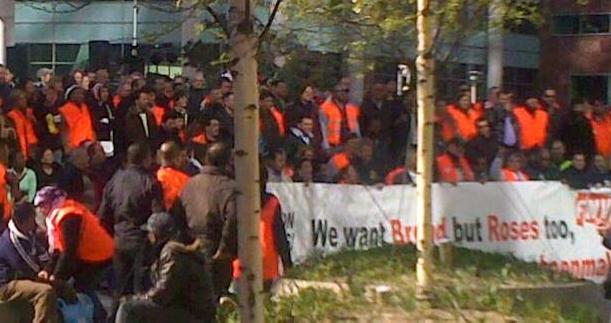
“We want bread but roses too.”
I see Jay Vos has already linked to the news about the cleaners strike, commenting on my previous post on the subject. The longest strike in Dutch history since 1933 ended in a well deserved victory for the cleaners yesterday. A binding agreement between the unions and employers has now been reached, which will see all cleaners recieve a 3,5 percent wage increase over two years, an added bonus for union members and strikers as well as free language lessons during working hours for those cleaners with limited knowledge of Dutch. It’s great news and proof that unions are still relevant and necessary, can do more than perfunctorily defend rights build up decades ago.
The cleaners strike then is an important watershed in union militancy, providing a direction for future struggles:
- Cleaning has been outsourced by most companies and government organisations and hence competition is now completely price driven — despite talk from some customers about ethical handvest and sustainable contracts and all that at the end of the day bullshit talks and money walks.
- Labour is responsible for at least eighty percent of the total costs of cleaning, hence there’s huge pressure to keep labour costs as low as possible, by keeping wages low and targets high.
- And since cleaning is “unskilled” work, largely unattractive to anybody with better options (how many students clean office buildings as a summer job) it’s mainly people who can’t find other work, or don’t have the right education, or can’t work regular hours because of other responsibilities (children), including many (recent) immigrants. Union participation therefore is low as well.
- Unlike the traditional union role therefore, the FNV had to be pro-active: actively recruiting new members while immediately campaigning with limited resources to improve working conditions. The unions had to prove themselves to the workforce.
- They did this with targeted campaigns. Last year it was cleaning strikes at Schiphol airport; this year it was a general strike, but again set up to have a miximum impact with minimal resources. In total there were less than a 1,000 strikers or so (not all union members either) on a total of 50,000 or so cleaners nation wide.
- So the strikers targeted highly visible customers like Schiphol and the railways, as well as semi-govermental organisations like the UWV (social security benefits). For example, they held a public sitdown strikes in Utrecht Centraal railway station, which is the busiest in the Netherlands. And it worked: public sympathy was high and remained high for the strikes, while the effects of the strike became increasingly noticable as it continued.
- In a broader context the effect of the victory is benificial not just for the cleaners, but for the unions and workers as a whole. It showed the power of the unions without them coming across as bullies, which is often difficult to avoid in a hostile media environment. For once the unions were also on the offensive rather than the defensive and success here will make it easier to gain victories elsewhere.
The towering culmination of all animal life
O is for Octopus: the A-Z of China Miéville.