Metal Monday: Easter Celebration Blasphemy edition

Heavy metal and Christianity don’t generally mix, though there are some pale imitations of metal bands that call themselves Christian — like every Christian imitation of a secular idea, they’re shit. In fact, whole subgenres have sprung up revolving around the hatred for Christianity or the joy of being a satanist. A lot of this is of course playacting, or just done to shock the bourgeoisie, but trust the Norwegians to have made it all real: the rise of Black Metal as a seperate genre in the early nineties saw a spate of church burnings, threats against more mainstream metal bands as well as at least one suicide and one murder. All this didn’t necessarily improve the music….

Venom – Welcome to Hell


Entombed – Left Hand Path


Mayhem – De Mysteriis Dom Sathanas — at the time of this album’s release, the lead singer had suicided and the guitarist had been murdered by the lead singer of a rival black metal band.


Nuclear Assault – Hang the Pope


Black Sabbath – Black Sabbath:


Happy Easter!

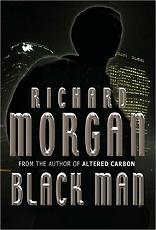
Black Man – Richard Morgan

Cover of Black Man


Black Man
Richard Morgan
630 pages
published in 2007

This was too much of a rerun for me. Black Man (published in the US as Thirteen for obvious reasons) has much the same plot as Morgan’s first novel Altered Carbon. A worldweary, cynical but ubercompetent mercenary is blackmailed into going after a murderer and in the process uncovers a far greater and more horrible truth than he suspected existed or his employers necessarily wanted him to find out. As with every Morgan novel I’ve read so far it’s an edge of your seat thriller, keeps you engaged to the bitter end, but five minutes later you’re thinking “that’s all“? I got the feeling Morgan was going through the motions, his heart not in it and it just seemed too slight to be worth a Clarke Award.

One big reason for the discomfort I felt was the silly worldbuilding. Morgan is excellent at creating a “realistic” sounding world, using infodumps, incluing and jargon to create an image in his readers’ heads, but it doesn’t work when he bases his future on the infamous Jesusland map. Remember 2006, after Bush had started his second (stolen) term and before the Congressional midterm elections, and how many of the liberal leaning blogs were despairing of their country? How it really seemed for a moment the US was split in two, with progressive coasts and an ignorant flyover country? Yeah? Remember also how fast that changed once the Democrats actually won an election? Well, it’s this that Morgan bases his future on: the Jesusland maps and books like Thomas Frank’s What’s the Matter with Kansas. It was already dated when he was writing it, now just feels hopelessly silly. It makes it hard to take the world Morgan created seriously.

Read more…

Nerd-r-I

Just saw the new Dr Who, with Matt Smith as the doctor and Steven “Coupling” Moffat as the lead writer. After several seasons with David Tennant and Russel T. Davies in the same roles Dr Who had become stale and somewhat boring, obsessed as it was with telling the same stories over and over. The teasers at the end of the last season already promised a new, lighter approach and I was glad to see this episode making good on this promise. As per usual at the start of a new seaosn much of it was spent showcasing the doctor again, with Matt Smith having the same sort of manic energy as Tennant and some of his mannerisms, but slightly wittier. The alien menace du jour looked cool and different, there were some nice hints about the overarching theme of the rest of the season and a good balance between tension and humour, we got a new companion and surprise surprise it’s another young woman already obsessed by the doctor and there’s nothing creepy about this, honest. All in all, quite an enjoyable episode, if slight.

I’m at my parents for Easter weekend btw. S. came out of hospital on Tuesday and had her son coming round for the holidays, so I could bugger off to Middelburg for some r&r. Which gave me the chance to sort through my comics collection again. I was a serious collector from about 1987 to about 2000, when I just stopped. It left me with some ten thousand or so comics, most in storage at my parents. As S. keeps telling me, we don’t have the storage to keep them all so I need to cull what I got.

Which has been …interesting, a sort of personal archaeology. So much shit I’ve bought over the years. No clue of what was good or not, just looking for a new superhero or following a favourite character and no matter it has crappy art and worse writing. It didn’t help that I started seriously collecting at a time the direct market went crazy, what with Image and Valiant and eight million copies of X-Men #1. So many comics bought because they were hyped up in Wizard or Previews, so many comics bought because they were cheap at a con and looked interesting, so many comics bought thanks to rec.arts.comics.misc or Comix-L. Then end result was a huge sprawling mess, which definitely needed culling.

But it’s hard. Getting rid of the shit comics is easy, but to get beyond that and cull the ones that are sort of okay, or even good, but just don’t fit — so many miniseries I only have two out of four issues of– that’s harder. I managed to lose about a thousand-two thousand comics in a first pass, but doubt I could do more at the moment…

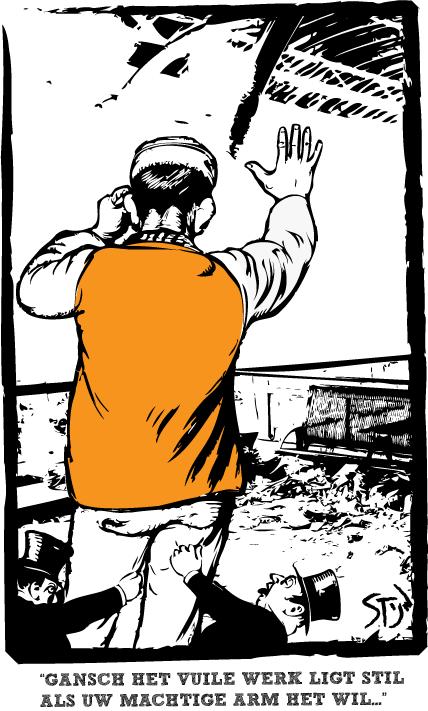
An Undutch strike

Gansch het vuile werk ligt stil, als uw machtige arm het wel -- from http://twitter.com/SPUtrecht/status/10792473205

The Dutch are not a very militant people, more given to trashing out labour relations through negotian than through strike action, especially since the agreement the unions reached back in ’82 with the government and employers’ organisations to trade wage rises for employment. Ever since union militancy has been on a low level, with occasional flareups, but mostly existing in a cozy symbiosis with the employers and the government. Not anymore though. The last few years, even before the economic crisis hit, have seen a growing number of disputes and the crisis has given them a new urgency. At the forefront of this new militancy are the cleaners.

The cleaning industry is one of the least organised branches of industry, employing people who have little or no other options for employment, often migrants, legal or otherwise. It’s badly paid and little respected, with the workers only judged on how fast they work. Most if not all cleaning these days is outsourced, which means that any and all cleaning contracts are soley judged on how little they cost, which in turn means a race to the bottom: not gpood for the workers themselves, but little better for their customers.

In the last few years Holland’s biggest union, FNV Bondgenoten (full disclosure: also my union) has been busy organising the cleaners, last year resulting in succesful strike action at Schiphol airport. With the confidence this gave the union went into negations with the cleaning companies for a sector wide binding agreement on cleaners’ wages and benefits. These negotiations failed, with the employers refusing to negotiate seriously about the union’s demands. In response, the union went on strike — which was six weeks ago.

Which makes this strike the longest since 1933! In my own office, at a semi-governmental agency which shall remain nameless, our desks haven’t been cleaned since, while the most public face of the strike are the railway stations, as the Dutch railways is one of the companies suffering from the strike. For those of y’all visiting the Netherlands in the past few weeks; our stations are not normally this filthy. Such a long strike is very undutch as one of the organisers put it (in Dutch).

But what are the cleaners striking for? Not just for better wages, abysmally low as they are now, the cleaners are only asking for two dimes extra per hour for this year and the next. What’s just as important or perhaps even more so is to get respect, the sort of basic amenities white collar workers (like, erm, me) take for granted. Things like training, travel benefits, even being able to use the company canteens where you work. Which is why the cleaners are not just targeting their own companies, but their customers. Customers like the railways, Schiphol Airport, the Free University and the Dutch unemployments benefits agency are role models for how less visible companies treat the cleaners. If they treat them right, others will be less likely to mistreat them and only these sort of big, powerful companies are able to force the cleaning companies to seriously negotiate.

The cleaners’ struggle is an important one not just for the cleaners themselves, but for all workers in the Netherlands. This is not a defensive strike, a defence of existing rights, but an offensive strike, to build up new rights, part of the union’s broader strategy to mobilise and improve the rights of workers in the weakest, least organised parts of the “labour market”. If it succeeds, it will be a powerful step forward for FNV Bondgenoten; if it fails…
Books read March

Still reading much less then I did last year in the same month, but some of the books I did read were very good indeed.

House of Suns — Alastair Reynolds
A very large scale space opera, taking place in a huge chunk galaxy and spanning millions of years, by somebody known for his “realist” approach to the genre. I found this disappointing because this scale had seemingly no impact on the characters or plot. It felt like just another Revelation Space novel.

Militant Modernism — Owen Hatherley
Owen is of course the man behind Sit Down Man, You’re a Bloody Tragedy and it’s his writing on architecture and modernism which made me read this. Owen gives a spirited defence of Modernism, puts it in its class and political context while attacking the notion that Modernism was unpopular or dehumanising.

Fields of Conflict — Douglas Scott, Lawrence Babits and Charles Haecker (editors)
A collection of essays on the challenges and difficulties of battlefield archaeology, explaining techniques and research methods and spanning a wide range of archaeological sites, from ancient Roman battlefields to those of the Korean War. An excellent book, written for professionals but very much accessible for lay people like me, interested in this subject.

Capitalist Realism — Mark Fisher
Another book by a blogger on my blogroll. Though it’s very short, barely eighty pages long, but dense in its ideas, tackling a difficult subject. We’re living in an age when there seems to be no alternative to capitalism and in which capitalism ideology has disappeared, has become the common sense assumptions underlying our daily lives. Mark Fisher sets out to make this process visible again, through the concept of capitalist realism, the ideological processes that keep capitalism propped up.

Type: the Secret History of Letters — Simon Loxley
A breezy but informed look at the history of typesetting and letter fonts. Interesting and unlike similar overview books on other subjects, it never flagged and kept my interest to the end.