So I missed my anniversary again

Last year I claimed that I started this blog on 10 March 2002, but I was lying. It was actually March 7 2002, which means I once again missed my anniversary. Not that it’s that important; I only started blogging because I needed some outlet for my frustration at reading the news and Usenet was dying and poisoned and by and large Wis[s]e Words has remained just that, a vehicle for my own thoughts. Anything more ambitious I might have hoped for has not been realised, largely because of my own laziness and reluctance to become a Stan Lee -like self promoter, as well as the usual distractions of Real Life. Over the years I’ve written a lot of reasonable posts, some truly bad ones and slightly more quite good ones, or so I’d like to think. Neilalien, a far better blogger than I, put it best when on his ten year anniversary he said:

It’s a creative outlet that brings me great joy- but I don’t let it take over my life, and I never make it a job. I don’t blog when I don’t feel like blogging. I don’t link to something that doesn’t interest me or that I haven’t read. (Nothing is more obvious and damning than a lack of interest.) I’ve always refused free review copies partly because I never wanted to feel the pressure of having to review a book. Adding ads to the site adds obligation to generate eyeballs, and potential smell-tests. The blog is not toil and trouble, it’s an escape from toil and trouble. So as yet, I never burned out. I kept it fun. If by protecting my joy, that means I haven’t shared or given of myself as much as I could have or as much as people expect from a weblog, or seem aloof, or I haven’t reviewed a comic book in a timely fashion, or I don’t get that book deal or get paid for blogging, or it means the night-sweat horror of a million missed links- so be it. The weblog is what it is. I do stubbornly addictively resist going a week without blogging, but if I do, so be it- you’ve always known what you’re getting, a working guy in his pajamas when he has time to blog about one of his life’s passions. I respect the audience, and try to be the consummate classy professional- like a Broadway actor or the Undertaker, when that curtain goes up, it’s A-Game time, regardless of what’s happening backstage or if the entrance pyrotechnics just gave you second-degree burns- I have never blogged about ennui with comics or blogging- but the moment I think to myself that I *must* blog today, that I owe you anything for visiting a free personal website, it’s over.
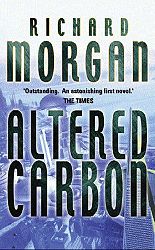
Altered Carbon – Richard Morgan

Cover of Altered Carbon


Altered Carbon
Richard Morgan
534 pages
published in 2002

Altered Carbon is Richard Morgan’s first novel. It made a strong impression, winning the Philip K. Dick Prize for best novel in 2003, as well as being optioned by Joel Silver, the sale of the movie rights enabling Morgan to become a fulltime writer. Since then Morgan has written several more novels, part of the same generation of British science fiction writers as Alastair Reynolds, Neal Asher and Jon Courtenay Grimwood. I knew of him, but had not read anything of his until last year, when I read Broken Angels and was sucked in from the first page. So not for the first time I started a series in the wrong way, as that was actually the sequel to this book — not that it mattered, as all they shared was the hero, Takeshi Kovacs.

Whereas Broken Angels was a Dirty Dozen type war romp with the cynicsm turned up to eleven, Altered Carbon is more of a Chandleresque film noir story. It starts with Takeshi as amercenary on Harlan’s World being caught and killed in a police dragnet, to wake up on Earth minus one partner and forced to solve the murder of Laurens Bancroft, which everybody but the murder victim in question thinks is suicide. If Takeshi refuses to cooperate or fails in his task he’ll go back in storage for the next couple of centuries or so.

Read more…

Metal Monday

I was both pleased and slightly annoyed last Friday on discovering BBC Four had decided to broadcast a heavy metal theme night. Pleased because metal rarely gets any kind of mention on the BBC, annoyed because if BBC Four was doing a Heavy Metal Brittannia retrospective it meant the genre had well and truly become obsolete. And true to form, the main documentary was indeed an exercise in nostalgia, focusing too much on metal’s pioneers, spending too much time on the sixties and early seventies, with barely a mention of the eighties and the N.W.O.B.H.M. and absolutely nothing on developments since. Even if the focus was on British metal, why was so much time spent on barely relevant acts like Uriah Heep instead of important post-1980 bands like Napalm Death, or Paradise Lost or whatever? Is it cynical of me to think that cutting off the story around 1980 would make metal still reasonably understandable to the BBC Four audience, while not having to mention the more extreme developments since? Still, it’s comforting to know the BBC’s usual slightly out of kilter view of music extents to metal as well — seemingly obsessed with roots and almost unable to move out of the baby boomers’ sixties-seventies time frame, as if everything that’s interesting in rock and pop got its start there.

But though I can fully appreciate the genius of Led Zeppelin, Black Sabbath or Deep Purple and the other hard rock pioneers, they’re not metal. These bands all fit in perfectly with the other big rock bands: the Stones, the Who, Cream and all the seventies stadion rock acts. Perfectly normal people could listen to them and go to their concerts and not be looked down upon. They weren’t metal. is metal:


And this.


Not to mention this.


Metal has always been a skeevy sausagefest sort of music, both thuggish and nerdy, listened to by the weird dorky kid with the Tolkien posters in his bedroom and the thicko failing woodshop with a habit of casual violence. It’s never been cool or top forty material, with some exceptions, yet remains popular everywhere anyway. Its image is violent, reactionary and misogynistic but apart from a few of the more loonier Christian pressure groups in the eigthies nobody ever got as outraged about it as they would get over a single fiddy cents video. And I love it.

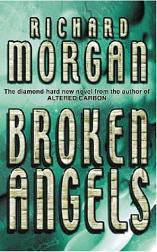
Broken Angels – Richard Morgan

Cover of Broken Angels


Broken Angels
Richard Morgan
490 pages
published in 2003

Richard Morgan is a British science fiction writer, who debuted in 2002 with Altered Carbon, to which Broken Angels is a sequel. It can however be easily read on its own, considering I just did that with no trouble at all. The only thing it has in common with the earlier novel is the protagonist, Takeshi Kovacs. I’d been aware of Morgan as a hot new writer, but hadn’t sampled him yet. Reviews of his work had been mixed and I hadn’t been interested enough to seek his books out. Which may have been a mistake, judging from Broken Angels.

From the reviews I’d read and the remarks made by friends who had read his novels I had gotten the impression that Morgan let his leftwing politics overwhelm his stories, while he was also accused of having a lot of unnecessary violence in his stories. I found neither of these allegations to be true in this case. There is a political undertone to Broken Angels, but certainly no dozen page rants; there’s violence, but it’s not at all reveled in the way John Barnes sometimes does. It reminded me in fact of Neal Asher, another author often accused of excessive use of violence, in that neither shy away from showing the consequences of violence, that being shot hurts and what it exactly does to a body. But where Asher’s descriptions are very organic, dripping with ichor and blood and bodily fluids, Morgan’s is very clean, sharp, bright and clinical but not at all detached. His characters feel their pain. And they get plenty of opportunities to feel this pain.