Ouch!

Louis Proyect puts the boot into Michael Bérubé:

He would not have time in his busy schedule to roll up his sleeves and organize like-minded people to build a coalition conforming to his own ideals. If you read his blog, you will learn that when he is not writing articles on cultural theory or redbaiting the left, he is playing hockey or the drums. In other words, he is not actually sufficiently motivated to put his crappy politics into action, the way that a serious political person might. Fundamentally, we are dealing with a dilettante who enjoys shitting on people whose views he disagrees with. Like Walter Mitty, he must have fantasies about leading people into a more just world but like most liberal intellectuals he does not bother since the Democratic Party does all the work that is necessary to rout the Taliban and al-Qaeda. After all, the Obama administration that Berube genuflects to has all the guns and money it needs to kill Afghans. Why would they require any kind of volunteer activism from a college professor who has better things to do with his spare time?

I’ve had my runins with Bérubé as well; he fancies himself as somewhat of an enforcer of acceptable leftwing behaviour but suffers from the usual liberal blinders. Especially in the early years of The War Against Terror there were quite a few liberals like him as much or even more outraged that resistance against it was largely organised by socialists, anarchists and other dirty fucking hippies than by the war itself. Hence those huge rants against Chomsky, ANSWER and such targets, who, no matter how outrageous their statements, never actually killed anybody or ordered bombardments on civilian targets in the name of freedom, but who did have the temerity to find good things to say about America’s officially designated enemies. All part of the policing political debate so that only serious people get to participate. The irony is, people like Bérubé got exactly the same treatment from the “respectable” right, but thought that the correct response would be to offer them better targets…
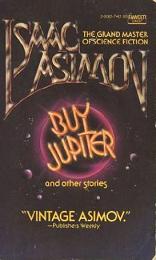
Buy Jupiter – Isaac Asimov

Cover of Buy Jupiter


Buy Jupiter
Isaac Asimov
238 pages
published in 1975

It’s hard to know for sure at this late date, but Buy Jupiter, together with I, Robot, was probably the first science fiction book I’ve ever read. one of the. I must have been seven or eight years old or so and this and the few other adult science fiction books the local library had in its childrens section instilled a lifelong love of the genre. It was therefore with some sense of nostalgia that I reread this book for the first time in years — these stories were like old friends to me. Nostalgia can be a dangerous guide of course, as so many books can turn out to have been visited by the suck fairy since you last time you’ve read them, not to mention the racism or sexism fairy. Luckily none of them have been busy on Buy Jupiter, the stories were just as good as I remembered.

This despite the fact that Buy Jupiter is a bit of a strange collection, filled with twentyfive years of leftover stories. There isn’t any classic in this, no one story you would put in a Best of Asimov collection but this might actually its strength. Because it’s a filler collection, because most of the stories are short or very short, you get a huge variation of stories and subjects, a smorgasbord of Asimov’s fiction. A good introduction to science fiction as well, though even at the time I first read those stories they were already dated — you don’t pick up on that as a child anyway.

Read more…

Stereotypes of Black superheroes

An interesting article on Io9 of all places, looking at how James Rhodes, longtime Iron Man sidekick/replacement, is just about the perfect stereotypical Black superhero:

By accident more than design, Rhodes has ended up possessing multiple characteristics that sum up the black superhero experience. Sure, he may not have the word “Black” in his superhero name (See: Black Panther, Black Lightning, Black Goliath, the Black Racer or even the Black Musketeers. Yes, that’s right; I said The Black Musketeers), and he may not ride a skateboard – Or not that we’ve seen, at least, who knows what he does in his spare time? – but look how many other checkboxes he’s managed to tick

He’s a sidekick who became a replacement for the original white hero, he’s edgy and…

He’s A Cyborg
Yes, James Rhodes is a cyborg these days. Just like DC’s Cyborg, from Teen Titans. Or Marvel’s Deathlok. Or DC’s John Henry Irons**. Or Marvel’s Bishop, from the X-Men. Or even Iron Fist’s girlfriend, Misty Knight (one of the Heroes For Hire/Daughters of The Dragon). What is it about high-profile black characters finding themselves turned into part-robot? Some kind of clever commentary on black culture being assimiliated into the white corporate machine, or white creators having a fear of a black robotic planet? I have no idea, but it’s kind of odd, isn’t it?

That so many prominent Black heroes are cyborgs might just be the result of a relatively small sampling size. since there are far fewer Black heroes than there are white, even a few cyborgs are noticable. The examples mentioned all (with the exception of Misty Knight) are all eighties or early nineties creations, which was a time crazy for cyborgs anyway. Just like every Japanese character from that time was a ninja.

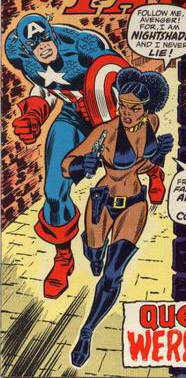
Deadly Nightshade is not afraid of catching a cold

One cliche the article misses is that Black characters not just have names that shout their Blackness — Black Panther, BlackLightning, Black McBlack, queen of the Black-Black — but also show just a litttle bit more skin than yer average white hero. A shirt open to the navel is almost de rigeur for a Black hero, while a heroine, well, bras and panties is the most they could hope for. Case in point –>

The painful truth about these cliches is that these characters were mostly created by well meaning white writers, in an attempt to address the honkiness of the Marvel and DC universes. Which explains the substitute heroes and sidekicks, because it’s always easier to introduce a variation on a proven concept than a completely original character. Even the few Black writers in comics, like Christopher Priest and Dwayne McDuffie haven’t had much luck creating new, non-derivative Black heroes, though the former worked wonders with Black Panther and the latter had a memorable run on the nineties version of Deathlok. But new characters, not tied to an existing title? Always difficult to sell, especially since the Big Two doesn’t believe black heroes will sell at all.

Another problem is that while the creators might have been well intended their experience with Black culture (and perhaps, Black people in general) often seems pretty limited, hence the tendency to follow a given decade’s pop culture cliches (disco pimps in the seventies, hiphop hard men in the nineties). Characterisation by MTV, so to speak. What’s more, the mere fact a character is Black is often supposed to be enough to distinguish them…

Hard cases make bad philosophy

Crooked Timber is going through one of its periodic spats about philosophy and especially about the use of socalled trolley problems to tease out universal principles of morality. A trolley problem is a classic philosophical thought experiment which goes something like this: “A trolley is running out of control down a track. In its path are 5 people who have been tied to the track by the mad philosopher. Fortunately, you can flip a switch, which will lead the trolley down a different track to safety. Unfortunately, there is a single person tied to that track. Should you flip the switch?” Over time these sorts of experiments have gotten more complicated and less real, which is why every so often there will be yet another 100+ comment thread on Crooked Timber on them. Now this isn’t something I’d normally would pay much attention to, but Christ Bertram’s comment as to why these examples have to be extreme struck me:

There’s a perfectly good reason why the examples we use are “far fetched”, “ludicrous” etc. It is because we are often trying to test our commitment to some principle or other which is alleged to hold universally. A principle wouldn’t even be a prima facie candidate for such universal status if it failed to deliver the right answer in the central cases, so we are bound to seek out more exotic examples – it is the way of the dialectic.

The problem with that approach is that you end up spending a lot of time and effort into constructing an extreme enough edge case to satisfy the need for universality and yet more time and effort into defending your construct against critics pointing out its flaws, leaving the consideration of the principle in question as at best a secondary activity [1]. What’s more, by forcing yourself into creating such an extreme case there’s always the danger that you’re building it towards a preferred outcome—either to prove or disprove universality.

It’s like software testing. For any moderately complex piece of software it’s easy to spent a lot of time and money creating test cases that try the limits of the system, but which are rarely or never encountered “in the wild” and which say little about the more mainstream circumstances with which the software needs to work. [2]

[1] Classic science fiction example: The Cold Equations
[2] Like the financial/payment system at a Big Government Facility I know that has provisions for combinations of benefit payouts and such that are throroughly tested with each new release but have never been used in production…

When Decents fight…

Say what you like about Marko Attila Hoare and his politics, but he knows nasty little bully boys when he sees them and he sees them at Harry’s Place:

Racism, misogyny, incitement to violence – all can be overlooked when a member of your sad little circle of groupies is the guilty party. But God forbid that anyone should hold you accountable for what appears in the comment boxes of your own website, or that anyone interfere with the right of freaks and psychos to defame and abuse whomever they want while cowering behind anonymity.

[…]

They make a cesspool, and they call it ‘freedom of speech’.

In this behaviour Harry’s Place resembles nothing quite as much as the wingnut parts of the American rightwing blogosphere. There’s the same persuction complex, the same need for enemies and the destruction of them, the same inability to understand that other people might disagree with their views other than out of sheer perversity, the same dynamics with which an already extreme worldview is made more and more extreme over time as the in crowd parrots its eternal truths over and over again while anything coming from outside the group is either rejected or seen as a confirmation of this worldview. It’s a very cultish mentality and the nasty attacks even on political allies like Marko fit in perfectly.