Comment of the Weekend: growing up multiracial

One multiracial child responds to that Louisiana judge’s foolishness about not wanting to perform mixed marriages because it’s so hard on the children not being normal:

White people are funny like that; they think they are the normal, and everyone else is “multicultural” and “ethnic” and strange; they think they are the only way to be. But we outnumber you, you know. Right now, we outnumber you in volume of numbers – I’m an Indian woman, one in twelve of living humans is Indian and female, and one in six is brown (and stands up straight, and is strong, intelligent and beautiful, despite not being pale like you). Right now, we outnumber you; mathematically, we are the normal, and it’s only accidents of history that make you so proud of being white. (Even if we weren’t, we sing, dance and tan better than you. Deal.)

As you can see from the handsome picture on the left hand side of your screen, I’m somebody who has grown up seeing people who look like me on television, in the movies, in magazines and so on all the time, whose race, skin colour and gender were defined as normal by the media I grew up with. Worse, I grew up in the most whitebread part of the most whitebread province in the Netherlands, where a full three quarters of the average school class would be blonde haired, blue aryans and the rest would have dark hair. And although the reality of life even there has become much more …colourful… the media have lagged behind. White men are still the norm, anybody else the exception. it’s no wonder that we think we are normal, as people like m grew up with the priviledge of seeing our natural assumption of being the norm affirmed all around us.

But even the flawed reflection in the media of our multicultural societies has made that illusion less and less easy to maintain. The US never was a purely “white” country, the UK and Holland haven’t been one for a long time, but for a lot of people, like that idiot in Louisiana, this is a hard truth to swallow. Especially when the world turned scary again in the wake of the September 11 attacks, the War on Iraq and locally, the murders of Pim Fortuyn and Theo van Gogh. This fear and discomfort forms what I think is the reason for Geert Wilders’ popularity, as well as a more widespread change of attitude in the Netherlands.


The Netherlands has long had a reputation for being a tolerant nation, but this tolerance has quickly disappeared in the past decade. It’s not just Islamophobia, though that’s a large part of it, but it’s a general shift in attitude towards all foreigners. There’s much less willingness to accomodate strangers, less pride in being able to speak to them in their own language and a more explicit demand that they learn our language if they come over here — and that goes for Moroccan as well as English immigrants.

The governmental commercial shown above is a good example of this new attitude. It shows several “obviously” foreign people (i.e., not-white) trying to ask questions in their own languages of an authority figure only to be stared at uncomprendingly before the patronising voiceover starts talking about how much easier it is to learn Dutch. The focus is on the duty of these people to adapt, not on the government’s role in helping them adapt.

This change in attitude is widespread, not limited to Wilders voters, — I’ve heard plenty of supposedly liberal people saying that of course everybody who lives here should learn Dutch and that the government shouldn’t waste money offering information in any other language. I’m not sure what can be done to change this attitude again, but it would help if the government didn’t encourage it in its propaganda.

Your Happening World (5)

A Pillow Book for Cats — Ursula Le Guin revealing a talent as cartoonist.

Fisking McArdle — almost as perverse an activity as sounds like and she won’t learn a thing anyway, because that’s not why she writes her crap, as this guy realises all too well, but he can’t help himself.

Over at Livejournal, Ross TenEyck had to do jury duty and described the experience for those of us living in a post-Napoleonic law system.

Continuing the legal theme, this judgement (pdf) in which queen bee of the Birthers Orly Taitz is slapped down for wasting the court’s time.

Meanwhile in Holland, the news that Brown is sending more troops to Afghanistan, but only if the Afghan government does x and the NATO allies do y and all the planets are aligned, has given fresh ammo to the people who’d like to extend the Dutch mission once again. We were promised back in 2001/02 that it would be one deployment with no extension, then we got an extension but with the promise that it would end in 2010, no matter what happened and now we have to extend this once again, because we can’t leave our allies behind. Must think we’re born yesterday.

You got to be fucking kidding me

BBC to vet BNP Question Time audience for anti-fascists but not fascists? Seem so:

Audience members for the Question Time edition featuring BNP chief Nick Griffin are being rigorously’ vetted by BBC producers to weed out likely anti-fascist demonstrators, it was confirmed today.

BBC bosses fear protesters could disrupt the recording of the programme, due to take place at the Wood Lane studios on 22 October.

As well as filling out the normal detailed questionnaire, applicants to become audience members will also be checked for membership or involvement in organisations such as United Against Facism. Many are likely to be questioned personally and be asked to prove their identities on the door.

United Against Facism, which is planning a mass blockade of the BBC studios on the day, has also urged its supporters to apply to join the audience, putting a link on its website to the audience application form.

The Corporation has confirmed that it is working closely with the Metropolitan Police and Hammersmith and Fulham council to keep a lid on the protests.

The council is concerned at the potential for disruption to local people and has asked the BBC to pay for extra policing, which the Corporation has rejected.

Heaven knows we can’t have any disturbances when the fash Nick Griffin is spouting his filth. Nice to see the Met getting involved as well; they know how to deal with peaceful protests, as proven earlier this year.

Bank fail

The biggest news story in the Netherlands today is the collapse of the DSB bank, the government closing it down yesterday after a renewed bank run when rescue plans failed over the weekend. The bank had seemed to weather the economical crisis remarkably well, but had gotten into trouble for the way its supposedly cheap loans and mortgages turned out to be not so cheap after the fact, as well as how it sold all sorts of unnecessary policies on top of its mortgages. Thousands of customers were sold much too expensive mortgages and insurance and things came to a head when the self-proclaimed spokesperson for these people called for a bank run on DSB, supposedly because a bankruptcy would make it easier to renegotiate these loans. Absurd, but it worked.

Or at least, worked so far in that DSB is now almost bankrupt. Whether or not anybody will get their money back is doubtful and anybody with a dodgy, too expensive mortgage will still be stuck with it no matter what. Debts are assets after all, somebody will buy them up, whether or not DSB will sink.

At the joint press conference yesterday the finance minister Wouter Bos explained why DSB was allowed to fail where Fortis, ABN Amro or ING weren’t. Apparantly these were completely healty banks overcome by an unforeseen economic crisis, while DSB caused its own problems. A strange explanation, when Fortis had to be rescued from its own greed in attempting to takeover ABN and ING had been selling –and worse buying– dodgy mortgages in America which turned out to be not so valuable as they had thought. They had dug their own graves as much as DSB, but only the latter was allowed to lie down in it.

A classic case of the centre vs the provinces, I fear. Dirk Schieringa, the DSB’s owner/creator and sugardaddy to current Dutch football champions AZ, is an archetypical provincial selfmade man, who made his money in the provinces and also spends it there, without connections to the established money and power centres. Brass, somewhat dodgy, an upstart, so easy to throw to the sharks.

Sequential Sunday – storytelling techniques

For some reason I was quite taken by this short comic, linked to from Journalista. It’s no more than a simple, short anecdote, but this simplicity makes it easy to see the form in which the story is told, the choices the writer and artist have made — consciously or unconsciously — to tell it. As Scott McCloud made clear in Understanding Comics and its sequels, this is an intricate yet easily overlooked craft. Until it’s laid bare for you like it was with me in this comic, you do not realise how much thought goes into these storytelling basics.

I hadn’t heard of either the writer, Jonathan Baylis, or the artist, Tim E. Ogline, before and I’m not sure what audience they had in mind for this comic. From evidence at the website it seems this is one in a series of comics done by Baylis, with different artists, all semi-autobiographical and starting with the word “so”. The style of the artists of the samples available is variable, so I think most of the credit for the presentation has to go to the artist, Tim Ogline.

It’s easy to forget if you’ve been reading them your whole life, but you need to learn how to read comics, how to interpret and order a sequence of images on a page; how an artist lays out the pages and tells the story can help or hinder this process. Tim Ogline’s choices here all seem designed to make the story easy to follow even for a non-comics reading audience. Some of his choices reflect what Bryan Talbot did for his Tale of one Bad Rat, one example of a comic deliberately designed to be readable by people unfamiliar with comics.


credits and introduction

Intrepid is only eight pages long, the first four pages providing the context for the heart of it, a two page flashback, followed by another two pages of wrapup. In it Jonathan Bayliss tells of how he went and visited the museum ship USS Intrepid with his uncle, who served on it during the Vietnam war, and how this visit triggered his uncle to talk about the day he lost his best friend there. It’s told as if Jonathan is sitting across from you in the pub telling it to you, as emphasised by the very first panel, just a head and shoulders shot of him, against an empty background, next to the credits. This headshot returns several times, each time with a simple coloured background, as a sort of guide.

The panel placement is interesting. On most pages they’re laid out in three rows, in a mixture of full length “establishing shots” and rows of two square or rectangular half length panels. But when the story comes to the moment of crisis the horizontal rows are replaced with narrow, angular panels, laid out in two rows of three columns, while the “camera” steadily moves inwards, closing up on the uncle’s face as he remembers. Since this takes place while the narrator and his uncle go down a stairwell into the bowels of the ship, the panel layout emphasises the claustrophobic, cramped feel of this. The layout is mirrored on the seventh page, after the flashback, when the “camera” moves outward again as they move back up.

When we enter his flashback we are back to the normal layout, but on the sixth page, the death of his friend is shown in four full length horizontal panels. Both choices slow down time, reinforced by the almost static images in the panel, but in the second sequence you also get an impression of the speed with which the accident happened.


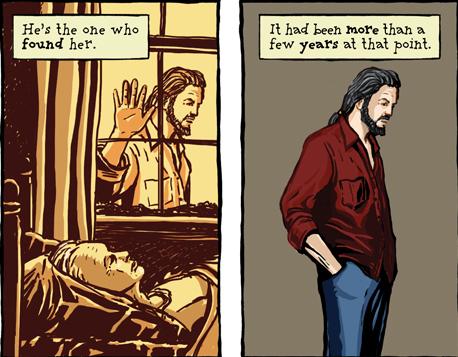
an example of how the artists shows flashbacks

As the above image shows, Ogline represents flashbacks by way of a yellow-sepia background, then carries the feeling of the flashback over into the present by the character’s stance, repeated again on the following page, as well as, more symbolically and in silhouette after the main flashback sequence. This use of colour makes the flashbacks immediately identifyable and make it easier to understand them. Colour also plays a role in emphasising mood, getting darker leading up to the flashback, while the resolution is presented in bright, clean colours.

Ogline’s drawing style in general is somewhat streamlined, if you can call it that. His people have faces that show personality enough for you to realise that they’re modeled on real persons, but which are far less detailed than his backgrounds. Interestingly, in the flashback, there is much less detail shown, the planes more sketched than drawn, which again helps establish that these are memories.

To recap then, what makes this comic accesible to new readers are several techniques. First, the panel and page layout is kept deliberately simple, moving from top to bottom, right to left in predictable patterns, but with the panel shapes changed to emphasise mood. Second, there’s the use of colour to create a distinctive look for the flashbacks, as well as to once again emphasise mood and place. Third, there are the repetitive elements: the narrator’s headshot, the way the uncle stands, to guide the reader through the story. Finally, there’s the artist’s drawing style which keeps a fine balance between overwhelming realism and cartoon. These are all techniques used by all cartoonists at one time or another, on particular fine display here.