Sequential Sunday – storytelling techniques

For some reason I was quite taken by this short comic, linked to from Journalista. It’s no more than a simple, short anecdote, but this simplicity makes it easy to see the form in which the story is told, the choices the writer and artist have made — consciously or unconsciously — to tell it. As Scott McCloud made clear in Understanding Comics and its sequels, this is an intricate yet easily overlooked craft. Until it’s laid bare for you like it was with me in this comic, you do not realise how much thought goes into these storytelling basics.

I hadn’t heard of either the writer, Jonathan Baylis, or the artist, Tim E. Ogline, before and I’m not sure what audience they had in mind for this comic. From evidence at the website it seems this is one in a series of comics done by Baylis, with different artists, all semi-autobiographical and starting with the word “so”. The style of the artists of the samples available is variable, so I think most of the credit for the presentation has to go to the artist, Tim Ogline.

It’s easy to forget if you’ve been reading them your whole life, but you need to learn how to read comics, how to interpret and order a sequence of images on a page; how an artist lays out the pages and tells the story can help or hinder this process. Tim Ogline’s choices here all seem designed to make the story easy to follow even for a non-comics reading audience. Some of his choices reflect what Bryan Talbot did for his Tale of one Bad Rat, one example of a comic deliberately designed to be readable by people unfamiliar with comics.
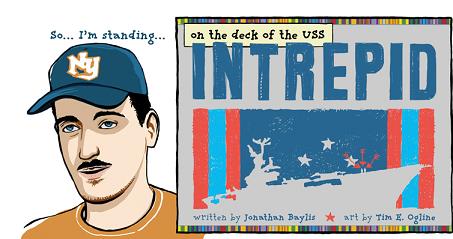

credits and introduction

Intrepid is only eight pages long, the first four pages providing the context for the heart of it, a two page flashback, followed by another two pages of wrapup. In it Jonathan Bayliss tells of how he went and visited the museum ship USS Intrepid with his uncle, who served on it during the Vietnam war, and how this visit triggered his uncle to talk about the day he lost his best friend there. It’s told as if Jonathan is sitting across from you in the pub telling it to you, as emphasised by the very first panel, just a head and shoulders shot of him, against an empty background, next to the credits. This headshot returns several times, each time with a simple coloured background, as a sort of guide.

The panel placement is interesting. On most pages they’re laid out in three rows, in a mixture of full length “establishing shots” and rows of two square or rectangular half length panels. But when the story comes to the moment of crisis the horizontal rows are replaced with narrow, angular panels, laid out in two rows of three columns, while the “camera” steadily moves inwards, closing up on the uncle’s face as he remembers. Since this takes place while the narrator and his uncle go down a stairwell into the bowels of the ship, the panel layout emphasises the claustrophobic, cramped feel of this. The layout is mirrored on the seventh page, after the flashback, when the “camera” moves outward again as they move back up.

When we enter his flashback we are back to the normal layout, but on the sixth page, the death of his friend is shown in four full length horizontal panels. Both choices slow down time, reinforced by the almost static images in the panel, but in the second sequence you also get an impression of the speed with which the accident happened.
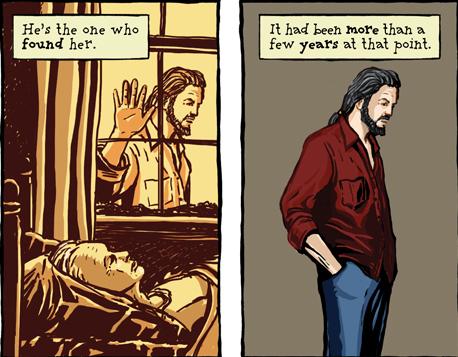

an example of how the artists shows flashbacks

As the above image shows, Ogline represents flashbacks by way of a yellow-sepia background, then carries the feeling of the flashback over into the present by the character’s stance, repeated again on the following page, as well as, more symbolically and in silhouette after the main flashback sequence. This use of colour makes the flashbacks immediately identifyable and make it easier to understand them. Colour also plays a role in emphasising mood, getting darker leading up to the flashback, while the resolution is presented in bright, clean colours.

Ogline’s drawing style in general is somewhat streamlined, if you can call it that. His people have faces that show personality enough for you to realise that they’re modeled on real persons, but which are far less detailed than his backgrounds. Interestingly, in the flashback, there is much less detail shown, the planes more sketched than drawn, which again helps establish that these are memories.

To recap then, what makes this comic accesible to new readers are several techniques. First, the panel and page layout is kept deliberately simple, moving from top to bottom, right to left in predictable patterns, but with the panel shapes changed to emphasise mood. Second, there’s the use of colour to create a distinctive look for the flashbacks, as well as to once again emphasise mood and place. Third, there are the repetitive elements: the narrator’s headshot, the way the uncle stands, to guide the reader through the story. Finally, there’s the artist’s drawing style which keeps a fine balance between overwhelming realism and cartoon. These are all techniques used by all cartoonists at one time or another, on particular fine display here.
an animated Under Construction sign blinking at the bottom of a page – forever

Early internet nostalgia at MeFi:

The amateur web circa 1999 actually took a certain ammount of technical knowledge to participate in. You at the very least had to know how to work a WYSIWYG editor, and more likely, knew HTML – all to put a site up on Geocities talking about how much you hate the Spice Girls, and your movie review for the Matrix. The Amateur web today requires about as much technical knowledge as it takes to operate any other basic computer program, since Web 2.0 has turned web pages into applications. I’m not qualifying one era against the other, and in fact I prefer the more egalitarian Internet, but it’s still interesting to look back through. A garish tripod page about cool gifs has a little more of a personal touch than even the best Facebook profile.

But then again:

The problem with that was that most people didn’t have the skill or inclination to make their own website and fill it with interesting content, so most sites were just simple text and random images that were stolen (or hotlinked) from somewhere else on the web. This resulted in most of the web being filled with poorly designed sites with a few random animated gifs, and those sites were usually incomplete and/or abandoned by the author when people found them. If you want a vision of the web in 1996, imagine an animated Under Construction sign blinking at the bottom of a page – forever.

A sort of similar point was made offhand in the BBC documentary series Electric Dreams, in which a modern family is taken back from their electronics filled home to 1970, to live through the seventies, eighties and nineties and experience what live was like then. In the middle of the eighties episode, when the time came for the family to chose a home computer, the experts talked about how different expectations of computers were “back then” than they are now. The idea was that everybody would learn how to program to be able to use them and now of course you don’t need to know much more than how to click your mouse. Computers, like the internet, have become much more useful, many more people can use them, but still something was lost when this sort of expertise was no longer needed. On the early internet there was a feeling that you could do anything, that the sky was the limit and nobody could stop you, as long as you yourself figured out to do something. These days, the internet is just as commercialised and fenced off as any other mass medium and there are rules, man.

(Via Sore Eyes.)

Octocon covering itself in glory

[UPDATE 8 October]: Octocon and Pádraig Ó Méalóid have issued a joint statement resolving their issues. Fandom can be sensible, sometimes…

Proof positive that it’s not just giant multinational companies that are clueless about p.r. in the age of the internet, comes the saga of Irish sf convention Octocon banning Irish fan Pádraig Ó Méalóid without providing good reasons. They did this with the incredibly moronic assumption that they could keep this ban quiet when the banned fan is actually quite well known and active online and had no reasons to keep quiet. The ensuing comment thread on the post linked above is a wonder to behold, as one fan after another comes out and says “well, I don’t know anybody involved in this, but boy is this stupid” while the Octocon committee flails around tryind to defend themselves, coming across as increasingly petty.

As Gary Farber notes in the thread, when you ban somebody for credible reasons, nobody makes a fuzz, but then again such bans rarely happen before the convention takes place. So when you do feel you need to pre-emptively ban a fan, especially a wellknown fan, especially when everybody in Irish fandom seems to know there’s bad blood between you and said fan, do so publically, with good reasons and make these reasons know. Don’t try to do it on the sly and don’t do it because he hurt you widdle feelings. No matter how much of an asshole you think he is, banning somebody will only rebound on you otherwise.

UPDATE. It doesn’t help your case if you ban somebody with as sole explanation that it was “due to your behaviour at the convention some time ago and your online behaviour”, say the matter is not open for discussion and will not be discussed with anybody, then complain when Pádraig doesn’t get in touch with you but complains online (and afaik only after the matter became public knowledge anyway). Apart from anything else, it’s not up to him to humbly request why he was banned, it’s up to you to explain it properly in the first place.

Supercontinent – Ted Nield

Cover of supercontinent


Supercontinent
Ted Nield
288 pages, including index
Published in 2007

I’ve read other good books on geology and the history of the Earth, notably Richard Fortey’s books, but this is the best one volume introduction to the idea of continental drift and the underlying dynamics driving it that I’ve seen. Nield is very good at explaining difficult concepts to a lay reader without simplifying them into incoherence. I took a gamble on Supercontinent when I saw it in the Amsterdam library just because Nield chose to introduce his subject with a short science fiction story about what would be left of us if aliens visited Earth 200 million years from now, when our current continents have all recombined again to form one Supercontinent. A catchy way to get my attention and fully justified by the rest of the book.

Supercontinent is both about the geological history of Earth as expressed through the ways continents have drifted apart, collided and fused together and broken up again and the history of the intellectual discovery of this history. As you might expect from the relative shortness of this book, barely 270 pages not counting index and notes, Nield provides only a broad overview, but he has an eye for the telling detail and manages to pack a lot of explanation into few words. For example, below is how he explains the recurring opening and closing of the “Atlantic Ocean” in the process called introversion and how this leaves parts of mountain chains on different sides of the ocean:

In other words, oceans can open and close, like a carpenter’s vice, more than once. Imagine that you open a vice, put the carpenter’s lunch (cold lasagne) into it and squeeze it tight. The lunch will ooze out and up, forming a mountain chain, which we shall call the Lasagnides. You then leave it until the lasagne has gone hard before opening the vice again. By now agents of erosion — mice — have scoured the once mighty Lasagnides back to bench level; but their roots, within the vice itself, remain. If you now reopen the vice to start the process again, some of hose olde Lasagnide remnants will stick to one jaw and some to the other/ but the vice reopens along the same basic line. That is how you get some parts of the same mountain chain in Europe and others in America.

Read more…

Books read September

Not a good month for reading. Work kept me busy and often too tired to read much.

The Shock Doctrine — Naomi Klein
An excellent overview of how neoliberal capitalism evolved itself over the past thirty years and how much it depended on brute repression to do so.

English History 1914-1945 — A. P. J. Taylor
A huge, traditional history of the UK from the start of the First World War to the end of the Second. Taylor’s emphasis is firmly on the political side of things, both domestic and foreign. This can be dull, but it’s clear to see why A. P. J. Taylor became such a popular historian, as he manages to keep things interesting at all times.

Complicity — Iain Banks
A reread of the first Iain Banks (as opposed to Iain M. Banks) book I ever read. This is a nicely paced thriller that’s now slightly dated.

Soul Music — Terry Pratchett
Another reread, of one of the slighter Discworld books. Fun as always.

An Ocean of Air — Gabrielle Walker
A somewhat disappointing look at our atmosphere, from an author who did far better in Snowball Earth.