Analog One — John W. Campbell, Jr (editor)

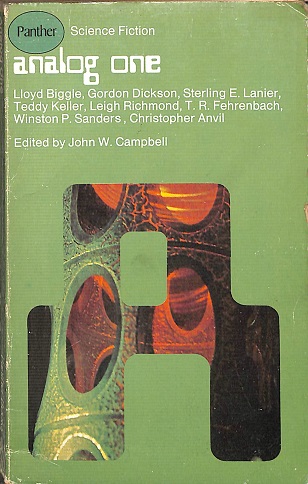
Cover of Analog One


Analog One
John W. Campbell, Jr (editor)
169 pages
published in 1963

There’s a version of the history of science fiction that goes a little bit like this. It was invented in the late nineteenth century by Jules Verne and H. G. Wells (in a slightly more progressive version, in the early nineteenth century, by Mary Shelly). Then, in 1926 Hugo Gernsback made it a genre, with the creation of Amazing Stories, the first ever science fiction magazine. Sadly however, the quality of science fiction published remained low, most of it being space opera, just more pulp fiction. All this would change when John W. Campbell, Jr became editor of Astounding Stories, one of the many Amazing Stories imitators. Together with authors like Isaac Asimov, A. E. van Vogt and especially Robert Heinlein Campbell would create the Golden Age of science fiction. Post World War II science fiction having gained even more popularity, finally got the respect it deserved. No longer dismissed as ‘that Buck Rogers stuff’ fit only for infants, now, as Campbell’s editorial here has it, it’s literature to truly challenge yourself, for people unafraid to use their brains. In a symbolic gesture, in 1960 Campbell changed the name of his magazine Astounding Stories to Analog Science Fact & Fiction, heralding the changed status of science fiction. This is the context in which Analog One was published.

It’s a beautiful myth, but no more than that. The reality is that science fiction became respectable the moment the A-bomb dropped on Hiroshima. That staple of the American imagination, the weapon that can wipe out an entire city, had become reality. Nothing really to do with Campbell, who in any case was diving deep into pseudoscience like the Dean Drive and Dianetics at this point. The new Analog too was no longer the top science fiction magazine either, with newcomers Galaxy and The Magazine of Fantasy and Science Fiction taking its place. The writers who had made the magazine had left it, either like Asimov, leaving science fiction entirely for a while, or moving on to other magazines. Analog‘s decline is clear when you look at this anthology’s table of content: the biggest writers listed are Lloyd Biggle and Gordon Dickson, not quite up to the standard of a Robert Heinlein or Theodore Sturgeon.

Read more…

If only you had a friend like Andrew Ridgeley

I watched the Netflix Wham! documentary on Sunday mainly because Mic Wright tweeted about it a few days ago:

The Wham! documentary on Netflix is one of the most beautiful things ever. And as we are having a discourse about men not talking about their feelings or being supportive: Andrew Ridgeley is a perfect example of someone who loved and supported their friend no matter what.

I was young enough in 1982-1986 to not be prejudiced against Wham!; they were just part of the pop landscape I grew up with. So I never had the disdain for their music that the eighties music press seemed to have. However, I did buy into the myths pushed by them: that George Michael was the one with all the talent in Wham and Andrew was just a hanger-on who got lucky. As the documentary makes crystal clear this was completely wrong. It was in fact Andrew who was the handsome one, the song writer, the stylist when Wham began. George lacked his confidence and wasn’t as skilled yet as he was. It was because Andrew was there as an example, as a friend, that George could grew into the superstar and artist he was when Wham ended.

Andrew was the booster rocket to George’s shuttle into star orbit. He lifted him up higher than he could’ve flown on his own, then dropped back to Earth once his job was done. It’s amazing how much he supported George, to the point of ending his own stardom for him. And not only that; he also shielded him from the gutter press. His fuckboi behaviour drew the attention of the tabloids which meant they never found out about George being gay. And being outed as gay in the eighties meant the end of your career. Not to mention continuous harassment from the press.

So cheers Andrew Ridgeley. If only we all had friends like you.

A gacha based economy would be interesting — First Impressions

Ryoto and his harem

I can so understand the frustration Richard Eisenbeis has with the wasted potential of generic isekai series #1,098, Level 1 Dakedo Unique Skill de Saikyou Desu:

The setting is likewise a mess of wasted potential. The idea of a world where literally everything comes from dungeons is insane. People with high drop rates for plants replace farmers. Those with high drop rates for weapons replace weapon smiths. Basically, all jobs outside the dungeon would be the infrastructure for those going into it.

Fully exploring this thought experiment would honestly make for an interesting fantasy story. What kind of government would arise in such a world—what kind of art, music, and religion. And since everything comes from the dungeon, how would technology advance—or would it at all? Then, on the isekai front, you could look at what would happen if someone from our world taught people how to farm—breaking the dungeon-industrial complex’s strangle hold on the agricultural economy in the process. It’s a playground for stories. It’s just unfortunate its used in this anime as little more than a one-off line to explain why slimes drop bean-sprouts.

Honestly the economics never make sense in any isekai series. Where is the money coming from to pay adventurers to kill monsters in the first place? How can a medievaloid society sustain an elaborate, country or even worldwide guild system filled iwth what are objectively deadbeats when in reality most of those would be needed to either farm or do craft work? How come there’s enough gold available to mint millions of coins to pay the protagonist their absurd monster bounties and not crash the economy? Foolish to worry about of course; that’s not what isekai stories are written for. It’s power fantasies all the way down and that includes the fantasy of finding treasure.

And this is a typical example. A guy dies of overwork in Japan and discovers while he’s only level 1, his ability to pull from gacha is S-tiered. So he goes hunting slimes to make enough money to afford a home with the cheerful small blonde girl who fed him soup when he first awoke in the dungeon. There are going to be more girls later on, if the opening is to be trusted. The animation and character design is not something to watch this series for, so it all depends on how you like the usual isekai formula.

Reincarnated as a vending machine — First Impressions

Jidou Hanbaiki Ni Umarekawatta Ore Wa Meikyuu Wo Samayou: dude gets reincarnated as a vending machine, hooks up with a muscular woman who takes him all over the Labyrinth they live in.

Lammis casually lifting up the 500kg vending machine Boxxo

This was fun if a bit slow in setting up the premise. Having the main character remain a vending machine will be even more limiting than having him be a sword. Curious to see how they’ll deal with it. Lammis, his muscular partner seems good fun and hopefully there will be a good cast to balance the series out. The original light novel apparently ran for only three volumes, so can be fully adapted in one season. Product quality is decent but not spectacular. A decent time waster, but you’ll miss nothing much skipping this.

Japanese vending machines are awesome by the way. If you can believe anime, they’re everywhere, always fully stocked and with a range of products varying from whale meat to used panties. It’s no wonder that our protagonist was such a fan of them he ended up dying trying to save one. Quite a contrast with the ones found over here, usually stocking overpriced colas and candy bars…

Best Superman this century

This is honestly the best Superman I’ve seen in years if not decades. He actually saves a cat in this first episode!

Superman, but he’s still discovering his powers and not yet invulnerable is always a ghood setting and having him, Lois and Jimmy be Daily Planet interns is even better. Loved the chemistry between Lois and Clark, who are clearly attracted to each other from the start. What I also liked is that she played as big a part in winning the fight against the giant robots as Clark himself. Jimmy was a bit of a third wheel but he was just as obnoxious as the original version. Which is great. Can’t have a Jimmy Olsen not be annoying.

Clark catches Lois when she falls down

There are tons of little homages and references hidden in this. Lois has a Vicki Vale article up on her bedroom wall. The Newsboys Legion reference. Having Superman fight actual giant robots, like in the Fleischer cartoons. That “who are you” at the end from Lois, surely a reference to the Christopher Reeve Superman movies. This seems to be a series that knows its history. Art and animation wise it’s all good. The action scenes all popped and the character designs are nicely streamlined. A good start and I hope My Adventures With Superman can keep it up.