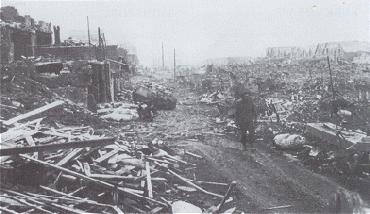
Breskens, 11 September 1944

Some of the destruction visited on Breskens on 11 September 1944

For one of the Netherlands’ best beloved football stars of the seventies, Willem van Hanegem, it was a close shave that day. It was only luck that he survived the bombardment of Breskens as a small child, as his father did not, dying on top of another small child whose life he saved this way. With van Hanegem’s father, another 183 Bressiaanders would die as allied planes bombarded the town in an attempt to cut off retreating German forces.

Antwerp had been liberated only days before, on September 4th, but the allied troops had not yet moved beyond the city towards the Schelde estuary. Caught between the advancing Allied troops and the river were still thousands of German soldiers and their equipment, who used the breathing space given to them to both reinforce their defensive positions on the south side of the river and evacuate to the north, from Breskens to Vlissingen, keeping the Schelde closed for allied traffic and hence preventing the use of Antwerp as a supply point much closer to the frontlines than the French ports they had been using until then. To use Antwerp then, the Allies had to move into Zeeland, taking control of both sides of the Schelde estuary, and the obvious first step towards that goal was to prevent the German forces still on the south side from escaping.

The town of Breskens, a small fishing village almost directly opposite the navy town of Vlissingen (or Flushing as English speakers know it better), was an obvious evacuation point, where thousands of German troops were ferried across. Its inhabitants had long become used to seeing Allied bombers flying over to attack Vlissingen with its dockyard and naval base, but had not yet been a target themselves. Which may explain why the bombardment of 11 September 1944 claimed so many victims. In military terms, this may have been a justifiable action, the many civilian victims a regretablle price to pay for making sure more German forces wouldn’t escape to fight on in Walcheren and Zuid-Beveland. But the price paid was heavy and still visible in the town today, a reminder of what happens even in ‘good’ wars.
Virgin Cocks more like

So yes, one of our little weaknesses is to watch cheery middleclass aspirational tv, anything that has either some celeb expert showing us how to improve our cooking, homes or lifestyle or some no-hopers being taught the same. In the latter category falls Virgin Cooks, a BBC Three series in which two members of the same family or household, both awful cooks incapable of boiling an egg at the start, are taught to cook properly and compete to win the big prize: to cook a three course meal for assembled family and friends in a real restaurant. A nice idea, not terribly original but entertaining fluff, if it wasn’t for the incredible number of upper middleclass douchebags the show insists on featuring.

Its not as if I didn’t expect a certain bourgeois bias in this sort of show of course, but usually some pretence is made at balance. Here however it seems as if every episode features some of the producers chums, public school boys all, for whom the show is the hardest thing they ever had to do in their lives. It all makes for a great five minute hate…

UPDATE: by which I mean that the contestants featured on the show are largely such knobs that the only enjoyment you can get out of it is by indulging in a spot of class hatred. There certainly isn’t any of the supposed educational content the trailers promised. Compare and contrast with Economy Gastronomy, another supposedly educational aspirational cooking show, again featuring reasonably posh well to do families but there’s a much greater emphasis on actually teaching something, there’s no contrived competition element and last but certainly not least the people eatured may be posh, but they have actual personalities. Virgin Cooks is lazy television, while Economy Gastronomy, unoriginal as it might be, is much better than it needed to be.

the freedom to swim in a river without the act being marketed as wild swimming

M. John Harrison gets annoyed about what he calls the new enclosures — the way perfectly ordinary activities have been commodified by business and government into something you need to pay for or ask permission for.

My point is simply that everyone must have the freedom to swim in a river without the act being marketed to them as “wild swimming”. The label is a danger because it’s the first step towards commodification.

The councils, lobbies, sports-regulatory bodies and swimming-hat manufacturers can’t take “wild swimming” indoors to control it as a commodity & meter it out to the participants in paid-for units (although that was ably done to rock climbing, which thought of itself as a “wild”, fully exterior activity, across the 1990s); but they can construct the kind of linguistic & cultural enclosure around it that will allow them to take profit in other ways.

In this sense, & in lots of others, the UK outdoors has been moved relentlessly indoors over the last two and half decades.

I don’t see how this observation has anything to do with elitism. What I am trying to disentangle–from political, commercial & media constraints–is the individual human freedom to decide to go swimming, or walking, or riding a bike without that action being a privilege granted by someone else and/or a source of profit for someone else.

The difference is between the activity as an action & the activity as a captive resource which is then offered back under the terms of whatever group has captured it.

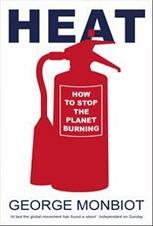
Heat – George Monbiot

Cover of Heat


Heat
George Monbiot
277 pages including index
published in 2006

Thanks to the climate change camp in London held this past week, global warming is back on the news agenda again. Despite the rear guard action fought by the Exxon-Mobile sponsored climate change denial groups, the media has sort of accepted the reality of it over the past two years, but as Alex Harrowell fulminates against, it’s largely treated as a consumerist, lifestyle issue:


As with most British media green pushes, there’s little sign of any interest in anything physical or lasting. Not an inch of rockwool. Everything is about changing your behaviour, and specifically micro-behaviour what you buy, or turning off lights, not how you work or where you live or how society works. Worse, it’s a demand for entirely free-floating behavioural change — nobody seems to be suggesting any way of monitoring or measuring the change, or any incentives. This isn’t going to work. And, again, it’s all consumer guff.

This is not something you can accuse George Monbiot of doing here. In Heat: How to Stop the Planet Burning he quickly dismisses consumer driven solutions like the 10:10 campaign in the introduction. The entire point of the book is that we cannot solve the problem of climate change with lifestyle choices, but only through solutions that apply to everybody, not everybody else, as he puts it. He starts with the assumption that the only way to migate the consequences of global warming, as we cannot prevent it anymore, is to keep runaway climate change from happening and that can only happen if we can keep global temperatures from rising more than 2 degrees celsius (above pre-industrial levels) in 2030. If not, major ecosystems begin collapsing as the ability to absorb excess carbon dioxide is exhausted. To keep this rise from happening we can’t just switch incandencent lightbulbs for LEDs, we need to cut 90 percent of our CO2 output. The challenge Monbiot sets himself in Heat is to show that we can do this without giving up our post-industrial lifestyles, by taking the United Kingdom as his test subject and looking at various aspepcts of our lives to see how CO2 output can be reduced in them. It is not a complete blueprint for change of course and you may not necessarily agree with all his solutions, but it is a genuine attempt at putting together a national plan of action that could be implemented relatively quickly and doesn’t require all of us to piss in hayboxes.

Read more…

The Killing Joke

In retrospect, Dorian Wright doesn’t like The Killing Joke:

In the long run, it was probably a mistake. While it’s still a masterfully crafted story, and Brian Bolland’s art is exceptional, the overall trend towards “darkening” Batman did serious damage, I feel, to the character and the comics industry as a whole. It was an attempt to chase a post-adolescent audience’s brief, media-driven flirtation with comics, but it froze out younger and more casual audiences. The audiences comics really needed to grow as a medium. It’s only lately, with the The Brave and The Bold cartoon and Grant Morrison’s Batman work, that a serious attempt to rehabilitate Batman from the brooding, angsty loner with mommy issues has been made.

Hear, hear.

Killing Joke always felt cynical to me, an attempt by Moore and DC to cash in on his surface reputation as a mature superhero writer, where mature equals R-rated sex and violence, for those readers who thought the nudity and brutality in Watchmen and Miracle Man were “deep” and missed anything more subtle. Even Moore at his most cynical offers glimmers of interest so it’s not completely bad, certainly not as bad as the glut of post-Watchmen, post-Dark Knight “mature” superhero titles that crowded the shelves in the late eighties/early nineties.

and yet it’s still awfully superficial and glib in its philisophy, the loveingly and lingering depiction of the the crippling and implied rape of Barbara “Batgirl” Gordon as a device to “break” Batman not that different from any such seen in a revenge movie like the “Deathwish” series, a device to propel the hero into action but only seen as an affront to the hero’s honour rather than as what it does to the victim, just a broken toy in this context. The ending where supposed hero and supposed villain meet in the middle and laugh it all off is annoying as well, as is its trite message, that all it can take is one bad day for a normal man to become a monster.

But the Bolland art is gorgeous.