Do my homework for me

Reading Margaret Morris’ The General Strike started a train of thought about union militancy, strike action and preparedness for confrontations with the government. Because even halfway through it became clear that a big part of why the strike failed has to due both with the unwillingness of the unions to properly prepare for a fight and then to see it through. The union leadership especially seemed unwilling to go to far in their fight, torn between respectability and militancy. Therefore they didn’t make the necessary preparations for the fight, which could be seen coming at least nine months beforehand so as to not antagonise the government unduly, while the government itself felt no such qualms and they bottled out at the first opportune moment.

Which reminded me of a recent strike action that was succesful, that did force a government to back down: the fuel protests of 2000, in which a combination of farmers and lorry drivers blockaded oil facilities, took the government by surprise and forcing them to freeze further tax increases on fuel, for at least some time. It was presented and percieved as somewhat of a reactionary protests, by the kind of people who in the UK at least are not thought of as being natural unionists, let alone socialists. But what I’m wondering about is if anybody did make the effort to analyse these protests, their tactics and their successes from a leftwing perspective. Compared to union action in the last decade or so it does seem to have been much more succesful than most strikes, especially in the way a relatively small group of protestors could have a national impact.

So, anybody want to give me some pointers? Anyone? Anyone? Ferris?

10 August 1974

The term “the 10th of August” is widely used by historians as a shorthand for the Storming of the Tuileries Palace on the 10th of August, 1792, the effective end of the French monarchy until it is restored in 1814. But that’s only the best known of several revolutionary events to have happened on this day.

There’s the Pueblo Revolt of 1680, against Spanish rule in Mexico, which started on this day. It’s also the day that news of the American declaration of independence reached London in 1776, as well as the day that what would become Ecuador first declared independence from Spain in 1809 (it didn’t take until 1822). Happy Independence Day, Ecuador!

In 1846 the Smithsonian Institution was established through an act of congress, signed into law by James Polk, funded by a $500,000 bequest of British scientist James Smithson. At the time of the bequest, there was a lot of controversy about whether or not Congress should accept such large sums of money — how much has changed since then.

In 1904 the Battle of the Yellow Sea took place, between Imperial Russia and Imperial Japan. It ended in a draw, but was a strategic victory for Japan. The Russians had attempted to leave Port Arthur in Korea to steam to Vladivostok and combine with the squadron there, which the Japanes prevented, damaging one battleship and causing others to sail into neutral ports to be interned for the duration of the war. It was the first hint all was not well in the Russian navy, as well as the strength and skills of the Japanese.

And August 10, 1948 saw the first broadcast of Candid Camera…

There are of course quite a few celebrity births that happened on this day — Curt Siodmak and Ward Moore being two of them with sfnal connections– as well as plenty of celebrity deaths — Maarten Tromp in 1653, Haydn in 1806, not to mention Isaac Hayes just last year.

The reason I mention all of this? Take a wild guess…

Any Questions and the limits of debate

I tend not to listen to Any Questions, unlike my partner, as it annoys me too much. You have this ritualised debate between government and opposition politicians through yet another venue, enlivened by a healty dose of mainstream media commentators all carefully mixed to present a “balance of opinion”, chasing the issues of the day through a thoroughly mainstream Westminster filter. A perfect example popped up on this week’s episode, which for once I did catch.

It came through an audience question about Harry Patch, the last survivor of the war of the trenches, who sadly died earlier this week. Patch had been adamant that he considered all war to be a waste of human live and the question was whether the panel agreed. Said panel, consisting of “Charles Moore, British Medical Association chairman Hamish Meldrum, commentator and chief executive of the Index on Censorship John Kampfner and chair of the Health and Safety Executive, Judith Hackitt CBE” was quick to agree with this but even quicker to backpedal. It just wasn’t possibe, Britain needs an army as deterrent, there are evil countries that need to be defeated, yadda yadda.

The highlight was a short side discussion between Charles Moore, Britain’s slightly more polite answer to Bill Kristol and the “leftist” John Kampfner about Ruanda and humanitarian intervention. Moore started by lamenting the failure of the UN to act in Ruanda, which Kampfner followed up to by agreeing and giving more examples of countries that should’ve been humanitarian intervented: Darfur, Birma, Zimbabwe, the usual litany of soft liberal foreign causes. He then went on to mourn the war on Iraq, as it was this that had shied away western countries from other interventions.

Both either don’t know, or don’t care to think about the realities of all interventions (and Kampfner really has no excuse here, as he wrote a book on Blair’s interventions). None of these interventions is ever done out of charity, few if any make any real difference to the people themselves and they all take place in a context of western supremacy and compliance in whatever situation we are supposed to resolve some years later. As Lenny shows, the Ruanda is actually the perfect example of how western intervention really works:

the story of the Rwandan genocide was one of non-intervention. The ‘West’, or the Euro-American powers so designated, demonstrated ‘indifference’. They considered it just another example of ancient tribal hatreds finding an outlet in a new blood-letting, failing to accept that what was taking place was a genocide that demanded urgent intervention to protect the innocent. (These racist spiels about ancient tribal hatreds are certainly culpable, but I wonder if the reactionary discourse of ‘good-vs-evil’ that imperialists are fond of is really any better?) The lesson drawn from this by those advocating ‘humanitarian intervention’ is that new norms of intervention, mandating the use of military force in emergency cases, have to be elaborated and embedded in international law. Now, even if it were true that the ‘West’ had not intervened, it would by no means follow that it should: you have to make another series of assumptions to justify that conclusion. But it isn’t true, and the widespread acceptance of this idea cultivates the claim of US innocence, the obverse of ‘indifference.

Sending in the US army or the UN blue helmets is just the most visible part of western intervention in the rest of the world. As Lenny argues, it’s the context in which these interventions take place that is important. You just cannot naively wonder why nobody cares enough about Birma or Darfur or Zimbabwe to “do something” about them, without taking into account the interests of the nations that are supposed to act. There are no neutral actors. What’s more, to keep insisting in the face of the evidence, in Iraq, in Afghanistan, in the former Yugoslavia, that interventions actually solve anything is downright irresponsible if not criminal. It also smacks of a certain arrogance to argue for intervention in Zimbabwe, when the opposition there has always made it clear they don’t want it, they want to solve their problems themselves.
Amsterdam taxis: free market fail

For personal reasons which I won’t bore y’all with, we’ve been forced to make a lot of use of the incomparable Amsterdam taxi system lately. It’s not been a good experience, the one or two excellent drivers notwithstanding. Our experiences are not unique; Amsterdam taxis are some of the worst in Europe, as I’m sure Frumious Bandersnatch will agree with:

However, I’ve heard that it has gotten better at Central Station. I heard that they have supervision. And I actually didn’t have a choice. So I walked to the head of the line.

First thing that I noticed. No supervision. No idea if he/she was getting coffee or just gone for the day. Uh-oh.

I went to the first driver in the row. He informed me that this would be 15 euros. I said that I wanted to go with the meter. He said that he only worked with a zone system, so it was 15 euros everything between 1-5 kilometers. (I know from experience that a taxi ride to where I needed to go was generally maximum 12 euros) I told him that I knew this wasn’t true and I had the right to go with the meter. He told me to “go find a TCA driver since they charge less.” He insisted that they were allowed to charge more for central station. (For non-Dutch people, TCA was the former big bad monopoly that got broken up in Amsterdam to protect the consumer. Ha.)

I looked around again to see if I could find their minder, but there was nobody visible. I went to the second taxi in the row. That person also refused to drive with the meter to Oost, and told me that I had to go with the first taxi. “Nobody here will use the meter,” he told me snottily.

The third taxi was from TCA. He told me that I had to go to the first taxi. He got abusive when I said that the first driver refused to go with the meter. He said “I won’t drive with the meter either.” By this point, one of the other drivers in the line had shouted at me to “fuck off”.

Another TCA taxi driver (farther back in the line) said that he didn’t dare to do otherwise besides do what the rest in the line did.

It doesn’t get any better from there. Such experiences are all too common, especially around the tourist heavy areas of the city centre like Central Station or Museumplein. The irony is, for most tourist destinations there are plenty of cheap, easy to use and fast public transport options to use instead. but if you don’t know that as a tourist, your natural instinct is to use a taxi and nine times out of ten they’ll take you for a ride. Central Station to Dam Square, with its quota of fancy hotels, is only a ten minute walk or a five minute tram ride; take a cab and they’ll either tell you to fuck off for wasting their time with such a short ride (that’s the honest ones) or they’ll show you the entire city and deliver you there an hour later.

The problem is that Amsterdam went from a monopoly situation in which there was only one taxi company, TCA, which only had to provide Soviet levels of service, to one in which everybody with a dodgy twenty year old Mercedes Benz could call himself a taxi driver. Too many taxi drivers chasing too few customers with no time for short rides, no time to be concerned with anything but getting the next fare in. Neither situation was ideal, to say the least.

The Amsterdam taxi market needs reform badly, but any solution that leaves either a load of freelancers or some sort of monopoly or duopoly in place isn’t going to work. In both cases there is the problem that the people driving the taxis are entirely dependent on their taxi to make a living and the pressure to chase golden rides remains. What Amsterdam needs I feel is to make the taxis into some sort of semi-public transport, with the drivers on a proper wage and the customers knowing what they get into when they step into the cab.

A beautiful day in the neighbourhood

So won’t you be my neighbour?

The Solar Neighbourhood

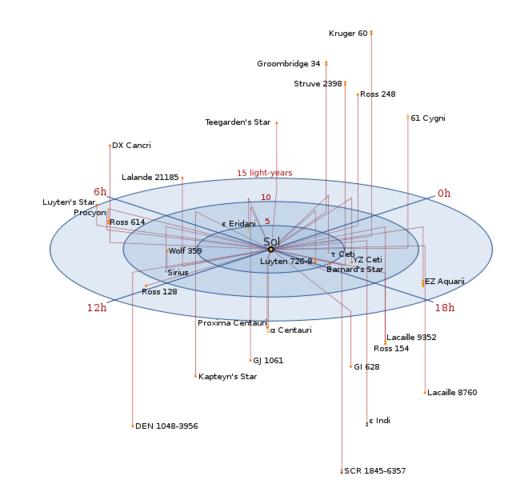
The nearest stars to us, within a range of fifteen lightyears. For the time being that is, as don’t forget we’re all in our separate orbits around the Galaxy. Essential knowledge for any science fiction writer who wants to keep some semblance to reality. As is this, an exploration of the solar neighbourhood up to sixtyfive lightyears out. Via James, of course.