Speed is not the only measure of progress, unless you are Jeremy Clarkson

in a discussion about what would happen once “Moore’s Law” no longer holds true over at James Nicoll’s place, Charlie Stross said the following:

And then there’ll be a huge recession and layoffs, just as there was in aerospace around 1970 when the industry hit a performance wall (note that airliners today fly no faster than they did in 1970 — Concorde’s champagne quaffing elite aside, travel at over Mach 0.9 is not commercially sustainable).

To which Alex Harrowell took exception

Forget Princess Margaret. Civil aviation only became interesting economically or sociologically after Charlie’s performance wall – we’ve had David Frost commuting for the BBC from London to New York, we’ve had Easyjet ravers/poverty jetset types bouncing from sofa to sofa around Europe, Viktor Bout’s inverted triangle trade shipping diamonds out of Africa and guns in, enabled by cheap Antonov-12s and international free trade zones, Kenyan farmers discovering they could get backload freight to Europe for pence. Before the “performance wall”, people watched movies about air hostesses; after, they actually flew.

Shades of endless rec.arts.sf.written discussions about the slowing down of progress, as measured by the speed of air travel. “We went from the Wright brothers to supersonic flight in less then fifty years and since then we’ve only gone backwards”. It’s even worse with space travel of course, with the complaints of how we went to the moon in ’69 and now can’t even get the shuttle in orbit; the fortieth anniversary celebrations aren’t helping either. The horrible truth about science fiction is that a lot of it is obsessed with Top Gear notions of progress: more power, more speed, bored with everything else.

Science fiction got its start in the twenties, a decade that was absolutely bursting with this kind of easy to understand technological progress: the maturing of radio into a mass medium, the development of the airplane into something that could cross the Atlantic, the first stirrings of television and rocketry, giant new insights in the nature of our universe, the atom, etc. Science fiction surfed this wave of techno-optimism until roughly the early sixties, but since then it has had to confront the reality that all its dreams were actually quit a bit harder to realise than it had made it seem. Easy travel to other planets, human-like robots, unmetered atomic power, artificial intelligence, flying bloody cars: all dreams that didn’t come true, or came true in ways that didn’t fit the Glorious Science Fiction Future. It’s no wonder the New Wave, the first movement in science fiction to not just question its assumptions, but even wonder out loud how important or even interesting these assumptions were in the first place, happened at the same time.

While the best science fiction has long since digested the reality that technological progress is hard, non-linear and more interesting in what it makes possible than in what it can do, there are still plenty of fans who think that just because their daily lives look superficially similar to how they lived ten or twenty years ago, there hasn’t been any progress. For those fans the idea that Moore’s law will end means their last big hope at getting to the technoutopia of their dreams, the Singularity, has ended. Charlie isn’t one of them, however; I think he was just a bit sloppy in the example he chose.
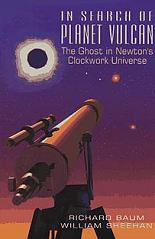
In Search of Planet Vulcan – Richard Baum and William Sheehan

Cover of In Search of Planet Vulcan


In Search of Planet Vulcan
Richard Baum & William Sheehan
310 pages including index
published in 1997

The classic idea of the universe was that it was geocentric: the Earth in the centre, with the planets, moon and the sun circling around it and the fixed stars as background. Over the centuries that central idea had to be modified with increasingly complex epicycles as the theory had to be adjusted to observational evidence. It was only in the sixteenth century that Copernicus, Kepler and Bruno challenged this Ptolemaic model and replaced it with the truth: that all the planets, including Earth revolved around the Sun. Copernicus was the first to propose this, Bruno would die at the stake for his advocacy but it was Kepler who figured out how the planets revolved and what governed their orbits. more than half a century later Isaac Newton formulated his laws of gravity, joining Kepler’s laws with more mundane events on Earth, finally providing a complete model of the workings of the Solar System. From then on, any planetary orbit could be calculated with the right observations and the use of Kepler’s and Newton’s laws.

except for one. The orbit of Mercury remained, as the subtitle of Baum and Sheehan’s book has it, “the ghost in Newton’s clockwork universe”. Time and again, no matter how carefully the observations were made and how intricate the calculations were, the two just would not line up. Even the best astronomers in the world, with the best observations could not make Mercury’s orbit confirm to what it should be according to Newtonian physics. It wasn’t until Einstein reformulated the laws of gravity that the reason why became clear. Newton’s laws break down near massive objects like the Sun and although “good enough” for most situations, Mercury’s orbit was just too close to the Sun and Newtonian physics just wasn’t accurate enough. Of course, until Einstein found the real answer, astronomers sought for other explenations for Mercury’s wrong orbit — and the most likely candidate was an undiscovered planet even closer to the Sun: Vulcan.

Read more…

Ritual combat

That’s what the Tory-Labour fight about Aghanistan and how “the troops” need more helicopters and aren’t properly equipped feels like. It’s as if neither side wants to examine the actual mission in Helmand province and its inherent dangers to the troops, let alone the broader question of why the UK is in Afghanistan or whether or not it should pull out. Since both parties have supported the Aghanistan mission from the start, there’s a danger for both of them in a honest examination of these questions.

From the Tory side therefore criticism is limited to the supposed lack of helicopters in Helmand, without any concrete proposal on how to get them in time for them to matter. It’s not like Boeing has a showroom full of Chinooks waiting for that lucky first time buyer. Any order now has to go to the back of the queue so will take months to years to deliver. UK army procurement being what it is, it will probably take years before the order is placed as well. Then there’s the question of paying for it. If done out of the existing defence budget, something else has to go; if additional funds are needed, where are they going to come from. And how many helicopters would be enough anyway?

It’s easy to call for more helicopters, but without a concrete plan to get them and put them into action, just a cheap way to score points. Again though, if the Tories were to put forward concrete proposals this would lead to all kind of nasty questions about the mission. The same would happen were Labour ministers to call them out on this lack. And since neither the Tories nor Labour want to confront the true reality behind the UK presence in Afghanistan, this can’t happen.

The point is, the UK is in Afghanistan not to fight terrorism, or to make the UK safe from Al Quaida or Islamic terrorism — it already was until it started meddling in Iraq and Afghanistan — or to help the country “transition towards democracy” or any of that nonsense, but purely to appease America. The UK, as well as holland and the other NATO countries with a presence in Aghanistan are only there because America wanted us to and because we were scared back in 2001 of what the US would do if we didn’t. That NATO war declaration was the world’s most public “don’t hit me” cry, completely unnecessary and illogical but the circumstances were such subtlety wouldn’t have been appreciated. Since then we’ve been sort of chained to America’s Afghanistan strategy, the UK especially as Blair was so smart as to make the UK’s support open-ended.

Anything that triggers a honest re-apprasail of the UK’s role in Afghanistan runs smack dab into the nature of the UK-US “special relationship” and both the Tories and Labour have too much invested in that to want to open that can of worms. We may think the relationship is abusive at best, but for UKanian prime ministers it’s the only way to still be important ont he world stage.

On preview, I see that Jamie makes the same point more succintly. He also links to a comment thread on an earlier post on what “more helicopters” actually means that’s worth reading.

John Ostrander needs our help

Is there anything more depressing than reading about yet another of your favourite comic book writers or artists, somebody responsible for a whole string of classic, critically acclaimed superhero series —Grimjack, Hawkworld, Suicide Squad, The Spectre, having to chose between going blind or going bankrupt. This time it’s John Ostrander, who has written some of my all time favourite “dark” superhero
comics, a few of which I mentioned above. He’s a victim of the US healthcare system, under which health insurance is unpayable for anybody but the most fortunate, certainly not for self-employed freelancers like the overwhelming majority of comics professionals since the 1930ties. No health insurance, no pension rights, paid peanuts for work that sometimes earned their publishers millions, so many of them, like Ostrander, find that in later life their savings inadequate to pay their medical bills. His friends and colleagues have come together to set up a trust to help him — you can donate via Paypal through adriane (at) comicmix.com — but as James Nicoll says, it’s hardly enough when so many others are struggling too — and some of them don’t have this circle of support.

And of course, people like Ostrander, who have a certain amount of fame, no matter in how small a circle are lucky duckies compared to millions of people working everyday jobs who also can’t afford health insurance and have to rely solely on their family and friends, or do without the health care they need. That’s why you need a proper, government subsidised healtcare system, in which health care is available to anybody no matter their financial status.