Pompeii – The Life of a Roman Town – Mary Beard

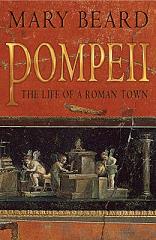
Cover of Pompeii - The Life of a Roman Town


Pompeii – The Life of a Roman Town
Mary Beard
360 pages including index
published in 2008

We think we know Pompeii. An ordinary Roman town like so many others in 79 CE, made extraordinary because it was overwhelmed without warning by the eruption of the Vesuvius, through its death granting us a rare glimpse of what daily life in the Roman Empire really was like. Under a metres thick layer of volcanic ashes Pompeii laid hidden for centuries, only discovered in the eighteenth century, its secrets kept intact, preserved by the very disaster that caused the death of the city. With the slow and careful excavation of the city those secrets are unlocked, giving up definitive answers to all kind of questions about how the Romans lived. This is the view of Pompeii that countless books, magazine articles and television specials have given us. Unfortunately, as Mary Beard explains in Pompeii – The Life of a Roman Town, it’s wrong.

Or at least, not entirely accurate. As she explains, Pompeii wasn’t overwhelmed by an unforeseen catastrophe, as most likely its inhabitants had had at least several days warning before the actual eruption. Quite a few of them therefore had already left the town when it got buried, while many of the dead found under the lava had been overtaken in their flight, or while having sought shelter nearby or within the city itself. What’s more, the city wasn’t immediately abandonded after the disaster either, as all through the city evidence has been found of people coming back to their houses or businesses to rescue possessions – as well as of plunderers looking for easy riches. What’s more, once Pompeii was rediscovered, obviously things gut dug up, damaged, disappeared or just altered through being exposed to the elements again. All of which means that what we can see in Pompeii now is not entirely the city that the inhabitants would’ve known in 79 CE, that if we dig up a largely empty villa it doesn’t necessarily mean the Romans were great minimalists…

Read more…

Pink Floyd on the Moon

An audio recording of what Pink Floyd was up to in the night of the Moon landing, courtesy of the BBC, who as Paul McAuley puts “had bought into the 60s” enough to invite them to play live during that long night. It seems fitting to have such a mystic, psychedelic band as audio commentary on the zenith of the greatest technocratic undertaking of the twentieth century. Today both are minority interests as going concerns, objects of nostalgia to everybody else. Even to me, a longlife science fiction fan and firm believer in space exploration, the Apollo project looks obsolete, irrelevant, the last hurrah of the technocratic age. The Apollo project is an awesome, inspiring story and I’m glad we did it, but we don’t need to repeat it, just like we don’t need to repeat Dark Side of the Moon.

Dead Iraqis

Ellis sharp has a new book out from New Ventures. Nicholas Lezard reviews it for The Guardian:

But other stories pile anything and everything in. One would not have thought an author could link Che Guevara and the Loch Ness monster, but Sharp does. Sharp is sui generis. At times he comes across as if he were a compound hallucination dreamed up by Iain Sinclair, William Burroughs (formulaically only; few drugs and no pederasty here) and . . . well, himself. This might sound like an unappealing mix but I am delighted to have read him. You can trust him because beneath the zaniness, at the level of the sentence, he is very good indeed. This is not magic realism. These are the bad dreams of the 20th century.

Why I loathe Norman Geras

Geras who?

You’re excused if you never heard of him before, but back in the halycon days of 2002-03, Norm Geras was a big shot blogger. A real life socialist professor who had written real books on Marxism (!) and who agreed with the war on terror, Geras was the token leftie of the socalled warbloggers, who treated 9/11 as their Pearl Harbour, but instead of signing up for their tour of duty fired up the old keyboard and fought the Greatest Intellectual Struggle of Our Time from the comfort of their office during lunch breaks. Geras whole schtick was to link to some self declared socialist and to explain, more in sorrow than in anger, how real socialists like Lenin and Marx would’ve supported American intervention in Afghanistan and Iraq. In that slightly stupifying academese of his he would then suggest that his victim, far from coming by his opinions honestly, was duped or more sinisterly, had ulterior motives for opposing the war, was anti-western, anti-american or worst of all, anti-Israel. Since those halycon days Geras’ fame has slowly dwindled, trapped in his own circle of hell with the rest of the ex-leftists and Eustonites as the War on Terror went sour, the successes of 2002 and 2003 turned into defeats and more honest bloggers, both left and rightwing no longer felt the need to take those people serious.

Which doesn’t mean Geras and others like them have stopped blogging, just because we stopped paying attention. Nope, the professor is still plugging away, recycling the same old stale shit:

However, when it comes to large-scale trends it is not merely accidental what issues people gravitate towards in significant numbers. The contemporary liberal-left is much more drawn towards some of these than to others for its condemnation and protest – the actions of Israel, the US and other Western democracies come to mind – and there are political preferences and blind spots involved in this. What I doubt, as a matter of sociological explanation, is that their choices have to do mainly with the prospect of success. Or, looking back: the anti-Apartheid struggle did not, at the time, seem like one that would be rewarded with an easy or proximate victory, but this deterred no one from speaking and acting in solidarity with the South Africans waging it. One may or may not want to get involved oneself, but those who protest from afar in support of the democratic movements in Zimbabwe and Iran do something of what they can do. Silence as the better option for such situations is an eccentric and paradoxical counsel within the traditions of progressive politics – though naturally, as with everything else, one can speak and act to better or to worse effect.

Let’s overlook the simple fact that he’s, you know, wrong, there have been plenty of leftist, socialist and liberal bloggers talking about Iran and Zimbawbe, as a simple google search should have told him in seconds. What’s infuriating is not that, but the way in which he insinuates but never quite says outright that the reason “liberal-left” (sic) is silent on Iran but not Israel is because we are all a bunch of jewhating anti-americans. Instead he slips in his needle without ever having to say outright anything he has to defend later. If anybody takes offence they’re the bad guys; he stayed perfectly civil.

What’s also infuriating is the sheer bloody pointlessness of the complaint. Even if it were true, even if leftist bloggers paid more attention to what their own governments are doing, so what? South Africa under Apartheid is actually a nicely revealing example Norm is using there, as the very same arguments he and his friends have been using to disparage “the singling out of Israel by the left” were used by friends of South Africa then. Campaigners against Apartheid were communist dupes, or just out to bring down a western government, hypocritical for not paying equal attention to atrocities in Black ruled countries, etc. And the reason why these arguments missed the point is that like Israel now, South Africa then was activily supported by the British and American governments and hence opposing these policies could have an impact that a condemnation of a nation already in the shithouse like Iran doesn’t. It’s very well to say that what’s happening in Iran is bad, but what’s the point when everybody already thinks so?
Notorious war criminal Robert McNamara dead at 93

McNamara’s whole life was an illustration of the limits of American liberalism, the way in which a man who tought of himself as a decent person could convince himself to support and plan atrocities against foreign peoples in the name of national interest. Educated in the best liberal traditions at Berkeley, he spent World War II helping Curtis LeMay lay waste to Japan more efficiently, to which the atom bombing of Hiroshima and Nagasaki was just a coda. He then went from warfare to business using the same methods to help Ford become profitable again, became president of Ford, the first outside of the Ford family before joining the Kennedy administration as the Secretary of Defence, as which he was largely responsible for shaping the American strategy in Vietnam and the escalation of the war there with all that entails. When he left (or was kicked out) in 1968, he then joined the World Bank until his retirement.

As the 2003 documentary Fog of War makes clear, McNamara throughout his career was driven by his own moral convictions, doing what he thought was right for America. He genuinely believed in the ideals on which America was supposedly founded, was never driven by greed or vanity as much as the idea of doing your duty for your country, of noblesse oblige. He was honest enough to understand when he was wrong and why he was wrong when it came to the War on Vietnam and to admit to it, even if the doubts he had about the whole war only surfaced once he was out of office. But in all this he was limited by his ideological background, more so because he never realised it was there. He believed he was a rational, pragmatic man, that the things he believed in where just the facts of life, that what was best for America was what was best for the world, that paternalistic capitalism was the best system in the world, that communism was threatening world peace and needed to be stopped and that what happened in Vietnam was the US defending itself. The limits of his vision meant that he could only recognise this last error, but not the errors in his own world view that lead to it.

He wasn’t a bad man, a genuine monster like the ones found in the Nixon, Reagan and Bush administrations, who only paid lip service to America’s ideals but only truly believed in American power. But his humanity wasn’t enough. He still served the system.