Books read in June

Another month, another list of books read. Let me know what you read this month?

Polity Agent — Neal Asher
Another fast paced Space Opera from Asher, entertaining if not that memorable.

The Weird Stone of Brisigamen — Alan Garner
A classic children’s fantasy that I’m way too old and well read in fantasy to enjoy fully the way it should. Colin and Susan are sent to their mother’s old nurse living near Alderley Edge in Cheshire when their parents have to be abroad for six months. There they get embroiled in an old legend. Comforting but it has moments with a real edge to them, best read between ages eight and twelve.

Galactic North — Alastair Reynolds
A collection of short stories set in the same universe as Revelation Space and its sequels. This could be thought at as the secret history of the Demarchist/Conjoiner universe. They do not always fit in well with the novels, as Reynolds acknowledges in his afterword.

James Tiptree, Jr: The Double Life of Alice B. Sheldon — Julie Phillips
An excellent biography of an important science fiction author, showcasing the importance of Sheldon/Tiptree beyond the boundaries of the genre.

The City & the City — China Miéville
Restraining his usual tendencies towards the baroque and fantastic, Miéville here has written a proper police procedural in the vein of an Ian Rankin. The story starts with a routine murder in a city on the edge of Europe, which quickly turns more complicated and ultimately involves the city’s much richer neighbour. The two cities exist in an uneasy and wholly unique relationship with each other and it’s this relationship that is at the heart of the book, transforming the mundane, realist experience of the police procedural into something more.

Pompeii – The Life of a Roman Town — Mary Beard
The cliche of Pompeii is that of a town where time stood still, it’s daily routine dramatically disrupted by the eruption of Vesuvius in 79 CE and so ironically preserved for our edification. Mary Beard here shows how little this view has to do with the reality of Pompeii as excavated, how much data we have managed to extract from these excavations but how little we still know about daily life in Pompeii. At the same time it’s an excellent overview of what we do know and since it was only published last year, about as up to date as you can get.

The Kingdom of the Hittites — Trevor Bryce
Excellent and up to date overview of the history of the Hittites, a people we knew nothing about until about a hundred years ago but which for some fivehundred years were one of the Near Eastern superpowers during the Late Bronze Age.

In Search of Planet Vulcan — Richard Baum & William Sheehan
Vulcan was the hypothetical planet proposed to be the cause of why the observations of Mercury’s orbit around the Sun continued to be different from what it was calculated to be based on Newton’s laws of gravity. We know now that these laws were not the entire truth, as Einstein showed; while good enough for daily use, they break down in the presence of a massive object like the Sun. As this had not yet been realised, astronomers proposed there was something else out there influencing Mercury, just as Neptune and Uranus had been discovered because of their influence on other planets…

Armed Struggle – The History of the IRA — Richard English
A recent history of the provisional IRA examing both its active history and the way its politics and ideology evolved over the years since its founding in 1969 up to the Good Friday peace agreements and beyond. Some context is of course provided, but this is not a history of Ireland, the Irish struggle for independence or even the Troubles, just of the pIRA. I found it enlightening.

The Gone-Away World — Nick Harkaway
Wow. I understand now why this was so much talked about last year. One of the best debut novels I’ve ever read; finished it in one go.

Charge! Hurrah! Hurrah! — Donald Thomas
An entertaining biography of Lord Cardigan, (in)famous for having led the charge of the Light Brigade during the Crimean War, which makes clear he was interesting for than that.

The Best of Murray Leinster — Murray Leinster
Read last weekend in honour of Murray Leinster Day in Virginia. Leinster was a pionering sf author, who started writing before the genre had even been established and managed to continue to do so during the Gernsback and Campbellian revolutions.

Dark Star — Alan Furst
An excellent thriller set in the years just before World War II, truly capturing the claustrophobic, threatening atmosphere of the times.

Operation Chaos — Poul Anderson
A fixup novel of three novellas, set in a world in which witchcraft and magic have taken the place of science and in which personal broomsticks are as commonplace as cars here. The first two parts are enjoyable if old fashioned adventure stories, the third is marred by Anderson’s later pessimism and hippie baiting.
Excusing dictatorships the liberal media way

Sadly No is surprised and upset that the Wall Street Journal would defend the military coup in Honduras:

It seems that President Mel Zelaya miscalculated when he tried to emulate the success of his good friend Hugo in reshaping the Honduran Constitution to his liking.

But Honduras is not out of the Venezuelan woods yet. Yesterday the Central American country was being pressured to restore the authoritarian Mr. Zelaya by the likes of Fidel Castro, Daniel Ortega, Hillary Clinton and, of course, Hugo himself. The Organization of American States, having ignored Mr. Zelaya’s abuses, also wants him back in power. It will be a miracle if Honduran patriots can hold their ground.

A far cry from their treatment of the Iranian elections in which its editorial opinion seems firmly on the side of the protestors and their demands for free and fair elections. How come the Wall Street Journal is so concerned about Iranian democracy but so cavalier about the Hondurian coup?

Simple. Iran is an enemy of the US and is therefore safe to attack. Honduras is an ally and what happened there has not be done without at least some level of support or approval from the US government, if not necessarily any official support. It’s an old, old tradition Mary O’Grady engaged in, this whitewashing of a military coup. Nicaragua, El Salvador, Brazil, Costa Rica, Cuba, Chile, Argentine; every time the US government meddled in a South American country or allowed its military to thwart a nascent democracy, the newspapers of record were there to excuse it. It doesn’t matter whether it’s the “liberal” NYT or the “conservative” WSJ, every time an US supported coup happened, they helped whitewash it. Read Manufacturing Consent, read Killing Hope, dig through the newspaper archives and you’ll find the same thing over and over again.

And liberals fall for it everytime.

(Crossposted at Prog Gold.)

Meanwhile, in Haiti..

UN soldiers shoot into a crowd of mourners for Father Gerard Jean-Juste, a long time opponent of the UN-installed provisional government in Haiti:

All this happened in the run up to the senate elections in Haiti, for which all candidates of the Fanmi Lavalas were barred from standing. Fanmi Lavalas is the party led by Jean-Bertrand Aristide, who was ousted as president in 2004 by the UN backed coup against him. It is of course a popular leftwing party and if there’s one thing that cannot be tolerated in Haiti it is a popular leftwing party. As in Iran, ordinary people have been protesting in the streets against the unfair and dishonest elections, boycotting them in large numbers. As in Iran, people have been shot at. Unlike Iran, they’ve been shot at by UN troops and unlike Iran, this went largely unreported. The difference is that Iran is our official enemy, while what happens in Haiti (and Honduras) is happening with our blessing.

(I’ve linked to Peter Hallward’s article on the 2004 Haiti coup before, but it’s still the best overview of what happened, why it happened and why it’s important I’ve found.)

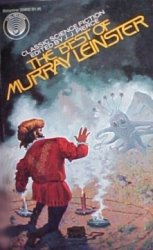
The Best of Murray Leinster

Cover of The Best of Murray Leinster


The Best of Murray Leinster
Murray Leinster
368 pages
published in 1978

Yesterday was Murray Leinster day in Virginia set up to honour one of science fiction’s pioneer writers. Murray Leinster started writing science fiction before it even existed as a genre, 1919 with the story “The Runaway Skyscraper” for pulp magazines like Argosy. When Hugo Gernsback created the world’s first dedicated science fiction magazine, Amazing Stories in 1926, Leinster was there, with “The Runaway Skyscraper” reprinted in the July issue. Leinster continued to write science fiction through the Campbell revolution of the late thirties and forties, when the higher writing standards Campbell demanded were too much for many pulp writers and kept being published throughout the fifties and sixties. Though he wrote in other genres, science fiction always seemed to be his first love and several of his stories were first: the first story to predict the internet, the first alternate worlds story, one of the classic stories of first contact.

All of which is why I read this, The Best of Murray Leinster, as a short of honour, a way to remember one of science fiction’s pioneers. This is one of a series of absolutely brilliant short story collections put out by Ballentine/Del Rey in the seventies, collecting the best stories of the socalled Golden Age science fiction writers: people like Isaac Asimov, Frederik Pohl, C.L. Moore, Leigh Brackett and Murray Leinster. Though long out of print as far as I known, this series can still be easily found in secondhand bookstores and is well worth searching out. As far as possible the collections were selected by the authors themselves, but sadly Leinster had already died by the time this collection was published. Instead it was edited by J. J. Pierce, who did quite a few of these. It’s a great selection, including the three stories I alluded to above.

Read more…

And so the great freakshow comes to an end … not quite

Over at the Prattle, Feòrag is busy tracking the inevitable Michael Jackson conspiracies, most of which think he faked his own death. More dead celebs have been accused of this, but there was a special kind of inevitability about this one. Jackson’s life story, his public persona and the constant media focus on how much a freak he supposedly is makes that he faked his own death halfway believable. Surely I’m not the only one who tought of that when they heard the news of his death?

It’s fitting that he died in the same way the poor guy had to live his life over the past four decades, in a media freakout. A child star in the early seventies, getting weird at the end of the decade, sleeping in his scarecrow costume from The Whiz, reinventing himself as the biggest selling pop artist ever, Off the Wall, Thriller, giving way to fresh excentricities: Bubbles, Neverland, hyperbaric oxygen chambers and all the other nonsense real or made up by the tabloids, but still canny enough to once again see where pop music was going and be there before it did, followed by more and nastier rumours about his private life, the unsuccesful marriage to the spawn of Presley, the accusations of kiddie fiddling, the lawsuits, the depts, the intended comeback and death. And now the endless speculating about how he died, who’s to blame, what will happen to his heritage, his kids, the feeding frenzy of tv news and tabloids finally faced with a story that they understand, none of that complex financial stuff, that dreary endless slog of more bad tidings about the economy, the environment, Iran… Then later there will be the anniversary specials, the tie-in books, biographies, tell all stories and so on undsoweiter ad infinitum.

Michael Jackson has been a background presence in my life for all my life, mostly an annoying one as I largely couldn’t stand his music and certainly didn’t need to have the Jackson freakshow shoved in my face all these years (and neither did he, I suspect). But only a complete ignoramus would deny his influence on pop music (step forward, Nick Cohen). He broke the colour ban on MTV and made it into the juggernaut it was in the eighties in those fabulous days when it still played music videos. If what he did with “Thriller” or “Bad” or “Beat it” (but never “Billie Jean”) looks corny now it’s because almost everything that came after it has build on his work. Zap through any pop-orientated music channel and half of what you see has been influenced by Jackson’s choreography or music. His influence is so pervasive that you don’t notice it consciouly unless you start looking for it. If Presley was the pop icon of the fifties and sixties, then Jackson was it in the eighties and nineties. To say that he “never was an important musician” is just foolish, but then the evidence that Nick Cohen is a fool is not exactly rare.

So Michael Jackson is dead but the show will go on. That a parasite like Cohen feels the need to attack the media coverage of his dead in service of yet another tawdry blogpost about the elitist ivory tower BBC/media is the best evidence for this…