Think of it as an exclusive country club

You wouldn’t want to just let anybody in your Holocaust memorial:

A plan to honor gays and other non-Jewish victims of Nazi persecution in Brooklyn’s Holocaust Memorial Park was blasted Sunday by critics as political pandering.

Politicians and community activists gathered at the Sheepshead Bay park Sunday to demand Mayor Bloomberg block a plan they contend undermines the memorial’s core message.

“The Holocaust is a uniquely Jewish event,” said Assemblyman Dov Hikind (D-Brooklyn), whose mother is a Holocaust survivor.

The city Parks Department has proposed adding five new markers to the memorial at West End Ave. and Shore Blvd. to honor homosexuals, Jehovah’s Witnesses, the disabled, Gypsies and political prisoners targeted by Adolf Hitler and his henchmen.

It’s quite shocking to see how many Zionists, both Jewish and otherwise, want to see the Holocaust not as an example of man’s inhumanity” to man but as “man’s inhumanity to Jews”, who would agree with Dov Hikind that it is “a uniquely Jewish experience”. Hikind is a nasty piece of work but his views are shared by many more mainstream Zionists. As Norman Finkelstein (like Hikind a child of Holocaust survivors) argues in his book The Holocaust Industry this obsession with keeping the Holocaust a Jewish tragedy is partially due to its use as the founding myth of Israel. Israel needs to be a explicitely Jewish state because that is the only way to avoid another Holocaust and if the Holocaust happened to other people (homosexuals, Sinti & Roma, disabled Germans, etc) that justification makes a lot less sense. Hence the opposition to putting the Holocaust in context with other examples of genocide like Ruanda or the Armenian genocide, hence the opposition to remembering other nazi victims. Hence also the attempts to teach the Holocaust as the logical culmination of centuries of European anti-semitism.

Public Holocaust memorials need to be universal, need to be true to the historic reality if they are to have any meaning. Jewish people were the largest group of victims of the nazis, but we should never forget that millions of others were killed by them as well: Poles, Russians, German socialists and other political opponents, disabled German children, Roma and Sinti, Jehova’s Witnesses and other religious people opposing the nazis out of their beliefs and yes, homosexuals (the only group nazi laws against which were enforced on after the war). Hate is universal and there isn’t something uniquely Jewish about being the victim of it.

To think otherwise is to beg history to repeat itself. Again.

D-Day

Five years ago I wrote this about the Dutch contribution to D-Day:

At D-Day, Dutch B-25’s bombarded targets in Normandy, including the headquarters of a German armoured division; eight of them were lost on operations in June 1944. The Dutch gunboats Hr. Ms. Soemba and Hr. Ms. Flores supported the invasion, targeting German positions on the landing beaches; they were valued so much by the British they gave them the nick name “The Terrible Twins”. To counter the threat of German torpedo boats, the dreaded “Schnellbote”, Dutch motor torpedo boats were active, while Dutch minesweepers were making the Normandy coast safe, one of which, the Hr.Ms. Marken was destroyed while doing so on 20th May 1944, sinking with only one survivor. A Dutch cruiser, the Hr. Ms.Sumatra was deliberately sank as a wave breaker for the two artificial harbours the Allies constructed at the Normandy coast. (Some of the caissons built for the construction of those harbours and not needed for them were later used to mend Dutch dykes damaged by Allied bombardement later in the year, as well as after the 1953 flood.) Finally, a large number of Navy and merchant marine people and ships were of course used to transport Allied soldiers and supplies to the beaches.

Most of the attention today has justifiably been on the English, Canadian, American and French contributions to the invasion, but the other countries that took part in it should not be forgotten: there were Dutch, Belgian, Polish, Czech, Commonwealth soldiers who died that day as well.

The referee is checking the doors


We may not understand cricket, half our national team may just be amateurs but the Netherlands just thrashed England in the opening game of the World Twenty20:

This wasn’t to be the case as Tom de Grooth steered the Dutch to victory with a game winning 49. Early in his inning de Grooth even managed to hit a marvelous reverse sweep off the bowling of Adil Rashid for 4 into the Tavern Stand much to the delight of the large number of Dutch fans around the ground.

With ten overs gone the prospect of a stunning Dutch victory started to gain momentum. Peter Borren was playing a key roll in the middle order for the Dutch taking quick singles to ensure de Grooth took more of the strike.

De Grooth finally fell in the 13th over but the damage was already done.

No idea what this all means but it was certainly exciting watching it on the BBC replay.

The Broken World – Tim Etchells

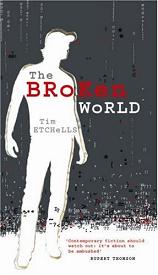
Cover of The Broken World


The Broken World
Tim Etchells
420 pages
published in 2008

Long live the public library. If it wasn’t for the fact that Night of Knives caught my eye having, I never would’ve seen The Broken World lurking nearby on the shelve, with a cover that looked like it could be something sufficiently science fictional as well. It turned out not to be, but I’m not complaining. Instead this is a novel that would appeal to any geek at least on a surface level, as it’s the story of a twentysomething slacker putting his considerable intelligence in playing through The Broken World, his favourite game while writing a walkthrough for it. In the process
the game and his real life start melding together, his friends popping up in the game while developments there mirror what’s happening to him outside of it and vice versa.

I started out hoping this would be a mindfuck novel, ala the Illuminantus trilogy or certain Philip K. Dick novels where the boundaries between fiction and reality are deliberately underminded until the novel seeps through in your own life, but alas. Instead, this is Microserfs for a generation to which playing computer games is as interesting and important as computer programming, an examination of modern life through a shared metaphor rather than an undermining of it.

Read more…