Back to the future…

This year’s European elections in the Netherlands are the first to use a particular futuristic piece of technology: the red pencil. This because the government last year was finally convinced voting computers just weren’t safe, after years of mounting doubts and campaigns against them. Because elections are organised on a municipal level, there has always been a patchwork of voting methods here, some councils like Amsterdam staying loyal to the red pencil long after most had implemented some form of electronic voting machine. Both main types of voting computer in use however at the last elections turned out to be easily hackable, which led to the first emergency return to the pencil.

Two years ago, the studygroup set up to making computer voting more safe recommended a two tier process: have the computer print out the ballot and use that as your physical vote. I’m not sure what happened to this recommendation, but obviously the current elections came to soon for it to be implemented. Personally, I don’t mind. The red pencil and paper ballot is about the safest method to use anyway: the most difficult to commit any subtle fraud with. Sure, ballot stuffing is still a possibility but as long as the system is reasonably honest, this will be much more noticable than altering computer records…

Your text messages: not safe with Vodafone and T-Mobile?

By law Dutch ISPs and phone companies are required to store all phone and internet traffic metadata to hand over to the police or secret service (AIVD) on request. That is, every phonecall you make, SMS you sent or internet connection you established is logged, stored and handed over to the police whenever they ask for it. Which is bad enough, but now it turns out at least two phone companies, Vodafone and T-Mobile went slightly too far in their zeal to assist the police, handing over not just the metadata on certain SMS messages, but the messages themselves. According to them, it was technically impossible to separate the “traffic data” from the message, so they had no choice but to hand over the whole thing. After this came to light Vodafone immediately acknowledged their error while T-Mobile denied it, but the AIVD declared that it could not and would not delete these SMS messages it had recieved.

Now, as The Netherlands’ best known IT lawyer, Arnoud Engelfriet explains (Dutch) what Vodafone and T-Mobile (allegedly) did is actually illegal under Artikel 273d Wetboek van Strafrecht. Which means their customers could file criminal charges against them…

The 60,000 euro question now is how many other phone companies have done this.

Books read May

The State of the Universe — Pedro G. Ferreira
A recently published book I got out of the library because I wanted to get caught up on the current state of astrophysics. This was somewhat of a disappointment as I kept stumbling over Ferreira’s explenations, which seemed to miss a step here or there. The problem is that a lot of astrophysics really only makes sense mathematically and explaining it by metaphor or analogy can be tricky.

The Cosmic Landscape — Leonard Susskind
Susskind’s attempt at doing the same thing went much smoother, though in fairness Ferreira attempted to do more than him, explaining the evolution of astrophysics as well as the current state of it. What helps is that Susskind has his own theory to sell.

Broken Angels — Richard Morgan
Takeshi Kovacs is a mercenary fighting a dirty war putting down a revolution on a planet mainly of interest due to its many Martian artifacts. He gets the chance of the lifetime when he is recruited to get one particular find located and safely sold to one of the Corporations, a find that will mean unlimited wealth and comfort for the rest of his life and a ticket out of the war, if he survives. Morgan has a reputation for being ultraviolent and having somewhat pushy leftwing politics in his stories, but while both were present here they felt right.

The Horn of Africa — Peter Woodward
A somewhat outdated (published in 1995) history of this region and the countries in it, in the context of their international relations with each other, other regional powers and the superpowers. Academic rather than polemic.

A Computer Called LEO — Georgina Ferry
LEO was the world’s first computer specifically designed for office work. And it wasn’t American, but British and not built by one of the giants of office automation like IBM, but by Lyons, the company running the Lyons teashops! A nice little history of how this computer came to be, made bittersweet by the inevitable failure to capitalise on this innovation.

Killing Hope — William Blum
A somewhat depressing catalogue of US military and CIA interventions since WWII. Required reading for anybody still harbouring illusions about the morality of US foreign policy or the nobility of Democratic governments.

The Ancestor’s Tale — Richard Dawkins
Using The Canterbury Tales as his templates, Dawkins tells the story of evolution backwards, going on a “piligrimage” to the beginning of life on earth, with more an more evolutionary splits joining at each rendez-vous, starting with ourselves and working our way back through our entire evolutionary history until our earliest singlecelled ancestor. A great book, only slightly marred when Dawkins gets distracted into a political rant every now and again.

The Gardener’s Year — Karel Capek
I only knew Capek as the playwright who gave the world the word we now use for any kind of mechanical man: robot. That he was also a keen gardener I did not realise, until I read this delightful little book, a year’s round guide to gardening, which made me laugh out loud several times. The drawings by his brother Joseph only add to the charm and humour.
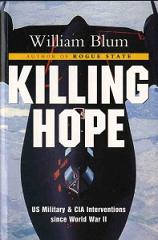
Killing Hope – William Blum

Cover of Killing Hope


Killing Hope
William Blum
469 pages including index
published in 2003

William Blum is a veteran leftwing journalist, active since the 1960ties, who made his name leaking the name and addresses of 200 CIA employees back in 1969. Since then he has been working in relative obscurity until around the turn of the millennium when he wrote a bestselling book about the US’s foreign police: Rogue State: A Guide to the World’s Only Superpower. It came at the right time to find its audience, just as interest in the subject soared due to the September 11 attacks. This succes is probably what got Killing Hope published, as it’s an updated version of one of Blum’s older books, originally published in 1986 as The CIA: A Forgotten History. It certainly has some of the hallmarks of a cash-in book, with the updating only going as far as the mid-nineties and the bulk of the book not noticably updated from the first edition. Many of the earlier chapters do not show much awareness of events and new revelations after 1986, if you see what I mean.

Killing Hope is the history of US military and covert interventions since World War II, with each chapter detailing a specific case. The chapters are in order of chronology, with several countries with a long history of US intervention having multiple chapters devoted to them. As Blum shows again and again in these chapters, the US talks a great deal about democracy and freedom, but the reality of its foreign policy at least since World War II is far different. With the excuse of “fighting communism” (or these days, “terrorism”) again and again the US has interfered on the side of dictatorships, nobbled democracies or fought liberation movements in order to safeguard its interests, be they strategic geopolitical ones or commercial ones. And Killing Hope is far from exhaustive, even in its original timeframe of 1945-1985 with Vietnam e.g. only having one short chapter devoted to it and little attention paid to other Asian countries like Taiwan, Japan or South Korea or even the UK.

Read more…

Insult to injury

Police officer who altered evidence in the murder of Jean Charles de Menezes has been cleared of “deliberate deception”:

The Special Branch officer deleted text from his computer note before speaking to the inquest in October last year.

The Independent Police Complaints Commission said he was not guilty of “deliberate deception”.

Mr de Menezes, 27, was shot dead by police at Stockwell Tube station in south London in July 2005.

The IPCC said the officer, known as “Owen”, had acted naively, but found no evidence of deliberate deception.

Last October, the officer told the inquest he deleted a line from computer notes which quoted Deputy Assistant Commissioner Cressida Dick.

The note had originally claimed Dick had initially said the electrician could “run onto Tube as not carrying anything”.

But at the inquest he said: “On reflection, I looked at that and thought ‘I cannot actually say that.'”

The officer, a supervisor in the operations room at Scotland Yard, told the court he had removed the line because he believed it was “wrong and gave a totally false impression.”

The IPCC found Owen “acted alone” in failing to disclose the note and then deleting it.

Its report concluded the officer had shown a “lack of understanding” of how he should behave, but had not committed an offence.

Unbelievable, but not surprising. The socalled “Independent” Police Complaints Commission has shown time and again in the de Menezes case to be toothless or unwilling to actually prosecute the police. The IPCC is too much a part of the police establishment to do its job, either unwilling or unable to handle these sort of cases. As with parliament we once again see that self regulation does not work.