Night of Knives – Ian C. Esslemont

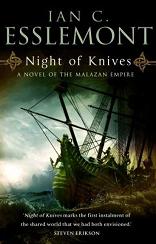
Cover of Night of Knives


Night of Knives
Ian C. Esslemont
284 pages
published in 2005

I’m always wary of books set in another writer’s world. Normally therefore I would’ve skipped this book, as it’s set in Steven Erikson’s Malazan universe. But as it turns out this isn’t a book by a new writer using an established colleague’s world to make a name for himself, as Ian Esslemont was in at the creation of Malazan from the start. Erikson and Esslemont had first met in 1982 on an archeological ditch and recognising kindred spirits, set out to create their own fantasy world. Scroll down roughly two decades and Erikson is the first to get his part of the world published with Gardens of the Moon, but it was always the idea that Esslemont would follow. As Erikson says in the introduction, this is not fan fiction, but Esslemont’s part of the enterprise. Malazan is too big an universe for one writer, but two?

Night of Knives fills in the backstory to some of the plot twists not explained in Erikson’s novels, but nobody will mistake it for his own work. It missed the widescreen, epic feel of the Erikson books, being set in a single place during a single day and night. Night of Knives also misses the deep layer of allusion, hint and complexity Erikson loads on to his epics. It’s much easier to follow and much more straight forward; it might make a good starting point for people curious about Malazan.

Read more…

The sterility of vanguardism

Is nicely expressed in the following quote from Morris Stein, one of American Socialist Workers Party’s bigwigs back in 1948, as presented by Louis Proyect in his ongoing critique of vanguardiasm and democratic centralism:

We are monopolists in the field of politics. We can’t stand any competition. We can tolerate no rivals. The working class, to make the revolution can do it only through one party and one program. This is the lesson of the Russian Revolution. That is the lesson of all history since the October Revolution. Isn’t that a fact? This is why we are out to destroy every single party in the field that makes any pretense of being a working-class revolutionary party. Ours is the only correct program that can lead to revolution. Everything else is deception, treachery. We are monopolists in politics and we operate like monopolists.

This idea that there’s only one road towards the Revolution and that the Party is the guardian of this Truth and needs to vanquish its rivals before it can leads a passive working class to the promised land is unfortunately still around in stronger or weaker form today in most, if not all radical leftwing groups and grouplets. You see the results in the dreary unending feuds between various parties whose only real difference lies in such esoteric questions as to whether the USSR was state capitalist or a deformed workers state, or in the obsessive need for every event or development to be neatly slotted into a theoretical framework handed down from GodTrotsky on high. This severly limits the appeal of those parties to people who aren’t Marxist nerds and does nothing to help them create a strong, broad, militant left capable of taking on capitalism.

What too many Marxist groups and grouplets seem to forget is that it isn’t the workers who have to prove themselve worthy to be led by the party, but that the party has to be proven worthy to help the workers. No revolution has ever been won by a vanguard (no, not even the Russian revolution).

Prador Moon – Neal Asher

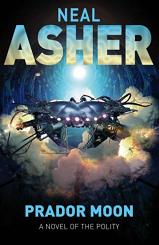
Cover of Prador Moon


Prador Moon
Neal Asher
248 pages
published in 2006

When I read The Voyage of the Sable Keech last year I dind’t realise at first it was part of a series of novels and quite late in the series too, which rendered it slightly more confusing than it needed to be. What I should’ve gotten instead is Prador Moon. It’s a prequel to the main series, set much earlier in its internal chronological order, doesn’t depend on knowledge of other books in it and is also a much simpler story altogether. Prador Moon is a straightforward tale of interstellar war, proper space opera. It all starts when the Polity, Asher’s star-spanning a.i.-cracy ruled from Earth central, comes up against the first alien race ever encountered by humans, the titular Prador.

Said Prador are a race of aliens looking something like a very large landcrab with slightly too many legs and which are very much a race of magnificent bastards, reveling in their evil. They can’t help it, biology makes them do it. A Prador’s life is full of danger, being reared in creches to serve their Father as loyal servants, stormtroopers and occasional food source, kept under control by pheromones. The biggest, meanest and most intelligent of the children become First Children, with some limited indepence and the potential to challenge their father’s supremacy. Whether there are female Prador is not mentioned. A Prador lives to conquer and subjugate and their whole society is built around conflict, which is why the first diplomatic meeting between humanity and the Prador was cut short when the ambassador didn’t surrender immediately, as was the ambassador himself…

Read More…

Tomlinson died of abdominal bleeding

From the press release issued by the City of London coroners court :

On 9 April 2009 HM Coroner for the City of London opened and adjourned the inquest into the death of Ian Tomlinson. In so doing he received evidence of identification and the provisional findings and opinion as to the medical cause of death from a report prepared by the consultant forensic pathologist, Dr F Patel, instructed by HM Coroner to conduct the post-mortem examination. The pathologist’s final opinion must await the completion of additional tests.

“Dr F Patel made a number of findings of fact including descriptions of a number of injuries and of diseased organs including the heart and liver. He found a substantial amount of blood in the abdominal cavity. His provisional interpretation of his findings was that the cause of death was coronary artery disease.

“A subsequent post-mortem examination was conducted by another consultant forensic pathologist, Dr N Cary, instructed by the IPCC and by solicitors acting for the family of the late Mr Tomlinson. Dr Cary’s provisional findings and his interpretation of the findings have been provided to HM Coroner in a further preliminary report (the final report once again awaiting the outcome of further tests). Dr Cary’s opinion is that the cause of death was abdominal haemorrhage.

“The cause of the haemorrhage remains to be ascertained. Dr Cary accepts that there is evidence of coronary atherosclerosis but states that in his opinion its nature and extent is unlikely to have contributed to the cause of death. The opinions of both consultant pathologists are provisional and both agree that their final opinions must await the outcome of further investigations and tests. These are likely to take some time. The IPCC’s investigation into the death of Ian Tomlinson is ongoing.”

In other words, the initial verdict of death by heart attack, widely reported even before the first coroner had reported his findings, was a lie. What’s more, the findings of the second report have been held up a week because the Independent Police Complaints Commission was afraid it could prejudice its inquiry. That’s not the end of it: the first pathologist investigating Tomlinson’s death had been reprimanded for his conduct before, once for smearing a black man who had died in police custody, once for diagnosing a murder victim as having died of natural causes, leaving the murderer to kill twice more. Why he was brought in to look at this death is unknown, but might his conduct in the first case have had anything to do with it?

Meanwhile the officer who had attacked Tomlinson minutes for his death, has now been questioned on suspicion of manslaugther. We’ll have to wait to see if anything comes from this, but at least it’s more than Jean Charles de Menezes’ family ever got. What’s also different from the Menezes case is how the media is reporting on Tomlinson’s death, much more critical of the police than they were then.
Iraq inquiry delayed until after election?

That’s what The Guardian is speculating:

Gordon Brown will announce by the autumn a “long” inquiry into the Iraq war, indicating that the potentially embarrassing report will be delayed until well after the general election expected next year.

Ministers have decided that the inquiry should be wide-ranging, possibly dating back to Margaret Thatcher’s tacit support for Saddam Hussein during the Iran-Iraq war in the 1980s. Its main focus will be on the conduct of the 2003 war and the breakdown of law and order afterwards.

David Lidington, the shadow foreign minister, said: “I think the government are determined to avoid the report being published before the general election. But they do not have even a figleaf of an excuse for a further delay.”

Brown has agreed that an inquiry will be held after the withdrawal of all British combat troops from Iraq, which must take place by 31 July. Government sources insist that no final decisions have been made on the format and timing of the inquiry, though it is expected to meet in private and to be given a lengthy timetable.

Which is depressing enough, but the most depressing bit comes at the end of the article:

Tony Blair would probably welcome any delay in publishing the report. The former prime minister is making active plans to assume the new role of president of the European Council if Irish voters pass the Lisbon treaty in a referendum this autumn.

That this is even a realistic prospect is enough to make you want to slit your wrists (down, not across).